


The Chung-Hua Institution for Economic Research (CIER, 中華經濟研究院) yesterday raised its GDP growth forecast for the nation to 2.47 percent this year, up from the previous estimate of 2.27 percent, as exports have fared well so far on stable global economic expansion.
The growth revision is higher than the government’s February projection of 2.42 percent and came after exports grew 10.6 percent last quarter, beating the 7.4 percent forecast by the Directorate-General of Budget, Accounting and Statistics.
“Better external demand merits the upward revision, although tension is building over a trade war between the US and China,” CIER president Wu Chung-shu (吳中書) told a news conference.
It is the third time the Taipei-based think tank has raised the growth forecast for this year after exports gained fast traction last quarter, despite a slow season and a high base last year.
Outbound shipments are now expected to grow 7.62 percent and imports 8.54 percent.
The projection suggests that domestic demand is to be the main growth driver, supporting GDP growth by 1.96 percentage points from 1.03 percentage points last year, CIER researcher Peng Su-ling (彭素玲) said.
Domestic firms are likely to show more willingness to invest after international technology giants IBM Corp and Alphabet Inc’s Google announced plans to hire more employees in Taiwan to meet demand for new technologies, Peng said.
Local semiconductor suppliers have found support in demand for high-performance chips used in Internet of Things applications and cryptocurrency mining, as the market for high-end smartphones grows increasingly satiated.
Private investment might increase 2.24 percent this year, reversing a 0.89 percent decline last year, Peng said.
Private consumption would also lend a helping hand with a 1.95 percent increase from last year, the CIER report said, as the local bourse continues to stay comfortably above 10,000 points on active trading.
The TAIEX showings reflect confidence on the part of investors, who have benefited from a positive wealth effect, Wu said.
The institute expects consumer prices to pick up 1.63 percent, from a 0.62 percent increase last year, on the back of higher oil and commodity costs.
The New Taiwan dollar might trade at an average of NT$29.35 against the US currency from NT$30.44 last year, the report said.
Downside risks include trade barriers by major economies that might hurt global growth, as well as the local elections in November, Wu said.
Taiwan Semiconductor Manufacturing Co (TSMC, 台積電) yesterday reported record revenue of NT$416.975 billion (US$13.17 billion) for last month, putting the world’s largest contract chipmaker on track to set a record for quarterly revenue. Last month’s figure surpassed March’s record NT$415.19 billion and represented increases of 1.5 percent from April and 30.1 percent from a year earlier. For the first five months of the year, TSMC generated NT$1.96 trillion in revenue, up 30 percent year-on-year, it said in a statement. TSMC has forecast second-quarter revenue of between US$39 billion and US$40.2 billion, representing sequential growth of about 10 percent and year-on-year growth of about
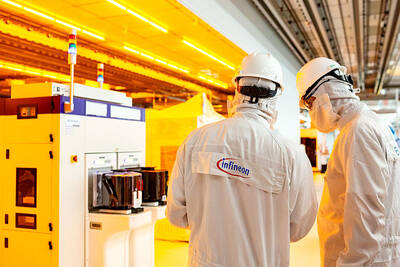
Infineon Technologies AG is preparing to open its largest single investment, a 5 billion euro (US$5.8 billion) semiconductor factory built with the help of EU subsidies, as the bloc seeks to boost chip production. The power chip fab, which is an extension of the German company’s Dresden campus, is scheduled to open on July 2, Infineon chief operating officer Alexander Gorski said this week at the site. The project is a major recipient of EU Chips Act funds, receiving about 1 billion euros in subsidies. The new plant represents a rare success for the bloc’s flagship semiconductor law, which was drawn up during
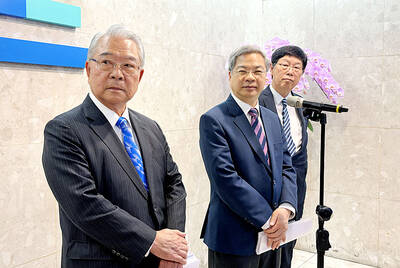
PATENT PROBE: US lawmakers called for a ban on imports of chips made by TSMC if they are found to infringe on US patents, with a preliminary ruling expected soon Minister of Economic Affairs Kung Ming-hsin (龔明鑫) yesterday expressed confidence in Taiwan Semiconductor Manufacturing Co’s (TSMC, 台積電) compliance with patent regulations after reports linked the company to a patent infringement lawsuit in the US. US Representative Ryan Zinke, and US senators Tim Sheehy, Roger Marshall and Bernie Moreno urged the US International Trade Commission in a May 22 letter to ban imports of chips made by TSMC if they are found to infringe on US patents, Axios reported on Wednesday. An administrative law judge is expected to issue a preliminary ruling this month, with the commission potentially making a final decision in
Taiwan remained the sixth-largest net creditor nation in the world last year, despite a fall of more than 10 percent in its net international investment position (NIIP) over the year, the central bank said yesterday. The NIIP is the difference between a country’s external financial assets and its external financial liabilities. Taiwan’s external financial assets hit US$3.27 trillion at the end of last year, up US$275.75 billion or 9.2 percent from a year earlier, the central bank said in its annual NIIP report. The growth largely reflected an increase in holdings of overseas marketable securities by residents in Taiwan, as well as a


 RSS
RSS