


Hon Hai Precision Industry Co (鴻海精密) plans to connect its supply chain partners’ industrial data within the next three years and develop 8K-resolution products to speed up the firm’s corporate transformation, chairman Terry Gou (郭台銘) said yesterday.
“This is the second phase of Hon Hai’s corporate transformation. The work from now to 2020 will be very important for us to completely become a big data, artificial intelligence and “smart” manufacturing company,” Gou said in his opening remark at the company’s annual carnival for employees at the Nangang Exhibition Hall.
More than 30,000 employees and their families from 32 different countries attended Hon Hai’s eight-hour carnival.
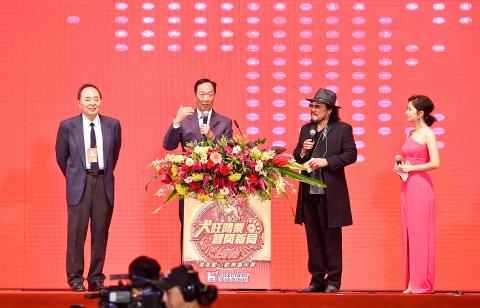
Photo: Fang Pin-chao, Taipei Times
Gou said he expects more employees to be dispatched to the US, Europe, India and Southeast Asian nations in the coming years, as Hon Hai continues to expand its global manufacturing network.
“We plan to host a ground-breaking ceremony for our manufacturing base in Wisconsin in the US by the end of April,” Gou told reporters, adding that it is snowing in Wisconsin, which is not suitable for ground-breaking.
Hon Hai had said that it plans to invest US$10 billion to set up a “smart” manufacturing facility in Wisconsin that focuses on 5G connectivity devices and 8K-resolution displays.
Gou and Sharp Corp president and chief executive officer Tai Jeng-wu (戴正吳) have been promoting 8K-resolution products in the belief that the wide use of 8K-resolution displays, cameras and content would play a crucial role in collecting and analyzing big data.
Hon Hai is in talks with RED.com LLC, a digital cinema camera manufacturer that worked with Netflix Inc to shoot the popular House of Cards in 4K, to invest in the firm or set up a joint venture to develop 8K products, Gou said, without elaborating.
Tai said he hopes Sharp would be able to reduce the price and weight of 8K consumer cameras, in an effort to accelerate the penetration rate of 8K products in the market.
Tai added that Sharp board member Young Liu (劉揚偉), who doubles as Hon Hai’s semiconductor subgroup head, is pushing toward a technological breakthrough for optical sensors in 8K cameras, which would make them smaller.
“I hope I will be able to introduce a lighter, smaller 8K camera that costs less than NT$200,000 [US$6,802.72] a year from now,” Tai told reporters.
On Friday, Hon Hai reported revenue of NT$400.6 billion for last month, which expanded 16.01 percent annually, but plunged 40.66 percent from the previous month.
Hon Hai attributed the decline to the weakness of its consumer electronics products, which include iPhones, amid traditional seasonality.

GROWING OWINGS: While Luxembourg and China swapped the top three spots, the US continued to be the largest exposure for Taiwan for the 41st consecutive quarter The US remained the largest debtor nation to Taiwan’s banking sector for the 41st consecutive quarter at the end of September, after local banks’ exposure to the US market rose more than 2 percent from three months earlier, the central bank said. Exposure to the US increased to US$198.896 billion, up US$4.026 billion, or 2.07 percent, from US$194.87 billion in the previous quarter, data released by the central bank showed on Friday. Of the increase, about US$1.4 billion came from banks’ investments in securitized products and interbank loans in the US, while another US$2.6 billion stemmed from trust assets, including mutual funds,

AI TALENT: No financial details were released about the deal, in which top Groq executives, including its CEO, would join Nvidia to help advance the technology Nvidia Corp has agreed to a licensing deal with artificial intelligence (AI) start-up Groq, furthering its investments in companies connected to the AI boom and gaining the right to add a new type of technology to its products. The world’s largest publicly traded company has paid for the right to use Groq’s technology and is to integrate its chip design into future products. Some of the start-up’s executives are leaving to join Nvidia to help with that effort, the companies said. Groq would continue as an independent company with a new chief executive, it said on Wednesday in a post on its Web
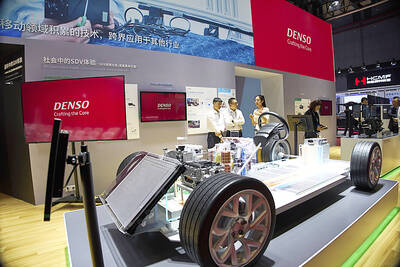
JOINT EFFORTS: MediaTek would partner with Denso to develop custom chips to support the car-part specialist company’s driver-assist systems in an expanding market MediaTek Inc (聯發科), the world’s largest mobile phone chip designer, yesterday said it is working closely with Japan’s Denso Corp to build a custom automotive system-on-chip (SoC) solution tailored for advanced driver-assistance systems and cockpit systems, adding another customer to its new application-specific IC (ASIC) business. This effort merges Denso’s automotive-grade safety expertise and deep vehicle integration with MediaTek’s technologies cultivated through the development of Media- Tek’s Dimensity AX, leveraging efficient, high-performance SoCs and artificial intelligence (AI) capabilities to offer a scalable, production-ready platform for next-generation driver assistance, the company said in a statement yesterday. “Through this collaboration, we are bringing two

Even as the US is embarked on a bitter rivalry with China over the deployment of artificial intelligence (AI), Chinese technology is quietly making inroads into the US market. Despite considerable geopolitical tensions, Chinese open-source AI models are winning over a growing number of programmers and companies in the US. These are different from the closed generative AI models that have become household names — ChatGPT-maker OpenAI or Google’s Gemini — whose inner workings are fiercely protected. In contrast, “open” models offered by many Chinese rivals, from Alibaba (阿里巴巴) to DeepSeek (深度求索), allow programmers to customize parts of the software to suit their


 RSS
RSS