


The consumer confidence index (CCI) this month picked up with six constituent gauges all moving upward on the back of a stock rally that saw the TAIEX hold firmly above 11,000 points, a National Central University (NCU) survey released yesterday showed.
The CCI climbed to 87.69 this month, a 1.64 point gain from last month and the highest in 28 months, as stock investment interest soared to the highest level in nearly three years, NCU Research Center for Taiwan Economic Development director Dachrahn Wu (吳大任) said.
“The confidence figure reflects improvement in popular sentiment led by the strong bourse,” Wu told a news conference.
The sub-index on stock investment registered 109.7, the second-highest level in the history of the survey, as foreign and local investors increased holdings in local shares after returning from the New Year holiday, Taiwan Stock Exchange data showed.
Stock trading lent force to the sentiment change, as seen in the average daily turnover of NT$135.4 billion (US$4.64 billion) so far this year, compared with NT$96.7 billion a day last year and NT$68.8 billion in 2016, NCU professor of economics Yau Ruey (姚睿) said.
The TAIEX’s performance is an important measure of market expectations of corporate profitability, Yau said, adding that the extended rallies suggested a rosy view.
International research bodies have forecast that global GDP growth would improve to more than 3 percent this year, while the domestic economy is to grow 2 percent, Yau said.
Despite lingering uncertainty, there appear to be fewer “black swan” incidents (surprises) on the horizon, and their effects are likely to be moderate if realized, Yau said, referring to elections in Italy, Mexico and the US.
The sub-index on household income gained 2.25 points to 87.2, while the gauge on economic outlook rose 2.05 points to 81.75, the survey found.
People demonstrated increased interest in durable goods purchases with the sub-index standing at 91.6, an increase of 1.4 points from last month, it said.
The gauge is often used to measure the housing market, where many domestic buyers and sellers believe it is wise to stay on the sidelines to avoid price corrections.
The sub-index on consumer prices rose to 52.5, a mild 0.45 point increase, suggesting that the public is dissatisfied with tapering purchasing power due to stagnant wages, Taipei Medical University statistics expert Shia Ben-chang (謝邦昌) said.
The situation will hopefully improve after government employees receive a 3 percent pay raise, Shia said, adding that many firms have voiced plans to follow suit.
The survey polled 2,624 adults by telephone from Jan. 19 to Jan. 21. It had a margin of error of 2 percentage points.
MANAGING RISKS: Taiwan has secured LNG sufficient to cover 95 percent of electricity demand for next month, UBS said, describing the government’s approach as proactive UBS Group AG has raised its forecast for Taiwan’s economic growth this year to 8 percent, up from 6.9 percent previously, and said expansion could reach as high as 8.6 percent if external energy shocks are avoided. The upgrade reflects a stronger-than-expected first-quarter performance and sustained momentum in artificial intelligence (AI)-driven exports, which UBS said are providing a firm foundation for growth despite geopolitical and energy risks. Taiwan’s GDP expanded 13.69 percent year-on-year in the first quarter, the fastest growth since the second quarter of 1987, the Directorate-General of Budget, Accounting and Statistics (DGBAS) reported on Thursday. On a seasonally

Ryanair, Transavia, Volotea and other low-cost airlines are feeling the financial pain from high jet fuel prices as a result of the Middle East war and are cutting flights. The closure of the Strait of Hormuz has taken a huge chunk of oil supplies off the market, sending the price of jet fuel soaring and triggering fears of shortages that could force airlines to cancel flights. Airlines are not waiting for a lack of supplies to react. “Travel alert: Airlines are cutting thousands of flights right now,” Travel Therapy host Karen Schaler said in an Instagram reel this past weekend.
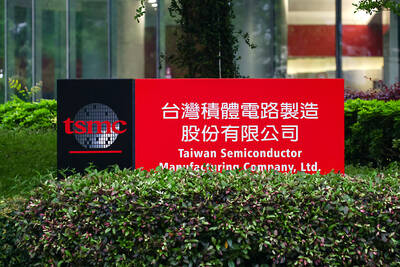
Shares of Taiwan Semiconductor Manufacturing Co (TSMC, 台積電) have repeatedly hit new highs, but an equity analyst said the stock’s valuation remains within a reasonable range and any pullback would likely be technical. The contract chipmaker’s historical price-to-earnings (P/E) ratio has ranged between 20 and 30, Cathay Futures Consultant Co (國泰證期) analyst Tsai Ming-han (蔡明翰) told Central News Agency. With market consensus projecting that TSMC would post earnings per share of about NT$100 (US$3.17) this year, supported by strong global demand for artificial intelligence (AI) applications, and the stock currently trading at a P/E ratio of below 25, Tsai said the valuation

The US Department of Commerce last week ordered multiple chip equipment companies to halt shipments of certain tools to China’s second-largest chipmaker, Hua Hong Semiconductor Ltd (華虹半導體), its latest action to slow the country’s development of advanced chips, two people familiar with the matter said. The department sent letters to at least a handful of companies informing them of restrictions on tools and other materials destined for two Hua Hong facilities US officials believe make China’s most sophisticated chips, the people said. Top US chip equipment companies Lam Research Corp, Applied Materials Inc and KLA Corp, each of which has significant


 RSS
RSS