


Shares in Largan Precision Co (大立光), which supplies camera lenses for Apple Inc’s iPhones, yesterday dived 4.75 percent to close at NT$3,930 in Taipei trading after the company reported soft sales results for last month and gave a conservative outlook for this month.
Shortly after the opening bell yesterday, Largan plunged 6.82 percent, or NT$280, to NT$3,820 from the closing price of NT$4,100 on Friday last week.
Largan’s stock price fluctuated during the session and eventually closed at NT$3,930 after a total of 1.17 million shares changed hands, according to data from the Taiwan Stock Exchange.
The Taiwanese camera lens supplier on Friday last week reported revenue of NT$4.87 billion for last month, a contraction of 10.43 percent year-on-year and 13.91 percent month-on-month.
Largan expects to record another monthly drop in revenue this month, as the first quarter is traditionally a slow season for the electronics industry, the company said.
Although Largan in November last year told investors that it expected a monthly decline in sales for last month due to weak demand from “some” customers, the double-digit plunge was deeper than market expectations.
Largan’s sluggish performance last month was mainly due to significant cuts in orders from Largan’s Chinese clients — Oppo Mobile Telecommunications Corp (歐珀移動) and Vivo Electronics Corp (維沃移動通信), Yuanta Securities Investment Consulting Co (元大投顧) said.
Largan’s operational performance this quarter could be worse on softening iPhone X demand, Yuanta analyst Jeff Pu (蒲得宇) said in a client note on Friday.
While Largan’s leading position in the lens industry is expected to remain solid, the company might not be immune to a slowdown in demand in the smartphone industry and a potentially slower-than-expected migration of camera lens specifications this year, Pu said.
Pu forecast Largan’s stock price to continue underperforming in the near term.
After factoring in last month’s revenue, Largan’s net profit for the whole of last year could total NT$25.75 billion (US$872.2 million), or NT$192 per share, he said, compared with his previous estimate of NT$26.45 billion, or NT$192.7.
Pu said his outlook on Largan would turn positive if there were signs that Largan’s lens composed of seven pieces of plastic was being broadly adopted in the smartphone industry.
In related news, Genius Electronics Optical Co (玉晶光), a smaller rival of Largan, yesterday posted revenue of NT$1 billion for last month, the company’s highest monthly record since October 2015.
The NT$1 billion result represented growth of 40.54 percent year-on-year and 7.49 percent month-on-month, a company filing with the Taiwan Stock Exchange showed.
The company’s cumulative revenue last year increased 14.45 percent to NT$8.02 billion, it said.

NEW IMPORTS: Car dealer PG Union Corp said it would consider introducing US-made models such as the Jeep Grand Cherokee and Stellantis’ RAM 1500 to Taiwan Tesla Taiwan yesterday said that it does not plan to cut its car prices in the wake of Washington and Taipei signing the Agreement on Reciprocal Trade on Thursday to eliminate tariffs on US-made cars. On the other hand, Mercedes-Benz Taiwan said it is planning to lower the price of its five models imported from the US after the zero tariff comes into effect. Tesla in a statement said it has no plan to adjust the prices of the US-made Model 3, Model S and Model X as tariffs are not the only factor the automaker uses to determine pricing policies. Tesla said

OpenAI has warned US lawmakers that its Chinese rival DeepSeek (深度求索) is using unfair and increasingly sophisticated methods to extract results from leading US artificial intelligence (AI) models to train the next generation of its breakthrough R1 chatbot, a memo reviewed by Bloomberg News showed. In the memo, sent on Thursday to the US House of Representatives Select Committee on China, OpenAI said that DeepSeek had used so-called distillation techniques as part of “ongoing efforts to free-ride on the capabilities developed by OpenAI and other US frontier labs.” The company said it had detected “new, obfuscated methods” designed to evade OpenAI’s defenses
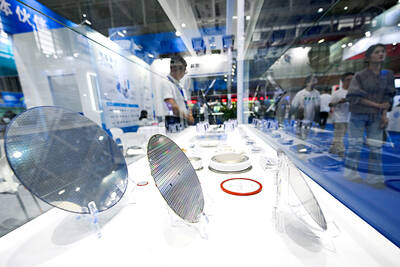
China’s top chipmaker has warned that breakaway spending on artificial intelligence (AI) chips is bringing forward years of future demand, raising the risk that some data centers could sit idle. “Companies would love to build 10 years’ worth of data center capacity within one or two years,” Semiconductor Manufacturing International Corp (SMIC, 中芯) cochief executive officer Zhao Haijun (趙海軍) said yesterday on a call with analysts. “As for what exactly these data centers will do, that hasn’t been fully thought through.” Moody’s Ratings projects that AI-related infrastructure investment would exceed US$3 trillion over the next five years, as developers pour eye-watering sums

Bank of America Corp nearly doubled its forecast for the nation’s economic growth this year, adding to a slew of upgrades even after a rip-roaring last year propelled by demand for artificial intelligence (AI). The firm lifted its projection to 8 percent from 4.5 percent on “relentless global demand” for the hardware that Taiwanese companies make, according to a note dated yesterday by analysts including Xiaoqing Pi (皮曉青). Taiwan’s GDP expanded 8.63 percent last year, the fastest pace since 2010. The increase “reflects our sustained optimism over Taiwan’s technology driven expansion and is reinforced by several recent developments,” including a more stable currency,


 RSS
RSS