


With a flashy gold watch and a chunky matching ring, Tang Van Cuol looks a far cry from the average Vietnamese farmer as he slings back a shot of rice wine and boasts about his projected earnings.
After years scratching a living growing rice and onions or farming ducks, the 54-year-old says his life was transformed in 2000 — by shrimp.
The Mekong Delta, long renowned as the “rice bowl of Vietnam,” is now also home to a multibillion-dollar shrimp industry and burgeoning numbers of farmers are building fortunes from the small crustaceans.
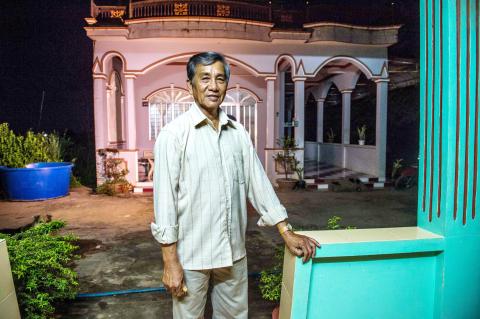
Photo: AFP
“Raising shrimp can bring so much income, nothing can compare,” Cuol said over lunch with friends, a healthy spread of rice, salad, pork and — of course — shrimp.
This year he expects to make 1 billion dong (US$44,000) — an enormous sum in the delta, where rice farmers make about US$100 per month.
The shrimp bonanza began in the 1990s when rising sea levels seeped saltwater into the Mekong Delta.
It has surged in parallel with demand from the US and EU.
Savvy locals were swift to spot the changing conditions were ripe for shrimp farming.
The wealth has transformed Cuol’s part of Soc Trang Province: motorbikes have replaced bicycles on newly paved roads dotted with multistory concrete homes unimaginable a generation ago.
Cuol owns several motorbikes, funded his daughter’s wedding and claims an impressive collection of antiques “worth hundreds of millions of dong.”
However, environmentalists say that the bounty from intensive shrimp farming might be short-lived.
Pollution and disease frequently lay waste to harvests.
However, a wider crisis is looming caused by the obliteration of mangrove forests to make way for farms, exposing the area to lashings from storms and further rises in sea level linked to climate change.
“This is not sustainable,” said Andrew Wyatt, Mekong Delta Program Manager at the International Union for Conservation of Nature (IUCN).
The IUCN is encouraging farmers to preserve mangroves and stop using harmful chemicals so their shrimp can be certified as organic, earning a 5 to 10 percent premium in the process.
Yet shrimp farmers say the financial rewards are too great to ignore.
Just like his father and grandfather, Tang Van Tuoi struggled as a rice farmer. He slept under a roof fashioned from coconut palms, earning just enough to support his family.
However, when saltwater started creeping into his rice fields, he saw an opportunity and started harvesting shrimp.
“Now everything is developed. We have vehicles, roads, things have changed massively,” he told reporters from his polished living room, where a flatscreen TV hangs over a wood furniture set.
Even in a bad year, he can earn more than he did as a rice farmer. In a good year he can rake in upward of US$40,000.
Flush with cash, he has built three homes for his family.
“We have money, we have enough of everything,” the father of six said as his granddaughter played on a smartphone nearby.
However, he admitted that such farming is a gamble.
His ponds have been hit by disease and pollution.
Attuned to the long-term risks, the government has resisted opening the whole region to the shrimp industry even as seawater continues to seep further inland.
Instead, authorities have ploughed millions of US dollars into sealing off freshwater zones needed to grow rice — the nation’s staple — throughout the Mekong Delta.
The strategy is in part to ensure the region can grow enough rice to feed the country, a historic pillar of the communist government’s centrally planned economy.
However, as the country has embraced market reforms, the lure of exporting shrimp has become increasingly attractive.
This year, Vietnamese Prime Minister Nguyen Xuan Phuc called for shrimp exports to reach US$10 billion by 2025, a jump from US$3 billion last year.
In parallel, export earnings from rice have steadily declined since 2011, bringing in US$2.2 billion last year.
“They’re trying to thread a needle between making money off of exports and economic development, but also not sacrificing long-term food security,” Cornell University doctoral researcher Tim Gorman said.
As a result, policies both encourage the quick cash generated by shrimp farms and protect the long-term future of the rice crop.
That can seem contradictory or haphazard to farmers.
In some areas, the government is urging farmers to grow rice half the year and harvest shrimp for the other half — a hard sell to farmers like Thach Ngoc Cuong who are eager to abandon rice.
He has two plots in Soc Trang Province, one contains freshwater for rice, the other is salty for the prized crustaceans.
“I would be very happy if we could raise shrimp on the rice side,” he said.

NEW IMPORTS: Car dealer PG Union Corp said it would consider introducing US-made models such as the Jeep Grand Cherokee and Stellantis’ RAM 1500 to Taiwan Tesla Taiwan yesterday said that it does not plan to cut its car prices in the wake of Washington and Taipei signing the Agreement on Reciprocal Trade on Thursday to eliminate tariffs on US-made cars. On the other hand, Mercedes-Benz Taiwan said it is planning to lower the price of its five models imported from the US after the zero tariff comes into effect. Tesla in a statement said it has no plan to adjust the prices of the US-made Model 3, Model S and Model X as tariffs are not the only factor the automaker uses to determine pricing policies. Tesla said

OpenAI has warned US lawmakers that its Chinese rival DeepSeek (深度求索) is using unfair and increasingly sophisticated methods to extract results from leading US artificial intelligence (AI) models to train the next generation of its breakthrough R1 chatbot, a memo reviewed by Bloomberg News showed. In the memo, sent on Thursday to the US House of Representatives Select Committee on China, OpenAI said that DeepSeek had used so-called distillation techniques as part of “ongoing efforts to free-ride on the capabilities developed by OpenAI and other US frontier labs.” The company said it had detected “new, obfuscated methods” designed to evade OpenAI’s defenses

China’s top chipmaker has warned that breakaway spending on artificial intelligence (AI) chips is bringing forward years of future demand, raising the risk that some data centers could sit idle. “Companies would love to build 10 years’ worth of data center capacity within one or two years,” Semiconductor Manufacturing International Corp (SMIC, 中芯) cochief executive officer Zhao Haijun (趙海軍) said yesterday on a call with analysts. “As for what exactly these data centers will do, that hasn’t been fully thought through.” Moody’s Ratings projects that AI-related infrastructure investment would exceed US$3 trillion over the next five years, as developers pour eye-watering sums

Bank of America Corp nearly doubled its forecast for the nation’s economic growth this year, adding to a slew of upgrades even after a rip-roaring last year propelled by demand for artificial intelligence (AI). The firm lifted its projection to 8 percent from 4.5 percent on “relentless global demand” for the hardware that Taiwanese companies make, according to a note dated yesterday by analysts including Xiaoqing Pi (皮曉青). Taiwan’s GDP expanded 8.63 percent last year, the fastest pace since 2010. The increase “reflects our sustained optimism over Taiwan’s technology driven expansion and is reinforced by several recent developments,” including a more stable currency,


 RSS
RSS