


It is early morning, just after breakfast, and six-year-old Cayley is wide awake, eagerly anticipating her daily dose of cannabis.
The black Labrador, tail wagging, laps up the liquid tincture owner Brett Hartmann squirts into her mouth, a remedy he uses morning and evening to help alleviate Cayley’s anxiety.
“Ever since I started her on CBD [cannabidiol — a marijuana extract], her separation anxiety has disappeared,” 30-year-old Hartmann said of his pet, a service dog he acquired while in college because he had epilepsy.
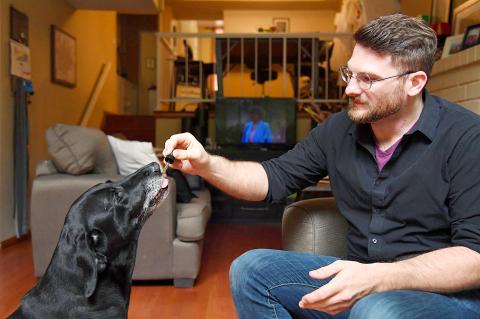
Photo: AFP
Hartmann, who lives near Los Angeles, said he turned to medical marijuana for Cayley after he no longer needed her to accompany him everywhere, having himself overcome his epilepsy with the help of the drug.
“I just allowed her to retire and ... I don’t think she handled the transition too well,” said Hartmann, who also has his aging dachshund on cannabis. “But CBD has really helped.”
With the multibillion-dollar medical and recreational marijuana industry for humans blossoming in the US, so is a new customer base — animals.
“We are seeing about 20 percent growth every single month,” said Alison Ettel, founder of Treat Well, a company in California that specializes in non-psychoactive medical cannabis products for animals and humans.
She said owners of animals — from dogs, cats, lizards, turtles, alpacas and horses to farm animals — are increasingly turning to cannabis to help treat ailments ranging from cancer and heart murmurs to arthritis and ear infections.
The feedback is more than encouraging, Ettel said.
“We probably get at least one to five cancer patients a day and the results we’re seeing are just blowing my mind,” she said, claiming the drug can help improve life expectancy.
When she started in the business about a decade ago, Ettel said she would treat about 20 animals per year, mostly dogs.
Today, with medical marijuana legalized in 29 states — plus the District of Columbia — the number of four-legged patients has skyrocketed.
“Now we are treating thousands of animals,” she said.
However, despite the rush to cash in on the booming industry, cannabis remains illegal on the federal level and marijuana laws on the state level do not apply to pets.
That has translated into pet owners having to get a marijuana card for themselves in order to purchase cannabis for their pups, as veterinarians are barred from prescribing marijuana.
The legal gray area and the lack of substantial studies on the effect of cannabis for pets also means that owners and dispensaries have had to tread carefully on dosages.
“We start very, very low and very, very slow to try and find the appropriate dose,” said Melinda Hayes, founder of Sweet Leaf Shoppe, a medical cannabis delivery service. “The last thing you want to do is for your dog or pet to be uncomfortable.”
Proponents have said the advantage of cannabis for ailing pets as opposed to painkillers or other traditional drugs is that when properly used, it has no known serious side effects.
“Other medicines can take a toll on an animal’s kidney, liver and other organs,” Hayes said.
Another advantage was the lower cost of medical cannabis compared to some medication, she added.
However, veterinarians are cautioning against viewing cannabis as a miracle drug.
“There are no studies on dogs or cats, much less guinea pigs or other species, so I don’t know what the potential benefits could be, if any,” California Veterinary Medical Association head Ken Pawlowski said.
While a pet might feel better after ingesting medical marijuana, he warned that did not mean its illness was gone.
“Is the underlying disease actually being treated or is it getting worse?” Pawlowski said. “The dog can feel better because it’s high, and actual known therapy that could help could be overlooked.”
However, pet owners like Hartmann are undeterred, while acknowledging that people need to be better educated on how to use the drug.
“We have so many success stories,” said Hartmann, who works as a cannabis consultant. “For the longest time I was anti-cannabis and was not a proponent of it until I started using it for my epilepsy. It helped me restore my body and it totally makes sense to use it for my dogs.”
“I have people who roll their eyes all the time and I say: ‘You’re just going to have to see it to believe it,’” he added.

Cairo’s new monorail slices across the city skyline, running above the familiar chaos of blaring horns and aging buses’ exhaust fumes that mark rush hour below. The US$4.5 billion monorail, opened this month, is among Egypt’s most prominent new transport projects, part of a debt-funded infrastructure drive criticized for sapping state finances while bringing limited benefits to most of the country’s 109 million people. “It feels like you’re in a different country,” said Ramy Sayed, a restaurant manager, aboard a driverless Innovia 300 train. “No noise, no traffic, we’re not used to this.” The eastern line runs 56km from the bustling middle-class

Starlux Airlines Co (星宇航空) today unveiled a long-haul network expansion plan at a shareholders’ meeting in Taipei, including direct flights to Barcelona, Spain, and Zurich, Switzerland, as well as a service connecting Taipei, Sydney and New Zealand. Starlux is to become the first Taiwanese carrier to offer non-stop services to the two European cities, while the inaugural oceanic route is expected to expand transit opportunities within the Australia-New Zealand market, Starlux said. Flight services to Chicago, Dallas, Washington and New York are under evaluation, the airline added. Prior to the shareholders’ meeting, the airline earlier this year announced that it would be

Taiwanese firms have increased investment in the Philippines in recent years as Manila’s ties with Washington deepen and global supply chains continue to shift away from China, an expert at the Chung-Hua Institution for Economic Research (CIER, 中華經濟研究院) said yesterday. The Philippines had not been among Taiwanese investors’ top choices in Southeast Asia, CIER Taiwan ASEAN Studies Center director Kristy Hsu (徐遵慈) said at a seminar in Taipei. However, Taiwan’s investment in the country has grown significantly since the COVID-19 pandemic, reaching US $257 million last year, a high in recent years, she said. Although Taiwan’s total investment in the Philippines still lags

Taiwanese prosecutors suspect that three people successfully smuggled at least one shipment of Nvidia Corp artificial intelligence (AI) chips to China after first exporting them to Japan, people familiar with the matter said. The trio was detained last week by the Keelung District Prosecutors’ Office for allegedly falsifying documents related to exports of Super Micro Computer Inc servers containing advanced Nvidia chips, which the US has barred from sale to China without a license from Washington. The move marked Taiwan’s first public crackdown on AI chip diversion after years of pressure from the US to take a more active role in curtailing


 RSS
RSS