


The Ministry of Finance yesterday filed an appeal to contest a High Court ruling over the Chang Hwa Commercial Bank (CHB, 彰銀) management rights dispute, saying the ruling is legally unsavory and fails to recognize the testimony of crucial witnesses.
The move has made reconciliation between the ministry and Taishin Financial Holding Co (台新金) unlikely ahead of CHB’s board elections on Friday.
The court’s argument over the existence of a contractual relationship between the ministry and Taishin Financial ran counter to facts and a legislative resolution that bars state-controlled shares from backing non-government stakes, Deputy Minister of Finance Su Jain-rong (蘇建榮) said.
The ministry has faithfully complied with the resolution and has never supported Taishin Financial in CHB board member elections, Su said.
“All important decisions about state-run financial institutions are subjected to the legislature’s oversight, but the lawmaking body has never reviewed such an agreement, indicating there was no agreement in the first place,” Su told a media briefing.
The High Court on May 17 ruled in favor of Taishin Financial, saying the ministry should continue to help the conglomerate win a majority of CHB board seats, as long as Taishin Financial remains the largest shareholder, in keeping with an agreement made in 2005.
Taishin Financial 12 years ago bought a 22.5 percent stake in CHB for NT$36.5 billion (US$1.2 billion at the current exchange rate) with a view to acquiring it and allegedly with tacit understanding from the ministry.
National Treasury Administration Director-General Frank Juan (阮清華) said the ministry yielded management rights in CHB to Taishin Financial in 2008 and 2011, because the government controlled fewer shares, compared with the bank-focused group.
“Things have changed over the years. Now state-run financial institutions and funds own more than 30 percent in CHB,” Juan said.
Juan said he regrets that the court failed to recognize the testimony of important witnesses, such as central bank Governor Perng Fai-nan (彭淮南) and former deputy minister of finance Liu Teng-cheng (劉燈城), who took part in the policymaking process in 2005.
Both Perng and Liu testified that the contractual relationship expired with the maturity of the special shares Taishin Financial acquired from CHB to help resolve the lender’s financial woes, Juan said.
CHB is to elect six board directors and three independent directors on Saturday.
Shareholders overwhelmingly rallied behind government-backed candidates in the 2014 board election, prompting Taishin Financial to write off huge asset losses and file lawsuits against the ministry.
Taiwan’s long-term economic competitiveness will hinge not only on national champions like Taiwan Semiconductor Manufacturing Co. (TSMC, 台積電) but also on the widespread adoption of artificial intelligence (AI) and other emerging technologies, a US-based scholar has said. At a lecture in Taipei on Tuesday, Jeffrey Ding, assistant professor of political science at the George Washington University and author of "Technology and the Rise of Great Powers," argued that historical experience shows that general-purpose technologies (GPTs) — such as electricity, computers and now AI — shape long-term economic advantages through their diffusion across the broader economy. "What really matters is not who pioneers

In a high-security Shenzhen laboratory, Chinese scientists have built what Washington has spent years trying to prevent: a prototype of a machine capable of producing the cutting-edge semiconductor chips that power artificial intelligence (AI), smartphones and weapons central to Western military dominance, Reuters has learned. Completed early this year and undergoing testing, the prototype fills nearly an entire factory floor. It was built by a team of former engineers from Dutch semiconductor giant ASML who reverse-engineered the company’s extreme ultraviolet lithography (EUV) machines, according to two people with knowledge of the project. EUV machines sit at the heart of a technological Cold
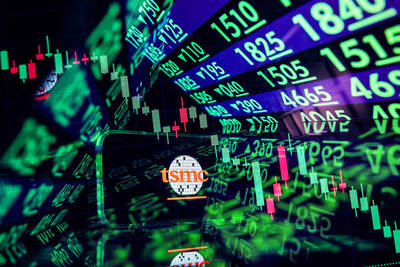
Taiwan Semiconductor Manufacturing Co (TSMC, 台積電) last week recorded an increase in the number of shareholders to the highest in almost eight months, despite its share price falling 3.38 percent from the previous week, Taiwan Stock Exchange data released on Saturday showed. As of Friday, TSMC had 1.88 million shareholders, the most since the week of April 25 and an increase of 31,870 from the previous week, the data showed. The number of shareholders jumped despite a drop of NT$50 (US$1.59), or 3.38 percent, in TSMC’s share price from a week earlier to NT$1,430, as investors took profits from their earlier gains
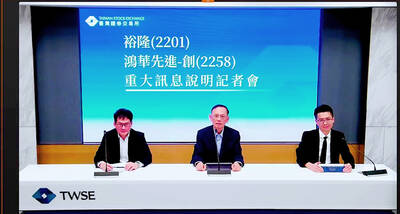
TAIWAN VALUE CHAIN: Foxtron is to fully own Luxgen following the transaction and it plans to launch a new electric model, the Foxtron Bria, in Taiwan next year Yulon Motor Co (裕隆汽車) yesterday said that its board of directors approved the disposal of its electric vehicle (EV) unit, Luxgen Motor Co (納智捷汽車), to Foxtron Vehicle Technologies Co (鴻華先進) for NT$787.6 million (US$24.98 million). Foxtron, a half-half joint venture between Yulon affiliate Hua-Chuang Automobile Information Technical Center Co (華創車電) and Hon Hai Precision Industry Co (鴻海精密), expects to wrap up the deal in the first quarter of next year. Foxtron would fully own Luxgen following the transaction, including five car distributing companies, outlets and all employees. The deal is subject to the approval of the Fair Trade Commission, Foxtron said. “Foxtron will be


 RSS
RSS