


The US dollar on Friday rose against the New Taiwan dollar, gaining NT$0.038 to close at the day’s high of NT$30.122 in a quiet session ahead of the Dragon Boat Festival holiday, dealers said.
Caution dominated market sentiment ahead of the release of first-quarter GDP data due later in Washington for more clues about the US economy, the dealers said.
The greenback opened at the day’s low of NT$30.060 and gained momentum into the end of the session. Turnover totaled US$867 million.
Soon after Taipei’s foreign exchange market opened, the US dollar fell against the NT dollar on follow-through selling from a session earlier, while traders took cues from the continued strength of the Chinese yuan to pick up the NT dollar, the dealers said.
However, the losses suffered by the US dollar were soon reversed in reflection of a weaker South Korean won, which the NT dollar follows closely, and the greenback continued its momentum until the end of the session, they said, adding that foreign institutional buying in equities lent some support to the NT dollar during the session.
According to the Taiwan Stock Exchange, foreign institutional investors bought a net NT$1.59 billion (US$52.79 million) worth of shares on the main board on Friday, the dealers said.
Despite the upturn enjoyed by the US dollar, it moved in a narrow range as traders were reluctant to make deals before the four-day Dragon Boat Festival holiday, which ends on Tuesday, they added.
The reluctance showed concerns over possible negative leads on the US dollar during the holiday, so many traders acted very cautiously, the dealers said.
In addition, the upcoming first-quarter GDP figure in Washington is expected to serve as an important indicator as to how the US Federal Reserve will adjust its monetary policy, they added.
The Fed has scheduled its next policymaking meeting for the middle of next month, and there are rising fears that the US central bank will raise its key interest rates then.
The Japanese yen on Friday rose nearly 1 percent against the US dollar after a dip in US Treasury yields hit the greenback, while the British pound hit a three-week low after a poll showed a narrowing lead for the ruling Conservatives before elections next month.
The US dollar was slightly higher against a basket of peers, while the euro reversed modest gains earlier in the day.
The yen hit a three-day high, up 0.8 percent to ¥110.88.
Analysts cited a fall in Treasury yields since Fed minutes on Wednesday prompted questions over the pace and extent of interest rate hikes.
“The yen appreciated and continues to correlate more closely with US bond yields. I don’t believe they’ll fall very far, but the move could be exacerbated by a number of places having a holiday on Monday,” said Kit Juckes, currency strategist with Societe Generale SA in London. “You can get outsized moves [owing to the holiday], and I suspect that yen shorts were a consensus trade last week.”
Investors tend to “square” or offset their long (buy) or sell (short) positions on currencies before major holidays.
Against a basket of six major currencies, the US dollar was up less than 0.1 percent to 97.281.
The euro pared gains made earlier in the day and was down 0.2 percent at US$1.1192, having touched a six-and-a-month high of US$1.1268 earlier in the week.
The common currency has enjoyed a near 3 percent gain this month on factors including an ebb in French political concerns and upbeat eurozone data.
In a sign that Britain’s June 8 election could be far more closely contested than previously thought, a YouGov poll published on Thursday showed that the opposition Labour Party had cut the lead of British Prime Minister Theresa May’s Conservatives to five points.
That pulled the pound more than half a percent lower to US$1.2837 by the European afternoon, further from a May 18 peak of US$1.3048, the pound’s strongest level since September last year.
The assumption that a landslide election win for May would strengthen her hand over Brexiteers in her ruling party and allow her to negotiate a smoother departure from the EU, has given sterling a near 4 percent bump since she announced the election.
However, that view has been challenged by recent polls.
“We’ve always been concerned the market is probably buying too much the large majority scenario for the Tory party and sterling is vulnerable in the near term to headwinds,” said Kamal Sharma, currency strategist at Bank of America Merrill Lynch in London. “The move on the opinion polls is not wholly surprising, given that we’ve seen similar dynamics heading into other elections.”

CHIP RACE: Three years of overbroad export controls drove foreign competitors to pursue their own AI chips, and ‘cost US taxpayers billions of dollars,’ Nvidia said China has figured out the US strategy for allowing it to buy Nvidia Corp’s H200s and is rejecting the artificial intelligence (AI) chip in favor of domestically developed semiconductors, White House AI adviser David Sacks said, citing news reports. US President Donald Trump on Monday said that he would allow shipments of Nvidia’s H200 chips to China, part of an administration effort backed by Sacks to challenge Chinese tech champions such as Huawei Technologies Co (華為) by bringing US competition to their home market. On Friday, Sacks signaled that he was uncertain about whether that approach would work. “They’re rejecting our chips,” Sacks

It is challenging to build infrastructure in much of Europe. Constrained budgets and polarized politics tend to undermine long-term projects, forcing officials to react to emergencies rather than plan for the future. Not in Austria. Today, the country is to officially open its Koralmbahn tunnel, the 5.9 billion euro (US$6.9 billion) centerpiece of a groundbreaking new railway that will eventually run from Poland’s Baltic coast to the Adriatic Sea, transforming travel within Austria and positioning the Alpine nation at the forefront of logistics in Europe. “It is Austria’s biggest socio-economic experiment in over a century,” said Eric Kirschner, an economist at Graz-based Joanneum

BUBBLE? Only a handful of companies are seeing rapid revenue growth and higher valuations, and it is not enough to call the AI trend a transformation, an analyst said Artificial intelligence (AI) is entering a more challenging phase next year as companies move beyond experimentation and begin demanding clear financial returns from a technology that has delivered big gains to only a small group of early adopters, PricewaterhouseCoopers (PwC) Taiwan said yesterday. Most organizations have been able to justify AI investments through cost recovery or modest efficiency gains, but few have achieved meaningful revenue growth or long-term competitive advantage, the consultancy said in its 2026 AI Business Predictions report. This growing performance gap is forcing executives to reconsider how AI is deployed across their organizations, it said. “Many companies
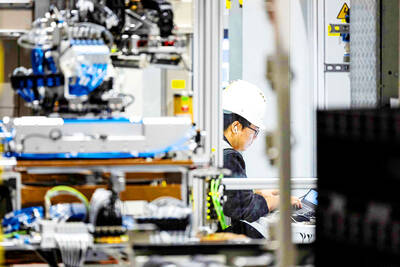
France is developing domestic production of electric vehicle (EV) batteries with an eye on industrial independence, but Asian experts are proving key in launching operations. In the Verkor factory outside the northern city of Dunkirk, which was inaugurated on Thursday, foreign specialists, notably from South Korea and Malaysia, are training the local staff. Verkor is the third battery gigafactory to open in northern France in a region that has become known as “Battery Valley.” At the Automotive Energy Supply Corp (AESC) factory near the city of Douai, where production has been under way for several months, Chinese engineers and technicians supervise French recruits. “They


 RSS
RSS