


Chang Chieh-kuan (張介冠), the owner of the last Chinese character letterpress and the last lead-character moldmaker in Taiwan, has long dreamed about passing on his work so that the dying technique of which he is a master practitioner can be preserved.
However, just days before his humble shop, Rixing Type Foundry (日星鑄字行), squeezed into a small lane on Taipei’s Taiyuan Road (太原路), celebrated its 48th anniversary yesterday, 65-year-old Chang came to believe those hopes were a pipe dream and that it would be impossible to cultivate such talent.
“I will just carve as long as I can,” Chang said, as he strives to preserve the culture of Chinese letterpress printing against the passing of time and advent of new technology.
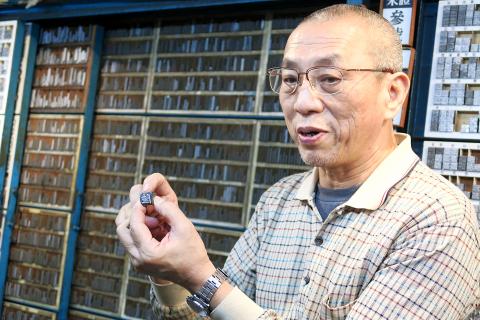
Photo: CNA
Rixing Type Foundry is possibly home to the last remaining collection of traditional Chinese movable type character molds in the world. It possesses 120,000 molds of different characters in a wide range of sizes and three different typefaces — kai ti (楷體) (regular script), song ti (宋體) and hei ti (黑體) (sans-serif black) — and has more than 10 million lead character pieces for printing or sale.
The foundry also has several molding machines that allow it to fabricate 3D lead type pieces, making it the last and only foundry of its kind in Taiwan.
However, the business might fade into history because many of its bronze molds are either partly or wholly worn.
What makes the situation even more daunting, as Chang has long feared, is that there is no way to train anyone in the skills needed to repair bronze molds for lead type.
It was in 1979 when Chang, a trained steel mechanic, started working at the lead foundry his father opened in 1969.
Training in the crafting and mending of lead type bronze molds should really start at 12 or 13, because it takes 10 to 15 years to master the skills, he said.
In addition, traditional masters remain at the peak of their abilities for about 10 years, at which point they have to rely more on experience as their eyesight deteriorates, Chang said.
“These days it is impossible to acquire apprentices aged 12 or 13. If people come here after graduating from college or university, their eyesight is already not good enough to do the job,” Chang said.
Joking that he was “forced” to enter the business, the lead type foundry master said he now often spends most of the day at his desk, mending the worn molds.
However, he said he never grows tired of the repetitive nature of tasks such as recrafting, scanning and correcting character types, which can seem extremely monotonous to an outsider. “I do not know how long the bronze molds at Rixing will last, as many of them are already badly worn,” Chang said. “I am now 65 years old. It will take another 65 years to repair them all.”
A skilled foundry master can mend a maximum of five character molds per day, he said, adding that to restore all 120,000 molds at Rixing Foundry would be extremely expensive.
Despite the time-consuming and labor intensive nature of the work, Chang told visitors to his shop that lead type imbues Chinese characters with a grandeur that digital printing cannot replicate.
It is like the difference between listening to music on vinyl or CD; it is all about the warm sentiment lead type conveys, he said.
Early this year Rixing launched a type bronze mold restoration project in the hope that an online fundraising program would help raise the funds needed to preserve its endangered bronze molds so that they can be passed on in their entirety.
“We want not only to preserve lead type, but also an era,” Chang said in a post on the project’s Web site at rixing2017.com.
“The ideal situation would be for people to express their support for the preservation of this culture through their everyday life choices,” he said.

Cairo’s new monorail slices across the city skyline, running above the familiar chaos of blaring horns and aging buses’ exhaust fumes that mark rush hour below. The US$4.5 billion monorail, opened this month, is among Egypt’s most prominent new transport projects, part of a debt-funded infrastructure drive criticized for sapping state finances while bringing limited benefits to most of the country’s 109 million people. “It feels like you’re in a different country,” said Ramy Sayed, a restaurant manager, aboard a driverless Innovia 300 train. “No noise, no traffic, we’re not used to this.” The eastern line runs 56km from the bustling middle-class
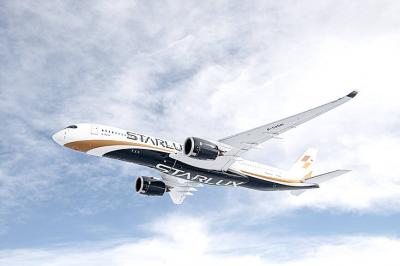
Starlux Airlines Co (星宇航空) today unveiled a long-haul network expansion plan at a shareholders’ meeting in Taipei, including direct flights to Barcelona, Spain, and Zurich, Switzerland, as well as a service connecting Taipei, Sydney and New Zealand. Starlux is to become the first Taiwanese carrier to offer non-stop services to the two European cities, while the inaugural oceanic route is expected to expand transit opportunities within the Australia-New Zealand market, Starlux said. Flight services to Chicago, Dallas, Washington and New York are under evaluation, the airline added. Prior to the shareholders’ meeting, the airline earlier this year announced that it would be

Taiwanese prosecutors suspect that three people successfully smuggled at least one shipment of Nvidia Corp artificial intelligence (AI) chips to China after first exporting them to Japan, people familiar with the matter said. The trio was detained last week by the Keelung District Prosecutors’ Office for allegedly falsifying documents related to exports of Super Micro Computer Inc servers containing advanced Nvidia chips, which the US has barred from sale to China without a license from Washington. The move marked Taiwan’s first public crackdown on AI chip diversion after years of pressure from the US to take a more active role in curtailing
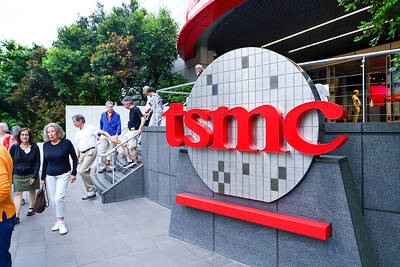
Taiwan Semiconductor Manufacturing Co (TSMC, 台積電) employee bonuses are likely to grow more than 30 percent this year, in line with the past few years as the company’s profits continue to set new records, an anonymous source cited TSMC chairman C.C. Wei (魏哲家) as saying yesterday. TSMC, the world’s largest contract chipmaker, is committed to taking care of its workers, the source said, citing Wei’s meeting with employees yesterday morning. Wei also expressed gratitude to employees for their contribution to the company’s improving bottom line, the source added. Since 2023, TSMC’s employee bonuses have grown at an annual rate of


 RSS
RSS