


Textile maker Far Eastern New Century Corp (遠東新世紀) yesterday said it is upbeat about sales of recycled materials this year amid increasing orders from international brands.
For the whole of last year, the company saw cumulative revenue edge down 0.92 percent year-on-year to NT$215.87 billion (US$6.88 billion), partly because of weak sentiment in global garment markets.
“However, the firm saw higher revenue contributions from recycled fiber and textiles last year, as our major brand customers from Europe and the US pay closer attention to social responsibility issues,” a company official said by telephone yesterday.
The official, who declined to be named, said that eco-friendly products have higher margins and the demand in the sector is expected to remain robust in coming years.
“Unlike other textile products, the demand for high-priced recycled materials is not easily influenced by fluctuations in global oil prices,” he said.
The company said that its plants in Shanghai have over the past two years expanded capacity to meet the need for “green” products, and further capacity increases are viable if necessary.
Commenting on investment plans in Vietnam, the official said that the company’s long-term target would not change, despite the US’ withdrawal from the Trans-Pacific Partnership (TPP).
“The TPP is not the only reason why we chose Vietnam [as a new production base],” he said, citing Vietnam’s trade agreements with the EU and other Asian countries.
The company plans to invest nearly US$760 million in developing a complete supply chain for fabrics and garments in Vietnam, in an effort to raise its global competitiveness.
The new plant in Vietnam, which is to produce knitted fabrics, is scheduled to begin operations in the second quarter of this year.
Other new factories for making polyesters are set to start production next year.
Headquartered in Taipei, the company offers a wide range of petrochemical and textile products, such as polyester-related materials, knitted fabric, and apparels.
As a main subsidiary of Far Eastern Group (遠東集團), the company also operates real-estate development business and mobile services business, including Far EasTone Telecommunications Co (遠傳電信).
The polyester and textiles businesses account for more than 50 percent of the company’s total sales, data showed.
Far Eastern New Century shares rose 0.39 percent to close at NT$26 in Taipei trading yesterday, outperforming the benchmark TAIEX, which increased 0.25 percent to 9,447.95 points.

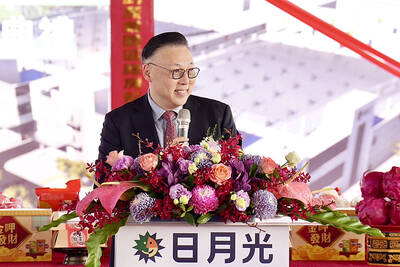
ENERGY ISSUES: The TSIA urged the government to increase natural gas and helium reserves to reduce the impact of the Middle East war on semiconductor supply stability Chip testing and packaging service provider ASE Technology Holding Co (日月光投控) yesterday said it planned to invest more than NT$100 billion (US$3.15 billion) in building a new advanced chip testing facility in Kaohsiung to keep up with customer demand driven by the artificial intelligence (AI) boom. That would be included in the company’s capital expenditure budget next year, ASE said. There is also room to raise this year’s capital spending budget from a record-high US$7 billion estimated three months ago, it added. ASE would have six factories under construction this year, another record-breaking number, ASE chief operating officer Tien Wu

The EU and US are nearing an agreement to coordinate on producing and securing critical minerals, part of a push to break reliance on Chinese supplies. The potential deal would create incentives, such as minimum prices, that could advantage non-Chinese suppliers, according to a draft of an “action plan” seen by Bloomberg. The EU and US would also cooperate on standards, investments and joint projects, as well as coordinate on any supply disruptions by countries like China. The two sides are additionally seeking other “like-minded partners” to join a multicountry accord to help create these new critical mineral supply chains, which feed into

For weeks now, the global tech industry has been waiting for a major artificial intelligence (AI) launch from DeepSeek (深度求索), seen as a benchmark for China’s progress in the fast-moving field. More than a year has passed since the start-up put Chinese AI on the map in early last year with a low-cost chatbot that performed at a similar level to US rivals. However, despite reports and rumors about its imminent release, DeepSeek’s next-generation “V4” model is nowhere in sight. Speculation is also swirling over the geopolitical implications of which computer chips were chosen to train and power the new

Intel Corp is joining Elon Musk’s long-shot effort to develop semiconductors for Tesla Inc, Space Exploration Technologies Corp and xAI, marking a surprising twist in the chipmaker’s comeback bid. Intel would help the Terafab project “refactor” the technology in a chip factory, the company said on Tuesday in a post on X, Musk’s social media platform. That is a stage in the development process that typically helps make chips more powerful or reliable. The chipmaker’s shares jumped 4.2 percent to US$52.91 in New York trading on Tuesday. The Terafab project is a grand plan by Musk to eventually manufacture his own chips for


 RSS
RSS