


Inventec Corp (英業達) chairman Richard Lee (李詩欽) yesterday said he is seeking a successor by June and hopes to lower the management’s average age to energize the company.
“The new chairman should be younger than 65 years old. I will make this happen at a board meeting in June,” the 69-year-old Lee told reporters ahead of a company event at the Nangang Exhibition Hall in Taipei.
Lee, who joined Inventec the year after it was established in 1975, has been chairman since founder Yeh Kuo-yi (葉國一) retired in 2008.
Under his leadership, Inventec secured smartphone orders from Chinese company Xiaomi Corp (小米) in 2010, merged its solar subsidiaries Inventec Solar Energy Corp (英穩達) and Inventec Energy Corp (英懋達) in 2015, and increased its server segment’s revenue contribution from less than 20 percent to between 35 and 40 percent last year.
The company also became the sole manufacturer of Apple Inc’s wireless earphones the AirPod last year.
Lee said the board would propose that Inventec Solar Energy chairman Tom Cho (卓桐華) become the sixth director at a board meeting at the end of March.
Inventec president Huang Kuo-chun (黃國鈞), Inventec Appliance Corp (英華達) chairman Jackson Chang (張景嵩) — both directors — and Cho are the three main candidates for the chairmanship, as they are all in charge of business units, Lee said.
The board is to elect a new chairman and nominate a new president at the meeting in June, Lee said, adding that he would remain a director “for a while” after the election.
Lee said Inventec is confident that its total shipments, which include notebook computers, servers and smart devices, would reach 100 million units this year.
The company has failed to achieve that target for the past two years due to a smartphone client changing its order. It shipped slightly more than 80 million units last year, flat from the previous year.
Inventec Appliance chief executive David Ho (何代水) said the company would ship 75 million smart devices this year, 25 percent more than last year’s 60 million units.
Ho said he is confident of reaching the goal as order visibility for wearable products and smart home devices is very clear “throughout” the entire year.
Production utilization for smart devices would run at full capacity this quarter, Ho said, adding that two of the wearable product lines would work extra shifts during the Lunar New Year holiday to meet strong demand from clients.
Inventec’s combined revenue climbed 9.28 percent year-on-year to NT$390.04 billion (US$12.19 billion) in the first 11 months of last year. The company is scheduled to release last month’s results on Monday.

Cairo’s new monorail slices across the city skyline, running above the familiar chaos of blaring horns and aging buses’ exhaust fumes that mark rush hour below. The US$4.5 billion monorail, opened this month, is among Egypt’s most prominent new transport projects, part of a debt-funded infrastructure drive criticized for sapping state finances while bringing limited benefits to most of the country’s 109 million people. “It feels like you’re in a different country,” said Ramy Sayed, a restaurant manager, aboard a driverless Innovia 300 train. “No noise, no traffic, we’re not used to this.” The eastern line runs 56km from the bustling middle-class
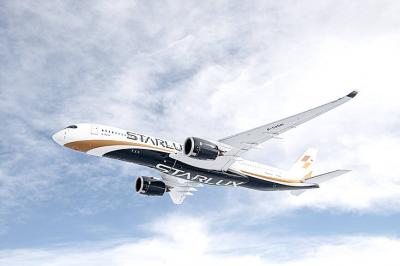
Starlux Airlines Co (星宇航空) today unveiled a long-haul network expansion plan at a shareholders’ meeting in Taipei, including direct flights to Barcelona, Spain, and Zurich, Switzerland, as well as a service connecting Taipei, Sydney and New Zealand. Starlux is to become the first Taiwanese carrier to offer non-stop services to the two European cities, while the inaugural oceanic route is expected to expand transit opportunities within the Australia-New Zealand market, Starlux said. Flight services to Chicago, Dallas, Washington and New York are under evaluation, the airline added. Prior to the shareholders’ meeting, the airline earlier this year announced that it would be
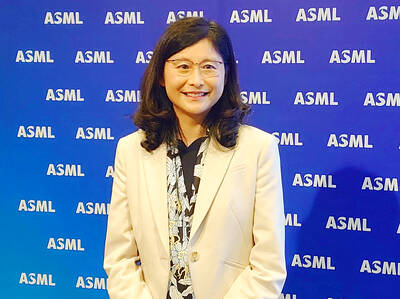
Netherlands-based semiconductor equipment supplier ASML Holding NV yesterday said that it is planning to hire an additional 1,000 people in Taiwan this year in response to growing demand from clients. ASML had previously planned to recruit 600 people this year, but that the plan has been adjusted upward, ASML vice president and ASML Taiwan general manager Grace Wang (汪佳慧) told reporters. ASML has a workforce of more than 4,500 in Taiwan, accounting for about 10 percent of its global total, Wang said. This year’s recruitment campaign would focus on adding people in the customer support, manufacturing and supply chain domains to assist ASML

Nvidia Corp yesterday announced that CEO Jensen Huang (黃仁勳) would attend an employee meeting in Taipei tomorrow to celebrate the launch of the company’s Taiwan headquarters project. Huang would attend a gathering at the site of Nvidia’s planned headquarters in Beitou Shilin Technology Park (北投士林科技園區), the company said in a statement. After arriving in Taiwan on Saturday last week, Huang told reporters that he plans to meet with Quanta Computer Inc (廣達) chairman Barry Lam (林百里) and Taiwan Semiconductor Manufacturing Co (TSMC, 台積電) chairman C.C. Wei (魏哲家), and would attend the groundbreaking ceremony for Nvidia’s Taiwan headquarters tomorrow. Nvidia has not yet applied


 RSS
RSS