


Royal Bank of Scotland Group PLC (RBS) bolstered its capital plan after failing multiple hurdles in the Bank of England’s (BOE) toughest-ever stress test.
Some “capital inadequacies” were revealed at two other banks, Barclays PLC and Standard Chartered PlC, though neither was required to submit a revised capital plan, the BOE’s Prudential Regulation Authority (PRA) said yesterday.
The test also covered HSBC Holdings PLC, Lloyds Banking Group PLC, Banco Santander SA’s British arm and Nationwide Building Society. The hurdle rate required all the banks to retain capital equivalent to 4.5 percent of their assets weighted by risk, plus Pillar 2A — a requirement that varies depending on the specific risks for each bank — in the stressed scenario.
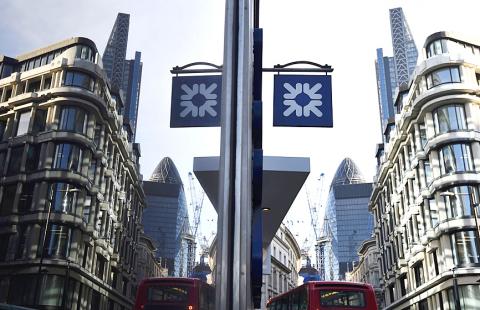
Photo: Reuters
“Based on RBS’ own assessment of its resilience identified during the stress-testing process, RBS has already updated its capital plan to incorporate further capital strengthening actions and this revised plan has been accepted by the PRA board,” the Prudential Regulation Authority said.
In a statement, RBS said its plan includes further cutting costs, reduction in risk-weighted assets, and the sale of personal and commercial loan portfolios.
“We are committed to creating a stronger, simpler and safer bank for our customers and shareholders,” RBS chief financial officer Ewen Stevenson said. “We have taken further important steps in 2016 to enhance our capital strength, but we recognize that we have more to do to restore the bank’s stress resilience, including resolving outstanding legacy issues.”
Overall, the BOE said the stress test showed that the UK banking system is “capitalized to support the real economy in a severe, broad and synchronized stress scenario.”
The BOE’s Financial Policy Committee judged that no systemwide macroprudential action on bank capital was needed in response to the test. It maintained the UK countercyclical capital buffer at zero percent and expects to keep it at that level until at least June next year “absent any material change in the outlook.”
Regulators began stress tests to restore confidence in the financial system after the bailouts that resulted from the crisis. Authorities impose a “severe, but plausible” scenario to ensure banks can withstand strain and keep credit flowing.
This year’s test featured a sharp economic slide in Hong Kong and China, a 1.9 percent contraction in the global economy and exchange-rate volatility as emerging-market currencies depreciate against the US dollar. It also assumed a 31 percent crash in British house prices during the five-year period, while UK commercial real estate sank 42 percent.
RBS missed targets for common equity Tier 1 capital, a key measure of financial strength, and a leverage measure before the conversion of some debt to equity was factored in. The PRA said it would monitor the Edinburgh-based lender’s progress in implementing the plan.
The adverse scenario was drawn up in March and does not model the impact of the Brexit negotiations or a withdrawal from the EU. RBS modeled its own performance based on the test and approached the BOE with a revised capital plan before it was asked to provide one by the central bank.
CHIP RACE: Three years of overbroad export controls drove foreign competitors to pursue their own AI chips, and ‘cost US taxpayers billions of dollars,’ Nvidia said China has figured out the US strategy for allowing it to buy Nvidia Corp’s H200s and is rejecting the artificial intelligence (AI) chip in favor of domestically developed semiconductors, White House AI adviser David Sacks said, citing news reports. US President Donald Trump on Monday said that he would allow shipments of Nvidia’s H200 chips to China, part of an administration effort backed by Sacks to challenge Chinese tech champions such as Huawei Technologies Co (華為) by bringing US competition to their home market. On Friday, Sacks signaled that he was uncertain about whether that approach would work. “They’re rejecting our chips,” Sacks
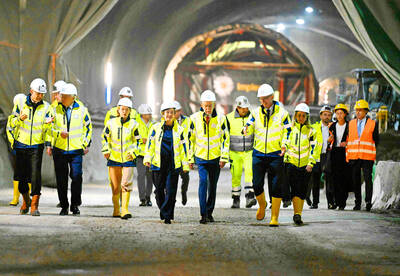
It is challenging to build infrastructure in much of Europe. Constrained budgets and polarized politics tend to undermine long-term projects, forcing officials to react to emergencies rather than plan for the future. Not in Austria. Today, the country is to officially open its Koralmbahn tunnel, the 5.9 billion euro (US$6.9 billion) centerpiece of a groundbreaking new railway that will eventually run from Poland’s Baltic coast to the Adriatic Sea, transforming travel within Austria and positioning the Alpine nation at the forefront of logistics in Europe. “It is Austria’s biggest socio-economic experiment in over a century,” said Eric Kirschner, an economist at Graz-based Joanneum

BUBBLE? Only a handful of companies are seeing rapid revenue growth and higher valuations, and it is not enough to call the AI trend a transformation, an analyst said Artificial intelligence (AI) is entering a more challenging phase next year as companies move beyond experimentation and begin demanding clear financial returns from a technology that has delivered big gains to only a small group of early adopters, PricewaterhouseCoopers (PwC) Taiwan said yesterday. Most organizations have been able to justify AI investments through cost recovery or modest efficiency gains, but few have achieved meaningful revenue growth or long-term competitive advantage, the consultancy said in its 2026 AI Business Predictions report. This growing performance gap is forcing executives to reconsider how AI is deployed across their organizations, it said. “Many companies
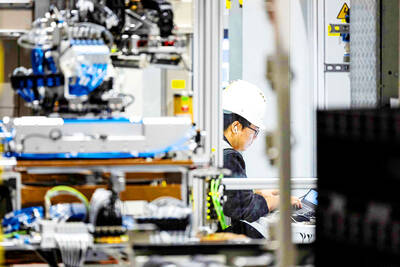
France is developing domestic production of electric vehicle (EV) batteries with an eye on industrial independence, but Asian experts are proving key in launching operations. In the Verkor factory outside the northern city of Dunkirk, which was inaugurated on Thursday, foreign specialists, notably from South Korea and Malaysia, are training the local staff. Verkor is the third battery gigafactory to open in northern France in a region that has become known as “Battery Valley.” At the Automotive Energy Supply Corp (AESC) factory near the city of Douai, where production has been under way for several months, Chinese engineers and technicians supervise French recruits. “They


 RSS
RSS