


Wistron Corp (緯創), an assembler of Apple Inc iPhones, yesterday approved a capital injection of US$33.5 million at its after-sales subsidiary in India so that it can build a smart devices plant for the Indian market.
“It will be Wistron’s first wholly owned plant in the country,” a Wistron investor relations official said by telephone.
Wistron has a coinvested smartphone plant with India’s Optiemus Infracom Ltd in the state of Uttar Pradesh with a production capacity of 600,000 smartphones per month.
The Uttar Pradesh plant’s clients include Taiwan’s HTC Corp (宏達電) and China’s Oppo Mobile Telecommunications Corp (歐珀移動), according to Indian media reports.
Wistron’s decision to expand its manufacturing capacity by setting up a wholly owned plant shows that it is optimistic about India’s growing domestic market.
The smartphone penetration rate is still less than 30 percent in India, making it one of the most attractive markets in the world, according to International Data Corp data.
The official said the wholly owned factory, which is to be in Bengaluru, is expected to become operational and enter mass production for a smart-devices client at the end of next quarter at the earliest.
However, the Wistron official said the company could not disclose the production capacity or the number of employees at the plant at client’s request, as it would reveal the scale of production.
KUNSHAN INVESTMENT
On the back of its growing smart devices business, Wistron’s board yesterday also approved a US$11.67 million expansion plan at the company’s smart devices factory in Kunshan, China.
The new plan comes only two months after the board agreed to invest US$2 million to purchase additional equipment for the Kunshan plant in September.
The official said the company would install new equipment to raise the production capacity this quarter.
Wistron expects its smart devices and liquid crystal modules (LCM) businesses, which contributed about 24 percent of its total revenue, to remain its main growth drivers this quarter, the official said.
The official said shipments by the company’s notebook business, which accounted for 40 percent of its total revenue, would decline by between 5 and 10 percent quarter-on-quarter due to the beginning of the traditional slow season.
Wistron’s net income plunged 22.07 percent year-on-year and 16.88 percent quarter-on-quarter to NT$512 million (US$16.1 million) last quarter, missing the market consensus estimate of NT$668 million.
The firm attributed the decline to a NT$338 million foreign-exchange loss due to the New Taiwan dollar’s appreciation against the US dollar.
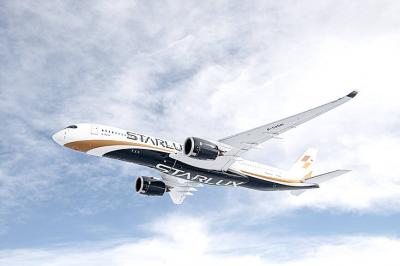
Starlux Airlines Co (星宇航空) today unveiled a long-haul network expansion plan at a shareholders’ meeting in Taipei, including direct flights to Barcelona, Spain, and Zurich, Switzerland, as well as a service connecting Taipei, Sydney and New Zealand. Starlux is to become the first Taiwanese carrier to offer non-stop services to the two European cities, while the inaugural oceanic route is expected to expand transit opportunities within the Australia-New Zealand market, Starlux said. Flight services to Chicago, Dallas, Washington and New York are under evaluation, the airline added. Prior to the shareholders’ meeting, the airline earlier this year announced that it would be

Netherlands-based semiconductor equipment supplier ASML Holding NV yesterday said that it is planning to hire an additional 1,000 people in Taiwan this year in response to growing demand from clients. ASML had previously planned to recruit 600 people this year, but that the plan has been adjusted upward, ASML vice president and ASML Taiwan general manager Grace Wang (汪佳慧) told reporters. ASML has a workforce of more than 4,500 in Taiwan, accounting for about 10 percent of its global total, Wang said. This year’s recruitment campaign would focus on adding people in the customer support, manufacturing and supply chain domains to assist ASML

UNDER MICROSCOPE: Taiwan detained three people who allegedly conspired to buy servers in Taiwan and export them using fraudulent documentation, prosecutors said Nvidia Corp chief executive officer Jensen Huang (黃仁勳) on Saturday urged Super Micro Computer Inc to tighten up on compliance after Taiwan detained three people this week for allegedly making fraudulent declarations about artificial intelligence (AI) servers made by its US partner. The development marked the nation’s first crackdown on semiconductor smuggling, which grew after the US slapped restrictions on exports of high-end chips such as Nvidia AI accelerators to China. Nvidia is “rigorous” in explaining regulations to all of its partners, Huang told reporters after arriving in Taipei. “Ultimately Super Micro has to run their own company,” he said in response to

Nvidia Corp yesterday announced that CEO Jensen Huang (黃仁勳) would attend an employee meeting in Taipei tomorrow to celebrate the launch of the company’s Taiwan headquarters project. Huang would attend a gathering at the site of Nvidia’s planned headquarters in Beitou Shilin Technology Park (北投士林科技園區), the company said in a statement. After arriving in Taiwan on Saturday last week, Huang told reporters that he plans to meet with Quanta Computer Inc (廣達) chairman Barry Lam (林百里) and Taiwan Semiconductor Manufacturing Co (TSMC, 台積電) chairman C.C. Wei (魏哲家), and would attend the groundbreaking ceremony for Nvidia’s Taiwan headquarters tomorrow. Nvidia has not yet applied


 RSS
RSS