

India’s billionaire Ruia brothers agreed to sell a 98 percent stake in their refinery unit to Rosneft PJSC, Russia’s biggest listed oil producer, and a consortium of Trafigura and United Capital Partners for about US$13 billion.
Essar Group is to sell 49 percent of Essar Oil Ltd each to Rosneft and the consortium for an enterprise value of 728 billion rupees (US$10.91 billion), the Indian conglomerate said in a statement on Saturday. The equity valuation is to be about US$5.8 billion, the price at which the company was delisted, Essar Group director Prashant Ruia told reporters at a briefing in Goa, India.
The all-cash deal is to help Essar, which also runs steel mills and ports, cut debt by more than 50 percent, Ruia said.
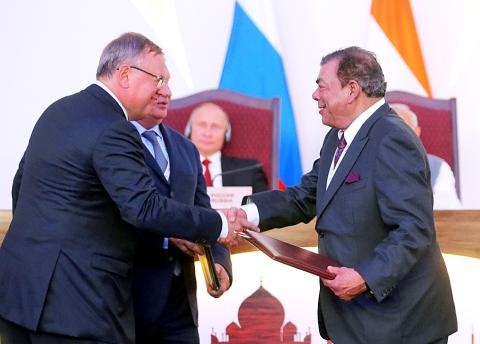
Photo: Reuters
The transaction includes India’s second-largest refinery at Vadinar, and another US$2 billion is to be paid for a port terminal and power plant that helps feed the refinery, as well as about 2,700 pumps.
All approvals are expected by the end of this year and most of the proceeds are to go to retire debt, Ruia said.
It will be the single largest foreign direct investment in India.
The deal “proves the attractiveness of the Indian energy market to foreign investors,” said Chanda Kochhar, chief executive of ICICI Bank Ltd, which was helping Essar reduce debt. “This deal is also a significant step in the process of deleveraging the balance sheets of Indian corporates.”
The deal shows how oil-rich nations are investing overseas into refineries to secure an outlet for their production amid an intense battle for market share between OPEC and non-OPEC countries. On top of Russia, Saudi Arabia is buying stakes in refiners through its state-owned oil giant Saudi Aramco in countries from Indonesia to the US. Kuwait is also investing in oil processing facilities.
Essar Energy Holdings Ltd and Oil Bidco (Mauritius) Ltd — which control Essar Oil — have signed separate agreements for the 98 percent stake sale. The first outlines the sale of 49 percent to Petrol Complex Pte, a unit of Rosneft.
The second sees the remaining 49 percent sold to Kesani Enterprises Co — owned by a consortium led by Trafigura and United Capital Partners Russia’s VTB Bank PJSC is to lend Essar US$3.9 billion to restructure debt, Andrey Kostin, VTB chief executive, told reporters at a separate briefing in Goa.
Rosneft is to pay US$3.5 billion for the Essar deal, Kostin said.
Russia has been deepening energy ties with India, which is expected to surpass Japan as the world’s third-largest oil user this year to become the fastest-growing crude consumer through 2040, according to International Energy Agency estimates.
India’s state-owned energy companies are investing US$5.5 billion to buy stakes in Rosneft’s Vankor and Taas-Yuryakh fields.
The transaction — which Essar said is the biggest tranche of foreign direct investment in India — was announced on the sidelines of the Brazil, Russia, India, China and South Africa summit, attended by Indian Prime Minister Narendra Modi and Russian President Vladimir Putin.
It has the support of both their governments, Ruia said, adding that that he does not see sanctions on Russia affecting the deal.

Federal Reserve Bank of Philadelphia President Anna Paulson on Thursday joined the chorus of policymakers saying additional interest-rate increases may be needed to ensure inflation returns to the central bank’s 2 percent goal. “Looking ahead, if conditions evolve as I expect, some modest further tightening may be warranted,” Paulson said on Thursday at an event in Philadelphia. Earlier on Thursday, New York Fed President John Williams said he and his colleagues “still have a lot of work to do” in dealing with lingering inflation risks. Several other officials have aired similar comments, in line with the signal given last week when policymakers voted
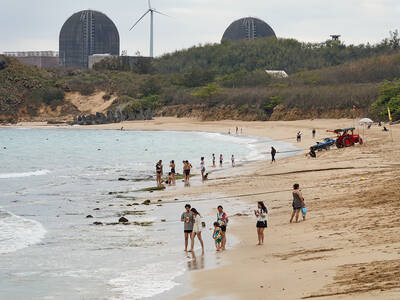
COURSE CHANGE: The shift comes amid pressure from chipmakers for stable, low-carbon electricity. Officials said Ma-anshan could be restarted as early as 2028 Taiwan has approved a preliminary plan to restart an idled atomic power plant, marking a reversal of the ruling party’s anti-nuclear stance as the nation pursues greater energy security. The Nuclear Safety Commission has cleared its review of an initial proposal to restart the Ma-anshan Nuclear Power Plant, it said in a statement on Thursday. Taiwan Power Co (台電) will still need to carry out follow-up work including safety inspections, before submitting another report on implementation for review, the commission said. The earliest the plant could resume operations is 2028, according to previous reports in local media, citing Minister of Economic Affairs
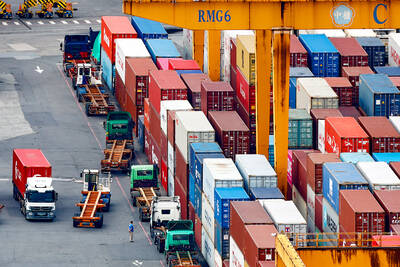
LOPSIDED DEVELOPMENT: While AI firms are riding the wave as far it can take them, traditional industries and their workers are not floated by the same flood While Taiwan is benefiting from a global artificial intelligence (AI) boom, many traditional industries have seen little of the benefit, widening the country’s “K-shaped” economic divide, an economist said. A “K-shaped” economy is one in which some sectors expand rapidly while others struggle, head of the commerce development and strategy research division at the Commerce Development Research Institute Ju Haw (朱浩) said in an interview. In Taiwan’s case, high-tech and AI-related industries have continued to grow while traditional industries have come under increasing pressure, he said. AI development has created crowding-out effects, as large high-tech firms generating strong profits are better able

Artificial intelligence (AI) requires safeguards that go beyond self-regulation, Microsoft Corp cofounder Bill Gates said in an interview that aired on Sunday, calling for legislation to be passed in US Congress. “You need law enforcement and the politicians to get into the discussion about what safeguards and monitoring look like,” Gates said in a taped interview on NBC’s Meet the Press program. “And that has to be a required thing.” A sudden groundswell has risen in favor of federal intervention after OpenAI in July said that an autonomous AI agent went rogue during a security test and hacked into another company, subverting


 RSS
RSS