


New Power Party (NPP) Executive Chairman Huang Kuo-chang (黃國昌) yesterday accused the Investment Commission of dereliction of duty, saying it failed to conduct a stringent review of Bai Chi Gan Tou Digital Entertainment Co’s (百尺竿頭) funding sources.
The commission’s review was inadequate and cursory, and involved little more than processing administrative paperwork, Huang said at a meeting if the Legislative Yuan’s Finance Committee.
Huang said the commission had failed to verify funding confirmation filings by the suitor of XPEC Entertainment Inc (樂陞科技), as commission officials later acknowledged that they were not aware that US$230 million of the funds listed in Bai Chi’s plan would come from Hong Kong-based investment subsidiaries backed by Chinese money.
“These lapses have severely affected the nation’s market mechanisms, and will continue to have a profound impact on the viability of Taiwan in the eyes of foreign investors in the absence of consequences for submitting incomplete and false filings,” Huang said.
The Finance Committee yesterday held a question-and-answer session with regulators who gave the green light to Bai Chi’s NT$4.86 billion (US$155 million at current exchange rates) tender offer to acquire a 25.71 percent stake in XPEC that later collapsed, leaving investors with heavy losses after the video game developer’s shares tanked.
While the Securities and Futures Investors Protection Center has begun to take legal action against Bai Chi, lawmakers demanded that the Financial Supervisory Commission (FSC) and the Investment Commission shoulder some of the reparations to affected investors.
Lawmakers also listed CTBC Bank Co (中國信託銀行), which served as the depository bank in the acquisition, as liable to damages for investors’ losses.
FRAUD
Huang said he suspected that XPEC planned to default on its loans and obligations in Taiwan, as the company had wired NT$5.3 billion to China earlier this year for its acquisition of a stake in Chinese mobile apps platform Xiamen ETombo Technology Ltd (廈門同步網路).
FSC Chairman Ding Kung-wha (丁克華) said the case has been classified as financial fraud involving market manipulation and insider trading, adding that the commission has handed its findings to prosecutors.
The Finance Committee also held a two-hour closed-door meeting with officials of state-run Mega International Commercial Bank (兆豐銀行) of the bank and regulators regarding contravention of US money laundering rules by a New York branch, which was handed a hefty US$180 million fine by the New York State Department of Financial Services (DFS).
Following a review of confidential data released by the FSC for lawmakers, Chinese Nationalist Party (KMT) Legislator William Tseng (曾銘宗), a former FSC chairman, said that none of the 174 wire transactions or 76 accounts in question had ties or originated from Taiwan, and none of the beneficiaries had Chinese-language names.
Tseng said these findings disprove allegations that the bank had been helping the KMT in whisking away its “ill-gotten” assets abroad.
However, Huang said that yesterday’s discussions were limited to suspicious transactions between 2012 and 2014, and that ongoing investigations should go further back to 2010, when Mega Bank was penalized by Panamanian financial regulators, for breaking money laundering rules.

NEW IMPORTS: Car dealer PG Union Corp said it would consider introducing US-made models such as the Jeep Grand Cherokee and Stellantis’ RAM 1500 to Taiwan Tesla Taiwan yesterday said that it does not plan to cut its car prices in the wake of Washington and Taipei signing the Agreement on Reciprocal Trade on Thursday to eliminate tariffs on US-made cars. On the other hand, Mercedes-Benz Taiwan said it is planning to lower the price of its five models imported from the US after the zero tariff comes into effect. Tesla in a statement said it has no plan to adjust the prices of the US-made Model 3, Model S and Model X as tariffs are not the only factor the automaker uses to determine pricing policies. Tesla said
OpenAI has warned US lawmakers that its Chinese rival DeepSeek (深度求索) is using unfair and increasingly sophisticated methods to extract results from leading US artificial intelligence (AI) models to train the next generation of its breakthrough R1 chatbot, a memo reviewed by Bloomberg News showed. In the memo, sent on Thursday to the US House of Representatives Select Committee on China, OpenAI said that DeepSeek had used so-called distillation techniques as part of “ongoing efforts to free-ride on the capabilities developed by OpenAI and other US frontier labs.” The company said it had detected “new, obfuscated methods” designed to evade OpenAI’s defenses
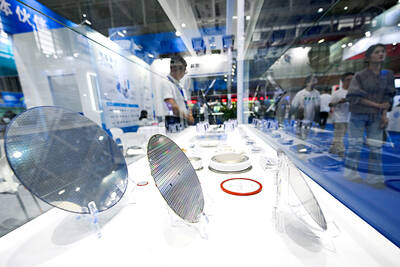
China’s top chipmaker has warned that breakaway spending on artificial intelligence (AI) chips is bringing forward years of future demand, raising the risk that some data centers could sit idle. “Companies would love to build 10 years’ worth of data center capacity within one or two years,” Semiconductor Manufacturing International Corp (SMIC, 中芯) cochief executive officer Zhao Haijun (趙海軍) said yesterday on a call with analysts. “As for what exactly these data centers will do, that hasn’t been fully thought through.” Moody’s Ratings projects that AI-related infrastructure investment would exceed US$3 trillion over the next five years, as developers pour eye-watering sums
Bank of America Corp nearly doubled its forecast for the nation’s economic growth this year, adding to a slew of upgrades even after a rip-roaring last year propelled by demand for artificial intelligence (AI). The firm lifted its projection to 8 percent from 4.5 percent on “relentless global demand” for the hardware that Taiwanese companies make, according to a note dated yesterday by analysts including Xiaoqing Pi (皮曉青). Taiwan’s GDP expanded 8.63 percent last year, the fastest pace since 2010. The increase “reflects our sustained optimism over Taiwan’s technology driven expansion and is reinforced by several recent developments,” including a more stable currency,


 RSS
RSS