


Taiwan’s export orders grew 8.3 percent annually to US$37.93 billion last month, ending 16 straight months of annual decline, the Ministry of Economic Affairs (MOEA) said yesterday.
“The better-than-expected result was mainly driven by the strong orders for electronics components because of Apple Inc’s new iPhone launch,” Department of Statistics Director-General Lin Lee-jen (林麗貞) told a news conference.
The latest figure was US$2 billion more than the ministry’s estimate, Lin added.
Orders for electronics components jumped 16.5 percent year-on-year and 11.8 percent month-on-month to a record level of US$10.44 billion last month, the ministry’s statistics showed.
Orders for semiconductor products, packaging and testing services, and passive components also saw a significant increase due to the iPhone 7 launch, Lin said.
Better-than-expected demand for notebook computers helped boost orders for information technology and communication products to US$10.52 billion, up 6.6 percent annually and 10.1 percent monthly, she said.
Orders for basic metal products reported their first annual growth in the past 21 months, up 10.7 percent to US$2.06 billion, thanks to inventory buildup of steel products, she said.
Orders for precision instrument goods showed an annual decline of 6.9 percent, but the pace narrowed July’s 12.5 percent fall because of higher flat panel demand, she added.
Machinery orders expanded by 10.6 percent year-on-year, while both plastic and petrochemical goods saw their orders end 24 months of annual decline.
US orders increased by 15.1 percent annually and 8.6 percent monthly to US$10.92 billion on the back of the new iPhone launch, while orders from China (including Hong Kong) surged 12.8 percent year-on-year and 11.2 percent month-on-month to US$9.77 billion, supported by smartphones, notebooks and panels demand.
As Apple started shipping its new iPhones from Friday last week, Taiwan’s export orders are expected to continue rising this month.
They could reach a range of between US$41.5 billion and US$43 billion, which would be an annual growth of between 0.48 percent and 4.11 percent, Lin said.

HORMUZ ISSUE: The US president said he expected crude prices to drop at the end of the war, which he called a ‘minor excursion’ that could continue ‘for a little while’ The United Arab Emirates (UAE) and Kuwait started reducing oil production, as the near-closure of the crucial Strait of Hormuz ripples through energy markets and affects global supply. Abu Dhabi National Oil Co (ADNOC) is “managing offshore production levels to address storage requirements,” the company said in a statement, without giving details. Kuwait Petroleum Corp said it was lowering production at its oil fields and refineries after “Iranian threats against safe passage of ships through the Strait of Hormuz.” The war in the Middle East has all but closed Hormuz, the narrow waterway linking the Persian Gulf to the open seas,

Apple Inc increased iPhone production in India by about 53 percent last year and now makes a quarter of its marquee devices there, reflecting the US company’s efforts to avoid tariffs on China. The company assembled about 55 million iPhones in India last year, up from 36 million a year earlier, people familiar with the matter said, asking not to be named because the numbers aren’t public. Apple makes about 220 million to 230 million iPhones a year globally, with India’s share of the total increasing rapidly. Apple has accelerated its expansion in the world’s most populous country in recent years, bolstered

HEADWINDS: The company said it expects its computer business, as well as consumer electronics and communications segments to see revenue declines due to seasonality Pegatron Corp (和碩) yesterday said it aims to grow its artificial intelligence (AI) server revenue more than 10-fold this year from last year, driven by orders from neocloud solutions clients and large cloud service providers. The electronics manufacturing service provider said AI server revenue growth would be driven primarily by the Nvidia Corp GB300 server platform. Server shipments are expected to increase each quarter this year, with the second half likely to outperform the first half, it said. The AI server market is expected to broaden this year as more inference applications emerge, which would drive demand for system-on-chip, application-specific integrated circuits
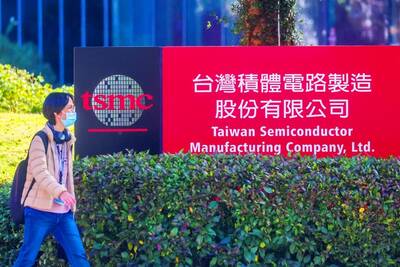
PROJECTION: TSMC said it expects strong growth this year, with revenue in US dollars projected to grow by about 30 percent, outperforming the industry Taiwan Semiconductor Manufacturing Co (TSMC, 台積電) yesterday reported consolidated sales last month reached NT$317.66 billion (US$9.98 billion), the highest ever for the month of February, driven by robust demand for chips built using the company’s advanced 3-nanometer (3nm) process. Last month’s figure was up 22.2 percent from a year earlier, but fell 20.8 percent from January, the world’s largest contract chipmaker said in a statement. For the first two months of the year, TSMC posted cumulative sales of NT$718.91 billion, up 29.9 percent from a year earlier. Analysts attributed the growth to sustained global demand for artificial intelligence (AI) products


 RSS
RSS