


The Ministry of Finance, the largest shareholder in Mega Financial Holding Co (兆豐金控), is to ask the conglomerate to seek compensation from former board directors for losses linked to a compliance failure by a New York banking branch.
The ministry yesterday submitted a report to the Financial Supervisory Commission to help determine where responsibility lies after speaking to former Mega Financial chairman Mckinney Tsai (蔡友才) and other parties a day earlier.
Despite its 20 percent stake in Mega Financial, the ministry cannot do anything except seek compensation to mitigate the fine now that Tsai no longer holds positions in state-run financial institutions, Minister of Finance Sheu Yu-jer (許虞哲) said.
It is up to the commission to decide whether Tsai is guilty of concealing the compliance failure, while law enforcement agencies are responsible for determining whether he should face criminal charges, Sheu said.
It is the first time that Sheu has commented publicly on the issue, nearly one month after the New York State Department of Financial Services fined Mega International Commercial Bank’s (兆豐銀行) New York branch US$180 million over breaches of anti-money-laundering rules.
Local media have asked about Sheu’s involvement, as he served as deputy finance minister for three years before the change in government on May 20, while he and Tsai were university classmates.
“I will not spare anyone found to have done wrong, regardless of personal connections,” Sheu told a media briefing.
The ministry on Monday replaced some Mega Financial board directors after installing Michael Chang (張兆順) as chairman on Sept. 2.
Sheu said that while deputy minister, he had no knowledge of affairs related to state-run financial institutions, because they were the responsibility of another deputy minister.
“All at the ministry can attest to the division of labor at the agency,” Sheu said, adding that he had not commented on the matter earlier because he was hospitalized with an immune-system illness last month.
Sheu said he would step down if the ministry is to blame for the Mega incident, comparing his position to temporary work that could end whenever his supervisor sees fit.
Amid criticism over his communication skills, Sheu said he would not take telephone calls from the media, saying the practice would render the role of Deputy Minister of Finance Su Jain-rong (蘇建榮) — who is also its spokesman — irrelevant.
“There is no need to speak to me on things the deputy minister can address,” Sheu said.
Meanwhile, the ministry is to draft a bill on inheritance and gift tax hikes by the end of this year to finance long-term care subsidies, Sheu said.
He would not comment on reports that the rates would rise from 10 percent to a range between 10 and 20 percent depending on the value of inheritances and gifts.
“It is better to save the discussion until the long-term care bill clears the legislature,” Sheu said.
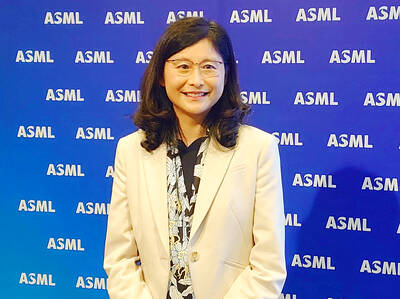
Netherlands-based semiconductor equipment supplier ASML Holding NV yesterday said that it is planning to hire an additional 1,000 people in Taiwan this year in response to growing demand from clients. ASML had previously planned to recruit 600 people this year, but that the plan has been adjusted upward, ASML vice president and ASML Taiwan general manager Grace Wang (汪佳慧) told reporters. ASML has a workforce of more than 4,500 in Taiwan, accounting for about 10 percent of its global total, Wang said. This year’s recruitment campaign would focus on adding people in the customer support, manufacturing and supply chain domains to assist ASML
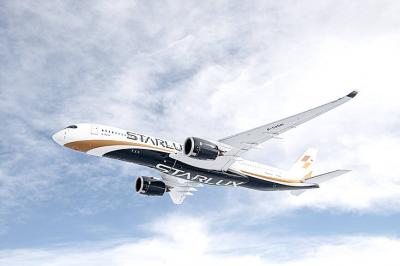
Starlux Airlines Co (星宇航空) today unveiled a long-haul network expansion plan at a shareholders’ meeting in Taipei, including direct flights to Barcelona, Spain, and Zurich, Switzerland, as well as a service connecting Taipei, Sydney and New Zealand. Starlux is to become the first Taiwanese carrier to offer non-stop services to the two European cities, while the inaugural oceanic route is expected to expand transit opportunities within the Australia-New Zealand market, Starlux said. Flight services to Chicago, Dallas, Washington and New York are under evaluation, the airline added. Prior to the shareholders’ meeting, the airline earlier this year announced that it would be

UNDER MICROSCOPE: Taiwan detained three people who allegedly conspired to buy servers in Taiwan and export them using fraudulent documentation, prosecutors said Nvidia Corp chief executive officer Jensen Huang (黃仁勳) on Saturday urged Super Micro Computer Inc to tighten up on compliance after Taiwan detained three people this week for allegedly making fraudulent declarations about artificial intelligence (AI) servers made by its US partner. The development marked the nation’s first crackdown on semiconductor smuggling, which grew after the US slapped restrictions on exports of high-end chips such as Nvidia AI accelerators to China. Nvidia is “rigorous” in explaining regulations to all of its partners, Huang told reporters after arriving in Taipei. “Ultimately Super Micro has to run their own company,” he said in response to
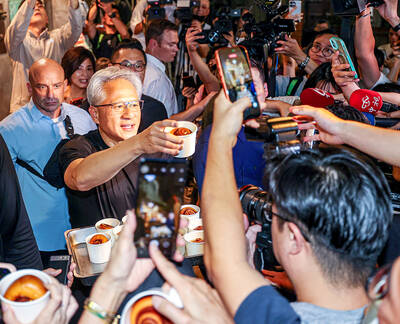
Nvidia Corp yesterday announced that CEO Jensen Huang (黃仁勳) would attend an employee meeting in Taipei tomorrow to celebrate the launch of the company’s Taiwan headquarters project. Huang would attend a gathering at the site of Nvidia’s planned headquarters in Beitou Shilin Technology Park (北投士林科技園區), the company said in a statement. After arriving in Taiwan on Saturday last week, Huang told reporters that he plans to meet with Quanta Computer Inc (廣達) chairman Barry Lam (林百里) and Taiwan Semiconductor Manufacturing Co (TSMC, 台積電) chairman C.C. Wei (魏哲家), and would attend the groundbreaking ceremony for Nvidia’s Taiwan headquarters tomorrow. Nvidia has not yet applied


 RSS
RSS