


Former deputy minister of finance Wu Tang-chieh (吳當傑) yesterday took over as chairman of state-run Hua Nan Financial Holding Co (華南金控), saying he would underscore risk control and legal compliance so the conglomerate can become a top-five player in Taiwan.
Wu, who was appointed as state-owned Land Bank of Taiwan’s (土地銀行) chairman one week after the change in governments on May 20, filled the vacancy left by Shiu Kuang-si (徐光曦).
Shiu was appointed to the helm of Mega Financial Holding Co (兆豐金控) on Aug. 16, but stepped down two weeks later to take responsibility for a failure of compliance by Mega International Commercial Bank’s (兆豐銀行) New York branch that led the New York State Department of Financial Services to impose a fine of US$180 million.
“Corporate governance is my focus and strength after more than three decades of government service in related fields,” Wu said at a handover ceremony.
Wu held several positions at the Ministry of Finance and Financial Supervisory Commission after passing civil servant examinations. He has a bachelor’s degree in taxation and a master’s degree in finance.
The cost of compliance negligence is heavy — as seen in the Mega Bank incident — and Hua Nan Financial will make sure its overseas operations meet the requirements of all local governments, Wu said, adding that retaining foreign legal counsel is expensive.
Wu said he would stand by his predecessor’s ambition to raise Hua Nan’s profit ranking from sixth.
The goal is achievable now that Mega Financial, the most profitable state-run financial service provider, is caught up in judicial and regulatory probes into breaches of money-laundering rules, as well as a management reshuffle.
Under his stewardship, Hua Nan will also support government policies, such as an attempt to help companies upgrade, innovate and reach out to export markets other than China, Wu said.
Main subsidiary Hua Nan Commercial Bank (華南銀行) is recruiting 290 management associates for the rest of this year to bolster its wealth-management business and groom young talent for managerial positions, Hua Nan board director Tommy Lin (林知延) said.
The lender recently issued a joint credit card with Dream Mall (夢時代購物中心), a multifunction shopping complex in Kaohsiung, in the hope of increasing customers in the city, Lin said.
In addition, Hua Nan Bank is to open a branch in Manila by the end of this year to serve Taiwanese firms and their suppliers in the emerging market, Lin said.
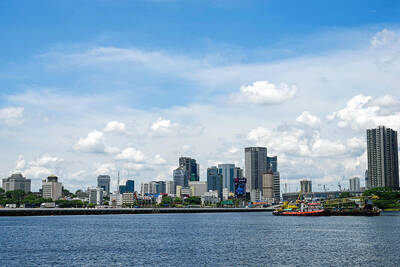
Vincent Wei led fellow Singaporean farmers around an empty Malaysian plot, laying out plans for a greenhouse and rows of leafy vegetables. What he pitched was not just space for crops, but a lifeline for growers struggling to make ends meet in a city-state with high prices and little vacant land. The future agriculture hub is part of a joint special economic zone launched last year by the two neighbors, expected to cost US$123 million and produce 10,000 tonnes of fresh produce annually. It is attracting Singaporean farmers with promises of cheaper land, labor and energy just over the border.

US actor Matthew McConaughey has filed recordings of his image and voice with US patent authorities to protect them from unauthorized usage by artificial intelligence (AI) platforms, a representative said earlier this week. Several video clips and audio recordings were registered by the commercial arm of the Just Keep Livin’ Foundation, a non-profit created by the Oscar-winning actor and his wife, Camila, according to the US Patent and Trademark Office database. Many artists are increasingly concerned about the uncontrolled use of their image via generative AI since the rollout of ChatGPT and other AI-powered tools. Several US states have adopted

A proposed billionaires’ tax in California has ignited a political uproar in Silicon Valley, with tech titans threatening to leave the state while California Governor Gavin Newsom of the Democratic Party maneuvers to defeat a levy that he fears would lead to an exodus of wealth. A technology mecca, California has more billionaires than any other US state — a few hundred, by some estimates. About half its personal income tax revenue, a financial backbone in the nearly US$350 billion budget, comes from the top 1 percent of earners. A large healthcare union is attempting to place a proposal before

KEEPING UP: The acquisition of a cleanroom in Taiwan would enable Micron to increase production in a market where demand continues to outpace supply, a Micron official said Micron Technology Inc has signed a letter of intent to buy a fabrication site in Taiwan from Powerchip Semiconductor Manufacturing Corp (力積電) for US$1.8 billion to expand its production of memory chips. Micron would take control of the P5 site in Miaoli County’s Tongluo Township (銅鑼) and plans to ramp up DRAM production in phases after the transaction closes in the second quarter, the company said in a statement on Saturday. The acquisition includes an existing 12 inch fab cleanroom of 27,871m2 and would further position Micron to address growing global demand for memory solutions, the company said. Micron expects the transaction to


 RSS
RSS