


A key member of South Korea’s Hanjin Group yesterday agreed to a conditional bailout of the group’s shipping unit, whose collapse has sparked turmoil worldwide on the high seas.
The board of group unit Korean Air Lines Co, meeting for the third straight day, decided to lend 60 billion won (US$55 million) to Hanjin Shipping Co, two-thirds of whose cargo fleet is marooned at sea due to huge debts.
“The board members decided to provide the loan but only in exchange for collateral [from Hanjin Shipping],” a company spokeswoman said.
At the two previous meetings on Thursday and Friday, some board members objected to offering the loan and securing collateral afterward, she said.
Hanjin Shipping is seeking bankruptcy protection at home and in the US after creditors rejected its latest plan to deal with a US$5.37 billion debt.
Its bankruptcy would be by far the largest in the history of container shipping, which is suffering its worst downturn in six decades because of slumping global trade and a slowdown in China.
Hanjin Group announced earlier in the week it would inject 100 billion won, including a personal donation of 40 billion won from its chairman and biggest shareholder, Cho Yang-ho, to help the shipping unit.
The remainder would come from Korean Air.
Earlier yesterday, a Hanjin Shipping spokesman said a US court had issued an order allowing it to unload some cargo without fear of creditors seizing its ships.
As of late Friday, 92 of 141 ships being operated by the world’s seventh largest shipping firm were stranded at sea.
They have been banned from docking in the US, China and many other countries until there are guarantees of payment for service firms and port workers.
The freight on the 92 ships is reportedly worth US$14 billion, the Chosun Ilbo reported.
Much of it is destined for US stores before the Thanksgiving and Christmas shopping spree.
Some ships have been seized by its creditors, further complicating the problem.
“The New Jersey bankruptcy court issued a stay order” aimed at protecting some ships from being seized by creditors, Hanjin Shipping spokesman Jang Jin-jong said.
Hanjin posted a net loss of more than 473 billion won in the first half of this year, after racking up total net losses of about 1.2 trillion won over the past three years.
The firm’s previous owner, Cho Su-ho, died in 2006 and his widow, Choi Eun-young, a housewife with little business experience, took the helm.
The firm’s troubles are partly blamed on long-term charters for high fees which she agreed when global shipping was still booming.
At a parliamentary hearing on Friday into the country’s troubled shipbuilding and shipping industries, Choi shed tears and said she “keenly” felt her responsibility.
“I had no expertise, as I had been stuck home as a housewife,” she said.
Choi has been under investigation on charges she was involved in insider dealing — selling off the shares of her and her two daughters before the company sought court receivership last month. She has denied the claims.
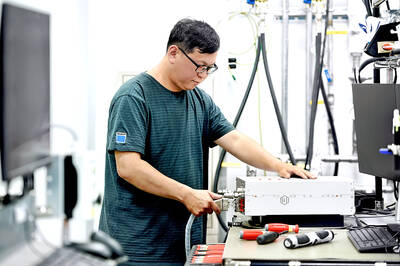
SEMICONDUCTORS: The German laser and plasma generator company will expand its local services as its specialized offerings support Taiwan’s semiconductor industries Trumpf SE + Co KG, a global leader in supplying laser technology and plasma generators used in chip production, is expanding its investments in Taiwan in an effort to deeply integrate into the global semiconductor supply chain in the pursuit of growth. The company, headquartered in Ditzingen, Germany, has invested significantly in a newly inaugurated regional technical center for plasma generators in Taoyuan, its latest expansion in Taiwan after being engaged in various industries for more than 25 years. The center, the first of its kind Trumpf built outside Germany, aims to serve customers from Taiwan, Japan, Southeast Asia and South Korea,
POWERING UP: PSUs for AI servers made up about 50% of Delta’s total server PSU revenue during the first three quarters of last year, the company said Power supply and electronic components maker Delta Electronics Inc (台達電) reported record-high revenue of NT$161.61 billion (US$5.11 billion) for last quarter and said it remains positive about this quarter. Last quarter’s figure was up 7.6 percent from the previous quarter and 41.51 percent higher than a year earlier, and largely in line with Yuanta Securities Investment Consulting Co’s (元大投顧) forecast of NT$160 billion. Delta’s annual revenue last year rose 31.76 percent year-on-year to NT$554.89 billion, also a record high for the company. Its strong performance reflected continued demand for high-performance power solutions and advanced liquid-cooling products used in artificial intelligence (AI) data centers,

Gasoline and diesel prices at domestic fuel stations are to fall NT$0.2 per liter this week, down for a second consecutive week, CPC Corp, Taiwan (台灣中油) and Formosa Petrochemical Corp (台塑石化) announced yesterday. Effective today, gasoline prices at CPC and Formosa stations are to drop to NT$26.4, NT$27.9 and NT$29.9 per liter for 92, 95 and 98-octane unleaded gasoline respectively, the companies said in separate statements. The price of premium diesel is to fall to NT$24.8 per liter at CPC stations and NT$24.6 at Formosa pumps, they said. The price adjustments came even as international crude oil prices rose last week, as traders
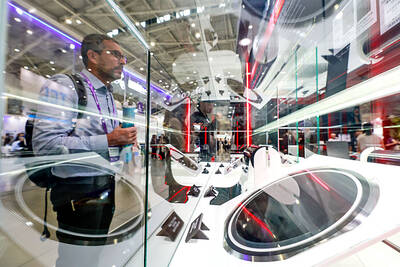
SIZE MATTERS: TSMC started phasing out 8-inch wafer production last year, while Samsung is more aggressively retiring 8-inch capacity, TrendForce said Chipmakers are expected to raise prices of 8-inch wafers by up to 20 percent this year on concern over supply constraints as major contract chipmakers Taiwan Semiconductor Manufacturing Co (TSMC, 台積電) and Samsung Electronics Co gradually retire less advanced wafer capacity, TrendForce Corp (集邦科技) said yesterday. It is the first significant across-the-board price hike since a global semiconductor correction in 2023, the Taipei-based market researcher said in a report. Global 8-inch wafer capacity slid 0.3 percent year-on-year last year, although 8-inch wafer prices still hovered at relatively stable levels throughout the year, TrendForce said. The downward trend is expected to continue this year,


 RSS
RSS