


The nation’s consumer price index (CPI) rose 0.57 percent year-on-year last month, its slowest annual gain this year, although fruit prices rose more than 20 percent due to continued supply disruptions, the Directorate-General of Budget, Accounting and Statistics said yesterday.
Despite benign inflation levels, the central bank might stop interest rate cuts later this month, as the economy remains on course to sluggish recovery this quarter after returning to positive territory last quarter, economists said.
Food costs, which account for 25 percent of CPI readings, gained 2.61 percent year-on-year last month, pushed up mainly by a steep hike in fruit prices, the agency said in a report.
Fruit prices gained 23.02 percent, as unstable weather disrupted supplies, agency Deputy Director Tsai Yu-tai (蔡鈺泰) told a news conference.
Prices of fishery products increased 5.33 percent and meat rose 0.57 percent, more than balancing out a 3.92 percent decline in vegetable prices, the report said.
Living costs dropped 0.8 percent, as gas and electricity prices fell by 15.68 and 11.68 percent respectively, while water charges picked up 3.68 percent, the report said.
Oil prices declined 4.3 percent, dragging transportation and communication costs down 0.61 percent, the report said.
The inflationary gauge after seasonal adjustments fell 0.23 percent from the previous month, suggesting stagnant consumer prices.
Core CPI — a more reliable indicator of long-term CPI movements, as it excludes volatile items — increased 0.77 percent, almost unchanged from a revised 0.79 percent rise in July, the report said, affirming stable inflation.
The mild CPI figure should give the central bank room for further monetary easing without worrying about inflation, but the monetary policymaker might opt to stay put this time around, Mega Securities Co (兆豐證券) economist Lucas Lee (李志安) said.
The central bank has cut interest rates a total of 50 basis points over the past year.
“Although slow, the recovery appears to be sustainable with the arrival of high sales season for technology products and other sectors, rendering further rate cuts unnecessary,” Lee said by telephone.
It is too early to entertain the thought of rate hikes, as the growth has more to do with a low base last year than a solid recovery in external demand, Lee said.
The wholesale price index (WPI) — a measure of production costs — fell 4.1 percent last month from a year earlier, widening from a revised 2.53 percent decline in July, the report said.
Excluding foreign exchange volatility, export prices weakened 3.09 percent from a year earlier, meaning exports last month needed a larger year-on-year increase to stay in positive territory.
The Ministry of Finance is to unveil last month’s export data today.
In the first eight months of the year, WPI shrank 3.93 percent from a year earlier, the report said.

NEW IMPORTS: Car dealer PG Union Corp said it would consider introducing US-made models such as the Jeep Grand Cherokee and Stellantis’ RAM 1500 to Taiwan Tesla Taiwan yesterday said that it does not plan to cut its car prices in the wake of Washington and Taipei signing the Agreement on Reciprocal Trade on Thursday to eliminate tariffs on US-made cars. On the other hand, Mercedes-Benz Taiwan said it is planning to lower the price of its five models imported from the US after the zero tariff comes into effect. Tesla in a statement said it has no plan to adjust the prices of the US-made Model 3, Model S and Model X as tariffs are not the only factor the automaker uses to determine pricing policies. Tesla said

OpenAI has warned US lawmakers that its Chinese rival DeepSeek (深度求索) is using unfair and increasingly sophisticated methods to extract results from leading US artificial intelligence (AI) models to train the next generation of its breakthrough R1 chatbot, a memo reviewed by Bloomberg News showed. In the memo, sent on Thursday to the US House of Representatives Select Committee on China, OpenAI said that DeepSeek had used so-called distillation techniques as part of “ongoing efforts to free-ride on the capabilities developed by OpenAI and other US frontier labs.” The company said it had detected “new, obfuscated methods” designed to evade OpenAI’s defenses
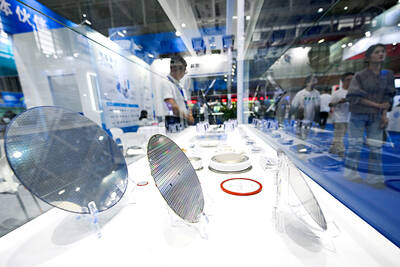
China’s top chipmaker has warned that breakaway spending on artificial intelligence (AI) chips is bringing forward years of future demand, raising the risk that some data centers could sit idle. “Companies would love to build 10 years’ worth of data center capacity within one or two years,” Semiconductor Manufacturing International Corp (SMIC, 中芯) cochief executive officer Zhao Haijun (趙海軍) said yesterday on a call with analysts. “As for what exactly these data centers will do, that hasn’t been fully thought through.” Moody’s Ratings projects that AI-related infrastructure investment would exceed US$3 trillion over the next five years, as developers pour eye-watering sums

Bank of America Corp nearly doubled its forecast for the nation’s economic growth this year, adding to a slew of upgrades even after a rip-roaring last year propelled by demand for artificial intelligence (AI). The firm lifted its projection to 8 percent from 4.5 percent on “relentless global demand” for the hardware that Taiwanese companies make, according to a note dated yesterday by analysts including Xiaoqing Pi (皮曉青). Taiwan’s GDP expanded 8.63 percent last year, the fastest pace since 2010. The increase “reflects our sustained optimism over Taiwan’s technology driven expansion and is reinforced by several recent developments,” including a more stable currency,


 RSS
RSS