


The Securities and Futures Investors Protection Center has seized Japanese company Bai Chi Gan Tou Digital Entertainment Co’s (百尺竿頭) assets in Taiwan, as part of its efforts to protect investors’ interests, the Financial Supervisory Commission (FSC) said yesterday.
“We have the Japanese company’s assets in hand. We will not let investors lose their life savings over this incident,” FSC Chairman Ding Kung-wha (丁克華) told reporters on the sidelines of a forum in Taipei.
Ding’s comments came after shares of game developer XPEC Entertainment Inc (樂陞科技) yesterday plunged by the 10 percent daily limit for the fifth consecutive trading session, after Bai Chi on Tuesday last week abandoned its planned acquisition of a 25.7 percent stake in XPEC that was worth NT$4.68 billion (US$148.99 million), or 38 million shares at NT$128 per share.
XPEC’s stock closed at NT$46.2 per share, the lowest price since July 10, 2012, data compiled by the Taipei Exchange show.
A total of 3.44 million XPEC shares were traded on the Taipei Exchange, with sell orders on 14.41 million shares awaiting execution in the next session.
Ding said the seized assets include Bai Chi representative Yoshiaki Kashino’s 14.1 percent stake in XPEC Entertainment Inc, which was worth NT$984 million based on XPEC’s closing price yesterday.
XPEC shareholders can inform the Securities and Futures Investors Protection Center about their purchases of XPEC shares, and the center will demand compensation on their behalf, Ding said.
Ding said the commission had also referred the case to the Taipei District Court over Bai Chi’s alleged violations of the Securities and Exchange Act (證券交易法).
He said he believes XPEC chairman Aaron Hsu (許金龍) will “definitely” return to Taiwan from Japan to handle the matter “for his own sake.”
Hsu went to Japan on Wednesday last week, a day after the deal fell apart, and has not returned to Taiwan since, sparking the ire of shareholders, who say he has abandoned them.
Hsu was quoted in Chinese-language newspaper the Commercial Times as saying that he is still in Japan and plans to visit Shanghai to seek financial support.
Hsu said he will “definitely” come back to Taiwan some time this week to solve the company’s crisis.
In related news, in a filing with the Taiwan Stock Exchange yesterday, XPEC said that one of its independent board directors, Sisy Chen (陳文茜), has resigned.
Citing Chen’s resignation letter, XPEC said she would not have enough time to continue supervising the company as an independent board director, because business trips will take her out of Taiwan.


Taiwan’s foreign exchange reserves fell below the US$600 billion mark at the end of last month, with the central bank reporting a total of US$596.89 billion — a decline of US$8.6 billion from February — ending a three-month streak of increases. The central bank attributed the drop to a combination of factors such as outflows by foreign institutional investors, currency fluctuations and its own market interventions. “The large-scale outflows disrupted the balance of supply and demand in the foreign exchange market, prompting the central bank to intervene repeatedly by selling US dollars to stabilize the local currency,” Department of Foreign

Intel Corp is joining Elon Musk’s long-shot effort to develop semiconductors for Tesla Inc, Space Exploration Technologies Corp and xAI, marking a surprising twist in the chipmaker’s comeback bid. Intel would help the Terafab project “refactor” the technology in a chip factory, the company said on Tuesday in a post on X, Musk’s social media platform. That is a stage in the development process that typically helps make chips more powerful or reliable. The chipmaker’s shares jumped 4.2 percent to US$52.91 in New York trading on Tuesday. The Terafab project is a grand plan by Musk to eventually manufacture his own chips for
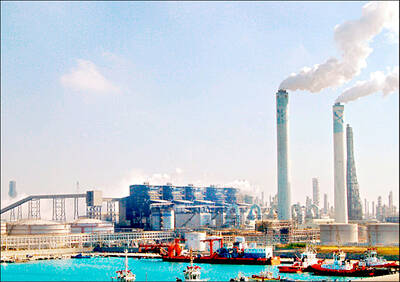
Taiwan Power Co (Taipower, 台電) yesterday said it plans to resume operations at two coal-fired power generators for three months to boost security of electricity supply as liquefied natural gas (LNG) supply risks are running high due to the Middle East conflict. The two coal-fired power generators are at Mailiao Power Plant in Yunlin County’s Mailiao Township (麥寮). The plant, operated by Formosa Plastics Group (台塑集團), supplied electricity to Taipower’s power grid until the end of last year. Taipower’s decision came about one month after Minister of Economic Affairs Kung Ming-hsin (龔明鑫) on March 10 said that the nation had no imminent

Some robotaxi passengers were left stranded in the middle of fast-moving traffic in a major Chinese city after their driverless vehicles stopped running, according to police and media reports on Wednesday. A preliminary investigation indicates more than 100 robotaxis came to a halt because of a “system malfunction,” police in the city of Wuhan said in a statement, without elaborating. No injuries were reported. One passenger told Chinese media that their robotaxi stopped after turning a corner. An instruction on a screen read: “Driving system malfunction. Staff are expected to arrive in 5 minutes.” After no one showed up, the passenger pushed


 RSS
RSS