


Pegatron Corp’s (和碩) performance in the second half of this year is expected to grow from the first half on the back of clients’ planned product launches and a relatively low base in the first six months, a company executive said yesterday.
“The operations in the second half of this year will be much better than the first half, but the scale of the growth would become clearer in the next one or two months,” Pegatron chief executive officer Jason Cheng (程建中) told reporters after the firm’s annual shareholders’ meeting in Taipei.
Pegatron’s revenue depends largely on its smartphone assembling business, with the firm’s communications segment contributing as much as 61 percent of its total revenue in the first quarter of this year.
Pegatron, a major assembler of Apple Inc’s iPhones, saw combined revenue contract 8.15 percent year-on-year to NT$388.15 billion (US$12.03 billion) in the first five months, mainly due to sluggish iPhone 6S sales.
Cheng said that overall demand in the first half was weaker than in the past few years, but the size of the decline is still within company estimates.
He said that demand in the second half will be driven by a wide range of product launches by Pegatron’s clients from different segments, including orders for Pegatron’s game consoles with rising demand for virtual reality (VR) applications.
“Our goal is to maintain annual revenue of more than NT$1 trillion this year,” Cheng said, declining to say whether Pegatron’s revenue would decline from last year’s record-high of NT$1.21 trillion.
Cheng said Pegatron has been adjusting its resources and organization since last year, increasing investments in new areas — such as automotive electronics and Internet-of-Things (IoT) applications — as part of Pegatron’s long-term strategy to diversify its operations.
The company is also to invest in developments in robotics, especially for industrial robots used in manufacturing because of the climbing demand for industrial automation and intellectualization, Cheng said.
Cheng said that the company is evaluating the feasibility of setting up a manufacturing plant in India, with original design manufacturer (ODM) peers Hon Hai Precision Industry Co (鴻海精密), Inventec Corp (英業達), Wistron Corp (緯創) and Compal Electronics Co (仁寶) all having stepped into the Indian market.
Pegatron chief operating officer S.J. Liao (廖賜政) said the company is also considering regulations and infrastructure in India and personnel to manage India-based workers before making a final decision of whether to enter the market.
Pegatron shareholders yesterday approved the company’s proposal to distribute a cash dividend of NT$5 per common share based on the company’s net income of NT$23.81 billion, or NT$9.23 per share, last year.
That represents a payout ratio of 54.17 percent and suggests a yield of 7.14 percent based on the company’s closing price of NT$70 in Taipei trading yesterday.
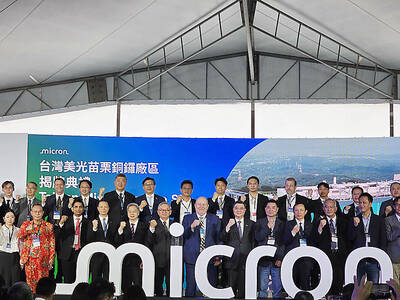
UNPRECEDENTED PACE: Micron Technology has announced plans to expand manufacturing capabilities with the acquisition of a new chip plant in Miaoli Micron Technology Inc unveiled a newly acquired chip plant in Miaoli County yesterday, as the company expands capacity to meet growing demand for advanced DRAM chips, including high-bandwidth memory chips amid the artificial intelligence boom. The plant in Miaoli County’s Tongluo Township (銅鑼), which Micron acquired from Powerchip Semiconductor Manufacturing Corp (力積電) for US$1.8 billion, is expected to make a sizeable capacity contribution to the company from fiscal 2028, the company said in a statement. It would be an extended production site of Micron’s large-scale manufacturing hub in Taichung, the company said. As the global semiconductor industry is racing to reach US$1 trillion

A man walks past real-estate advertisements outside a house in Taipei yesterday. The central bank yesterday said it plans to establish an “Inflation-at-Risk” gauge as a supplementary tool for observing inflation, as policymakers express wish to communicate more effectively with the public when making inflation forecasts.
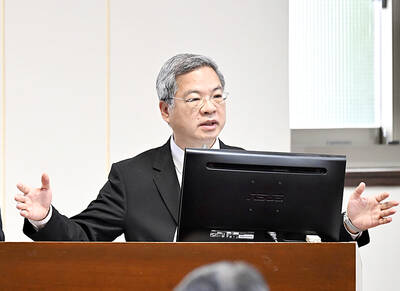
ABOVE LEGAL REQUIREMENT: The Ministry of Economic Affairs is prepared if LNG supply is disrupted, with more than the legal requirement of 11 days of inventory Taiwan has largely secured liquefied natural gas (LNG) supplies through May and arranged about half of June’s supply, Minister of Economic Affairs Kung Ming-hsin (龔明鑫) said yesterday. Since the Middle East conflict began on Feb. 28, Taiwan’s LNG inventories have remained more than 12 days, exceeding the legal requirement of 11 days, indicating no major supply concerns for domestic gas and electricity, Kung said at a meeting of the legislature’s Economics Committee in Taipei. The ministry aims to increase the figure to 14 days by the end of next year, he said. While one or two LNG or crude oil shipments for May

Memory chip stocks extended their losses yesterday after Alphabet Inc’s Google publicized research that could allow more efficient use of the storage needed for artificial intelligence (AI) development. SK Hynix Inc and Samsung Electronics Co, South Korean leaders in the market, fell more than 6 percent and about 5 percent respectively in Seoul. In the US, Micron Technology Inc, Western Digital Corp and Sandisk Corp slid more than 2 percent in pre-market trading, after they all closed lower on Wednesday. Memory companies have been on a tear in recent months as the rapid development of AI infrastructure triggered a spike in chip


 RSS
RSS