


Prices of solar cells last week continued to spiral to approach cost-level and the decline is expected to accelerate due to a supply glut, TrendForce Corp (集邦科技) said.
TrendForce attributed the slump to sagging demand amid uncertainty about Beijing’s new “green” energy policy and subsidy measures, the Taipei-based researcher said in a statement released on Tuesday last week.
Demand from the US and Europe are likely to be lukewarm as no new subsidy programs are available to drive solar system installations, the researcher said.
Solar power companies are expected to take a wait-and-see approach to placing new orders for next quarter, given the current price downtrend, it said.
As a result, TrendForce analyst Corrin Lin (林嫣容) expects “photovoltaics manufacturers in China and Taiwan to see sharp drops in incoming orders in late June,” according to the statement.
In the wake of aggressive capacity expansions in the first half of this year, solar companies are likely to be under pressure to cut prices to digest new capacities in the third quarter, TrendForce said.
The price of multisilicone solar cells produced by Taiwanese manufacturers fell on Wednesday to US$0.293 per watt, while prices of high-efficiency multisilicone solar cells dropped to US$0.295 per watt, according to the latest price information from TrendForce.
Taiwanese and Chinese manufactures have “no leeway to cut prices further,” Lin said.
Drastic price declines are squeezing gross margins to “nearly zero,” the researcher said.
Downward solar prices are expected to extend into the second half because of an oversupply, according to TrendForce.
Overall this year, global solar cell capacities are expected to grow by between 13 gigawatts and 15 gigawatts annually, greatly outpacing market demand of a mere 4 gigawatts year-on-year increase, TrendForce predicted.
As market demand slows, solar companies are likely “to face great challenges during the slowdown this year and next year,” TrendForce said.
The nation’s major solar cellmakers, Neo Solar Power Corp (新日光) and Gintech Energy Corp (昱晶), reported 9.94 percent and 4.9 percent sequential growth in revenue last month to NT$1.7 billion and NT$1.63 billion, (US$52.75 million and US$50.5 million) respectively, thanks to higher shipments.
Despite concerns over a potential slowdown in the Chinese market next quarter, Gintech said it was confident about market demand and would continue to run equipment at 100 percent to cope with seasonal demand in markets beyond China during the second half of this year.
Neo Solar is also pinning its hopes on seasonal demand to propel its growth next quarter. The company expected production lines in Malaysia to begin operations by the end of next quarter, which would help the firm tackle rising customer demand.
Neo Solar shares sank 1.14 percent to NT$17.3 on Wednesday, while Gitench shares were unchanged at NT$23.7.
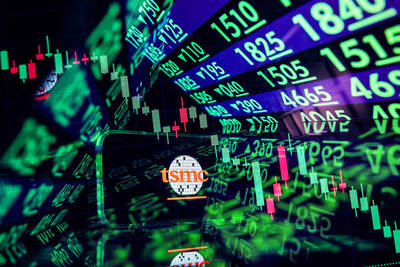
Taiwan Semiconductor Manufacturing Co (TSMC, 台積電) last week recorded an increase in the number of shareholders to the highest in almost eight months, despite its share price falling 3.38 percent from the previous week, Taiwan Stock Exchange data released on Saturday showed. As of Friday, TSMC had 1.88 million shareholders, the most since the week of April 25 and an increase of 31,870 from the previous week, the data showed. The number of shareholders jumped despite a drop of NT$50 (US$1.59), or 3.38 percent, in TSMC’s share price from a week earlier to NT$1,430, as investors took profits from their earlier gains

In a high-security Shenzhen laboratory, Chinese scientists have built what Washington has spent years trying to prevent: a prototype of a machine capable of producing the cutting-edge semiconductor chips that power artificial intelligence (AI), smartphones and weapons central to Western military dominance, Reuters has learned. Completed early this year and undergoing testing, the prototype fills nearly an entire factory floor. It was built by a team of former engineers from Dutch semiconductor giant ASML who reverse-engineered the company’s extreme ultraviolet lithography (EUV) machines, according to two people with knowledge of the project. EUV machines sit at the heart of a technological Cold
Taiwan’s long-term economic competitiveness will hinge not only on national champions like Taiwan Semiconductor Manufacturing Co. (TSMC, 台積電) but also on the widespread adoption of artificial intelligence (AI) and other emerging technologies, a US-based scholar has said. At a lecture in Taipei on Tuesday, Jeffrey Ding, assistant professor of political science at the George Washington University and author of "Technology and the Rise of Great Powers," argued that historical experience shows that general-purpose technologies (GPTs) — such as electricity, computers and now AI — shape long-term economic advantages through their diffusion across the broader economy. "What really matters is not who pioneers
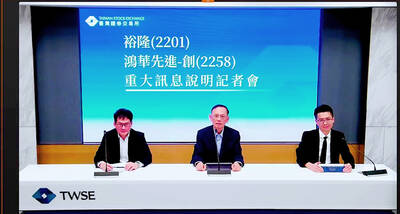
TAIWAN VALUE CHAIN: Foxtron is to fully own Luxgen following the transaction and it plans to launch a new electric model, the Foxtron Bria, in Taiwan next year Yulon Motor Co (裕隆汽車) yesterday said that its board of directors approved the disposal of its electric vehicle (EV) unit, Luxgen Motor Co (納智捷汽車), to Foxtron Vehicle Technologies Co (鴻華先進) for NT$787.6 million (US$24.98 million). Foxtron, a half-half joint venture between Yulon affiliate Hua-Chuang Automobile Information Technical Center Co (華創車電) and Hon Hai Precision Industry Co (鴻海精密), expects to wrap up the deal in the first quarter of next year. Foxtron would fully own Luxgen following the transaction, including five car distributing companies, outlets and all employees. The deal is subject to the approval of the Fair Trade Commission, Foxtron said. “Foxtron will be


 RSS
RSS