


US Federal Reserve Chair Janet Yellen on Monday said that the US economy is improving, but remains defined by so many uncertainties that it is unclear when the Fed should resume raising interest rates.
Speaking in Philadelphia, Yellen struck a broadly positive and optimistic tone about the economy.
She said that the job market had strengthened significantly since the Great Recession and said that consumer spending and economic growth seem likely to accelerate after a tepid start to this year.
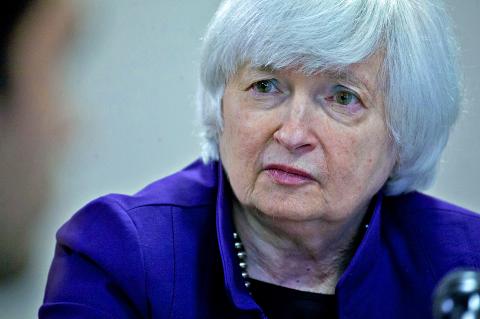
Photo: Bloomberg
However, the Fed chair suggested that a dismal jobs report that the government issued on Friday last week raised some doubts about the broader economy.
She referred repeatedly to the uncertainties surrounding the Fed’s outlook.
In doing so, Yellen dropped a reference she had made in a speech on May 27 that a Fed rate hike would likely be appropriate “in the coming months.”
In its place, she offered no specific timetable for the Fed to act.
Yellen’s speech had been highly anticipated given that it comes a week before the central bank’s next meeting. Until last week, many analysts had thought the Fed could raise rates on Wednesday next week — or, if not then, at its subsequent meeting in late July. The bleak jobs report for lat month, and Yellen’s speech on Monday, seemed to fan doubts about any Fed rate hike this summer.
“She did not address the timing of the Fed’s next gradual move, which suggests to us that she is in no hurry,” said Chris Rupkey, chief financial economist at MUFG Union Bank in New York. “We are telling clients to take the summer off. See all of you Fed watchers in September.”
Investors sent stock prices up, reflecting a belief that a rate hike this month is now even less likely than it had seemed after Friday’s weak jobs report and that borrowing rates will remain ultra-low. The Dow Jones industrial average closed up 113 points.
In her speech, Yellen called the employment report “disappointing,” but cautioned that it would be wrong to put too much stock in a single monthly report.
Without referring to any particular date, Yellen said: “I continue to believe that it will be appropriate to gradually reduce the degree of monetary policy accommodation, provided that labor market conditions strengthen further and inflation continues to make progress toward our 2 percent objective.”
Inflation, by the Fed’s measure, has remained persistently below its 2 percent target.
Given the uncertainty facing the economy, Yellen said, the Fed cannot move on “a preset path.”
“For a time in January and early February, financial markets here and broad became turbulent and financial conditions tightened, reflecting and reinforcing concerns about downside risks to the global economy,” Yellen said.
She said that as a result, Fed officials felt “it would be prudent” to keep rates unchanged at meetings in January, March and April.
Part of the uncertainty, she said, reflects continued foreign threats, including economic challenges in China and an upcoming vote in Britain over whether to leave the EU.
In a question-and-answer session with the World Affairs Council of Philadelphia that followed her speech, Yellen was asked about fears that the world economy could be headed for a crash if Donald Trump, the presumptive Republican presidential nominee, were to win the White House.
“I’m sorry — I have got nothing for you on that,” Yellen said to laughter from the audience. “We are very focused on doing our jobs. We will just see what happens.”
Employers added just 38,000 jobs last month, the weakest monthly gain in more than five years. Job gains have averaged just 116,000 in the past three months, down sharply from an average of 230,000 in the 12 months ending in April.

NEW IMPORTS: Car dealer PG Union Corp said it would consider introducing US-made models such as the Jeep Grand Cherokee and Stellantis’ RAM 1500 to Taiwan Tesla Taiwan yesterday said that it does not plan to cut its car prices in the wake of Washington and Taipei signing the Agreement on Reciprocal Trade on Thursday to eliminate tariffs on US-made cars. On the other hand, Mercedes-Benz Taiwan said it is planning to lower the price of its five models imported from the US after the zero tariff comes into effect. Tesla in a statement said it has no plan to adjust the prices of the US-made Model 3, Model S and Model X as tariffs are not the only factor the automaker uses to determine pricing policies. Tesla said

OpenAI has warned US lawmakers that its Chinese rival DeepSeek (深度求索) is using unfair and increasingly sophisticated methods to extract results from leading US artificial intelligence (AI) models to train the next generation of its breakthrough R1 chatbot, a memo reviewed by Bloomberg News showed. In the memo, sent on Thursday to the US House of Representatives Select Committee on China, OpenAI said that DeepSeek had used so-called distillation techniques as part of “ongoing efforts to free-ride on the capabilities developed by OpenAI and other US frontier labs.” The company said it had detected “new, obfuscated methods” designed to evade OpenAI’s defenses
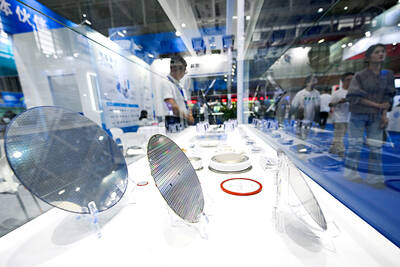
China’s top chipmaker has warned that breakaway spending on artificial intelligence (AI) chips is bringing forward years of future demand, raising the risk that some data centers could sit idle. “Companies would love to build 10 years’ worth of data center capacity within one or two years,” Semiconductor Manufacturing International Corp (SMIC, 中芯) cochief executive officer Zhao Haijun (趙海軍) said yesterday on a call with analysts. “As for what exactly these data centers will do, that hasn’t been fully thought through.” Moody’s Ratings projects that AI-related infrastructure investment would exceed US$3 trillion over the next five years, as developers pour eye-watering sums
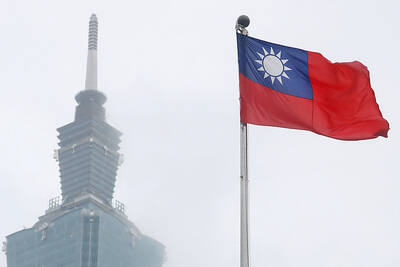
Bank of America Corp nearly doubled its forecast for the nation’s economic growth this year, adding to a slew of upgrades even after a rip-roaring last year propelled by demand for artificial intelligence (AI). The firm lifted its projection to 8 percent from 4.5 percent on “relentless global demand” for the hardware that Taiwanese companies make, according to a note dated yesterday by analysts including Xiaoqing Pi (皮曉青). Taiwan’s GDP expanded 8.63 percent last year, the fastest pace since 2010. The increase “reflects our sustained optimism over Taiwan’s technology driven expansion and is reinforced by several recent developments,” including a more stable currency,


 RSS
RSS