


China National Chemical Corp’s (ChemChina, 中國化工) US$43 billion deal to buy Syngenta AG is dividing credit rating agencies on whether the company’s acquisition spree would load it with too much debt.
State-backed ChemChina is borrowing US$50 billion for the purchase that would make it the world’s largest supplier of agricultural chemicals, people familiar with the matter said.
The Beijing-based company’s debt-to-equity ratio was 260 percent on Sept. 30 last year, more than four times the average of 61 percent for global agricultural chemical producers, data compiled by Bloomberg showed.
“The Syngenta acquisition will lead to higher debt loads, which will have a negative impact on ChemChina’s financial health,” Moody’s Investors Service senior analyst Zou Jiming (鄒吉明) said in Shanghai. “The government support would mitigate, but likely not fully offset the standalone risk of higher leverage after the Syngenta acquisition.”
The announcement of the deal divided assessors, with Moody’s placing ChemChina subsidiary China National BlueStar Group Co (中國藍星集團) under review for a downgrade, while Fitch Ratings Inc put it on positive watch.
The split comes amid concern state-owned enterprises are accumulating too much debt.
“ChemChina’s leverage might increase, primarily depending on the final funding structure, but we believe the acquisition of Syngenta would raise ChemChina’s overall strategic importance to the Chinese agriculture and food industry, as Syngenta is the world’s third-largest seed company and one of the four dominant producers of genetically modified seeds,” Fitch Shanghai-based analyst Stella Wang (王曉穎) said. “This would strengthen the linkages between ChemChina and the Chinese government.”
The government would probably support the acquisition due to ChemChina’s “high-leverage position” and the strategic importance of agriculture, Wang said.
Enhancing crop yields is crucial, as the nation has more than 20 percent of the world’s population with less than 10 percent of its arable land, Fitch wrote in a statement last month.
Yields are now more than 40 percent lower than those of most Western nations, the statement said.
ChemChina has announced US$47.3 billion of acquisitions this year, including pending takeovers, a jump from US$8.9 billion last year and US$1.4 billion in 2014.
Chinese companies have announced US$72.6 billion of offshore acquisitions valued at US$1 billion or more this year, compared with US$73.6 billion in all of last year, as a slump in exports fuels yuan depreciation expectations.
The yuan has weakened 3.6 percent against the US dollar over the past year.
“ChemChina’s standalone weak financials show it doesn’t have the capacity for the Syngenta deal,” Standard & Poor’s Financial Services LLC Hong Kong-based analyst Lawrence Lu (盧文正) said. “It is likely to get government support for the Syngenta transaction, because the agriculture sector is one of the most important in China.”
ChemChina’s debt was about 9.5 times its earnings before interest, tax, depreciation and amortization in 2014, while the average of its global peers was only 2.3, according to data compiled by Bloomberg.
It had total debt of 156.5 billion yuan (US$24.1 billion) on Sept. 30 last year, exceeding cash and cash equivalents of 29.8 billion yuan, Bloomberg data showed.
ChemChina bought or invested in assets in Italy, France, Norway, Britain and Singapore in the past few years, including tiremaker Pirelli & C SpA.
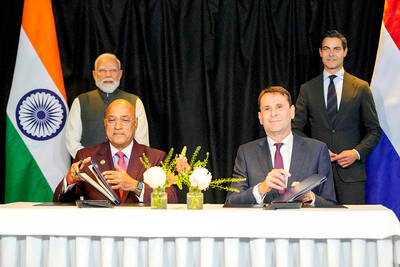
NEW MARKET: The partnership opens up India to the Dutch company, which already has a strong hold in the semiconductor market of South Korea, Taiwan and China ASML Holding NV entered into a partnership agreement with Tata Electronics Pvt Ltd aimed at ramping up India’s goal to develop domestic chip-manufacturing capabilities. The Dutch company’s technology would help power Tata Electronics’ planned 300 millimeter (mm) semiconductor foundry in Gujarat, according to a joint statement from the two companies on Saturday. The signing of a memorandum of understanding coincides with a visit by Indian Prime Minister Narendra Modi to the Netherlands, which is looking to deepen bilateral relations with New Delhi. ASML, whose top customers include Taiwan Semiconductor Manufacturing Co (台積電) and Samsung Electronics Co, makes lithography machines that can print

Tokyo Electron's Taiwan unit today said in a written response that it respects the judicial process, takes the court ruling seriously and would not appeal in the Taiwan Semiconductor Manufacturing Co (TSMC, 台積電) trade secrets case. Last month, a court fined the Taiwan unit of Japan's Tokyo Electron NT$150 million (US$4.74 million) in a case involving trade secrets related to TSMC's sensitive chip technology.
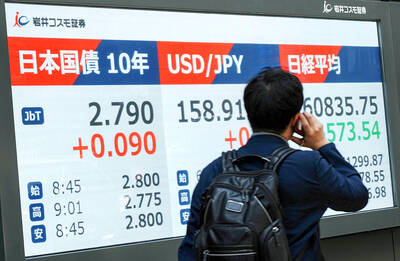
ROUGH RECORDS: Bonds in Japan, as well is in New Zealand, Australia and the US, are seeing the effects of a nervy market as stock exchanges across Asia edge down A deepening slump in Japanese government bonds added fuel to the selloff in global debt markets as rising oil prices stoked inflation fears and pushed yields to multi-decade highs. Japan’s 30-year yield yesterday surged as much as 20 basis points to the highest level since the tenor’s debut in 1999, before paring some of the move. Shorter-maturity Japanese debt was also under pressure, underscored by weak demand at a sale of five-year notes that offered a record-high coupon of 2 percent. Concerns over inflation and government spending rippling through markets including the US, Australia and New Zealand are being amplified in Japan,
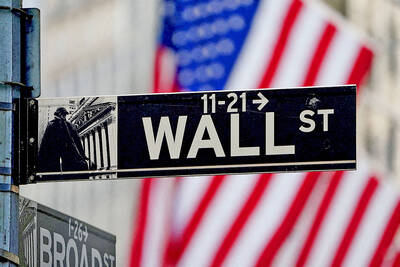
Wall Street is licking its chops over an unprecedented slate of massive initial public offerings (IPOs) set to arrive in the coming months, beginning with Elon Musk’s Space Exploration Technologies Corp (SpaceX) next month. That is expected to be followed by artificial intelligence (AI) rivals OpenAI and Anthropic PBC. The trio of mega listings, each eyeing valuations around US$1 trillion or more, constitutes a heady period of elevated risk and reward. SpaceX is targeting an IPO that would raise up to US$80 billion — about double the funds generated from all IPOs last year. OpenAI and Anthropic are eyeing IPOs raising US$60 billion. “We’re


 RSS
RSS