


The official purchasing managers’ index (PMI) dropped to 48.6 last month from 50.8 in June, suggesting a contraction for the local manufacturing industry due to soft demand from markets abroad, the monthly survey by the Chung-Hua Institution for Economic Research (CIER, 中華經濟研究院) showed yesterday.
The Nikkei Taiwan Manufacturing Purchasing Managers’ Index came to a similar conclusion of operating conditions further deteriorating across the sector.
“The slowdown trend is evident and solid, even though we do not like it,” CIER president Wu Chung-shu (吳中書) told a news conference.
The PMI last month was the lowest since February’s 47.8, ending four consecutive months of increase and bucking expectations of inventory-building into the second half.
A PMI score of less than 50 indicates business contraction, while values above the neutral mark suggest expansion. The Nikkei reading already signaled a fourth consecutive month of deterioration.
The critical subindex on new orders fell to 44.4 percent last month, the lowest since November 2012, as firms in the electronics and food production sectors reported business increases, while all others saw shrinking orders, the CIER report said.
Likewise, the new export subindex retreated to 41.2, with firms in all sectors recording negative cyclical movements, the report said.
Consequently, companies tempered output, pushing down the production subindex to 48.9, the CIER said.
The global slowdown bodes ominously for Taiwan, as exports drive more than 70 percent of its growth, Wu said.
There is little the nation can do to reverse weakening external demand, the academic said, although the government has encouraged local manufacturers to upgrade to cope with growing competition from rivals.
However, the employment subindex gained another 0.9 points to 52.9, the report said, consistent with expectations of business improvement ahead of the high sales season.
The head count increase was at variance with a dim view about business outlooks, the CIER report said.
Companies in all industries expect business to cool in the coming six months, driving the outlook subindex to 42.6, the weakest since December 2012 and 10.5 points lower from June, the report said.
Annabel Fiddes, an economist at Markit Ltd, which compiles the Nikkei figure, said the global economy remains a downside risk given the disappointing start to the third quarter.
Taiwanese manufacturers reported softer demand from clients in China, Europe and the US, Fiddes said.
In a related development, the non-manufacturing index gained 1.6 points to 52.1 last month, suggesting that firms in service sectors fared better than the manufacturing industry, the CIER said in a separate report.
Summer is a high sales season for restaurants and hotels, but traditionally brings slow sales for wholesalers, retailers, real-estate developers and property brokers, it said.
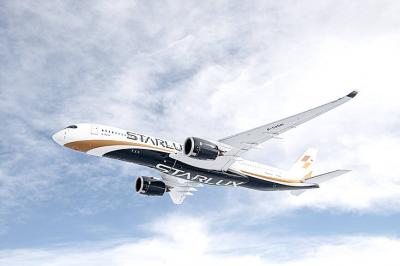
Starlux Airlines Co (星宇航空) today unveiled a long-haul network expansion plan at a shareholders’ meeting in Taipei, including direct flights to Barcelona, Spain, and Zurich, Switzerland, as well as a service connecting Taipei, Sydney and New Zealand. Starlux is to become the first Taiwanese carrier to offer non-stop services to the two European cities, while the inaugural oceanic route is expected to expand transit opportunities within the Australia-New Zealand market, Starlux said. Flight services to Chicago, Dallas, Washington and New York are under evaluation, the airline added. Prior to the shareholders’ meeting, the airline earlier this year announced that it would be
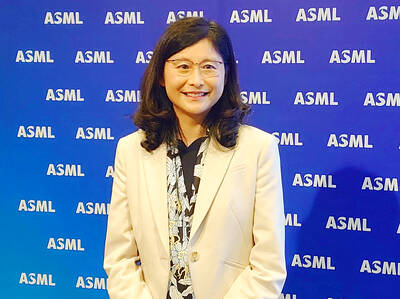
Netherlands-based semiconductor equipment supplier ASML Holding NV yesterday said that it is planning to hire an additional 1,000 people in Taiwan this year in response to growing demand from clients. ASML had previously planned to recruit 600 people this year, but that the plan has been adjusted upward, ASML vice president and ASML Taiwan general manager Grace Wang (汪佳慧) told reporters. ASML has a workforce of more than 4,500 in Taiwan, accounting for about 10 percent of its global total, Wang said. This year’s recruitment campaign would focus on adding people in the customer support, manufacturing and supply chain domains to assist ASML

UNDER MICROSCOPE: Taiwan detained three people who allegedly conspired to buy servers in Taiwan and export them using fraudulent documentation, prosecutors said Nvidia Corp chief executive officer Jensen Huang (黃仁勳) on Saturday urged Super Micro Computer Inc to tighten up on compliance after Taiwan detained three people this week for allegedly making fraudulent declarations about artificial intelligence (AI) servers made by its US partner. The development marked the nation’s first crackdown on semiconductor smuggling, which grew after the US slapped restrictions on exports of high-end chips such as Nvidia AI accelerators to China. Nvidia is “rigorous” in explaining regulations to all of its partners, Huang told reporters after arriving in Taipei. “Ultimately Super Micro has to run their own company,” he said in response to

Nvidia Corp yesterday announced that CEO Jensen Huang (黃仁勳) would attend an employee meeting in Taipei tomorrow to celebrate the launch of the company’s Taiwan headquarters project. Huang would attend a gathering at the site of Nvidia’s planned headquarters in Beitou Shilin Technology Park (北投士林科技園區), the company said in a statement. After arriving in Taiwan on Saturday last week, Huang told reporters that he plans to meet with Quanta Computer Inc (廣達) chairman Barry Lam (林百里) and Taiwan Semiconductor Manufacturing Co (TSMC, 台積電) chairman C.C. Wei (魏哲家), and would attend the groundbreaking ceremony for Nvidia’s Taiwan headquarters tomorrow. Nvidia has not yet applied


 RSS
RSS