


North America, once a sponge that sucked in a significant portion of the world’s oil, will instead be supplying the globe with the fossil fuel and other liquid hydrocarbons by the end of this decade, according to ExxonMobil Corp’s annual long-term energy forecast.
Additionally, the “almost unspeakable” amount of natural gas found in recent years in the US and elsewhere in North America will be enough to make the region one of the world’s biggest exporters of that fuel by 2025, even as domestic demand for it increases, Exxon chief strategist Bill Colton said.
“The world has such an improved outlook for supplies,” Colton said in an interview. “Peak oil theorists have been run out of town by American ingenuity.”
In a forecast that might make economists happy and environmentalists fret, Exxon’s two chief products, oil and natural gas, are to be abundant and affordable enough to meet the rising demand for energy in the developing world as the global middle class swells to 5 billion from 2 billion and buys energy-hungry conveniences such as cars and air conditioners.
This is a result of advances in drilling technology that have made it possible for engineers to reach oil and gas in unconventional rock and extreme locations and quieted talk that the world was quickly running out of oil.
It is despite what Exxon assumes will be increasingly strict policies around the world on emissions of carbon dioxide and other gasses emitted by fossil fuel use that scientists say are triggering dangerous changes to the world’s climate.
PRICING FLUCTUATIONS
Exxon’s outlook forecasts world energy supply and demand through 2040 and is updated every year. It is referred to by investors and policymakers and used by Exxon to shape its long-term strategy.
Colton said the recent sharp decline in oil prices does not have much effect on the company’s long-term vision and that the company expects prices to rise and fall, sometimes dramatically, throughout the period.
Exxon’s vision is broadly similar to that of other forecasters, including those by the International Energy Agency, which released its most recent long-term forecast last month. Demand for energy will grow rapidly in coming decades in the developing world, while demand in the developed world is expected to be flat or even decline as countries impose stricter emissions policies and become more efficient.
The use of coal — now the world’s second-most important fuel after oil — will eventually slip as nations try to reduce air pollution and greenhouse gas emissions. Natural gas, which burns cleaner than coal and emits half the global warming gases as coal, is expected to supplant coal in the No. 2 spot.
OIL TO DOMINATE
Exxon takes a relatively dim view of the prospects for renewable energy generation. It believes that some of the aggressive targets for renewables cited by governments are too expensive to come to fruition and the technologies have not advanced far enough to make them cheap or effective enough for broad adoption globally.
“They are just not ready for prime time,” Colton said.
While Exxon expects wind, solar and other non-hydroelectric energy generation to grow faster by far than any other energy technology over the period, those sources will provide just 4 percent of the world’s energy by 2040, up from 1 percent in 2010. Exxon expects that fossil fuels will still dominate: Oil will account for 32 percent of world energy, natural gas for 26 percent and coal for 19 percent. Nuclear and biomass will account for 8 percent each, and hydroelectric power will account for 3 percent.
OTHER VIEWS
Michael Mann, a climate scientist and director of Pennsylvania State University’s Earth System Science Center, said that many experts dispute Exxon’s conclusions on renewables because in several places around the world renewable energy generation is competitive with the price of traditional power, even without a high price on carbon pollution that Exxon and others seem to agree is coming.
Scientists say if Exxon’s vision comes to pass the world’s climate will become dangerous and chaotic, and some environmental economists suggest that economies will be forced to stop burning fossil fuels at such high rates to prevent catastrophic climate change.
“Exxon’s vision of a fossil-fuel-driven future is one in which carbon dioxide levels rise well beyond the dangerous limit, where we will witness fundamental threats to food, water, land, our economy, national security and our environment,” Mann said. “Let us hope, for the sake of us and our planet, that this is not our future.”
Other recent scientific studies suggest oil and gas companies and government forecasters could be overestimating how much oil and gas is accessible in the shale formations that have fueled the US boom in oil and gas production.
Exxon government and public affairs chief Ken Cohen said the studies “are not consonant with the facts.”
He says Exxon is finding instead that improving technology is increasing productivity of each well they drill.
“Limitations are political and policy-related more than technical,” Cohen said.

OpenAI has warned US lawmakers that its Chinese rival DeepSeek (深度求索) is using unfair and increasingly sophisticated methods to extract results from leading US artificial intelligence (AI) models to train the next generation of its breakthrough R1 chatbot, a memo reviewed by Bloomberg News showed. In the memo, sent on Thursday to the US House of Representatives Select Committee on China, OpenAI said that DeepSeek had used so-called distillation techniques as part of “ongoing efforts to free-ride on the capabilities developed by OpenAI and other US frontier labs.” The company said it had detected “new, obfuscated methods” designed to evade OpenAI’s defenses
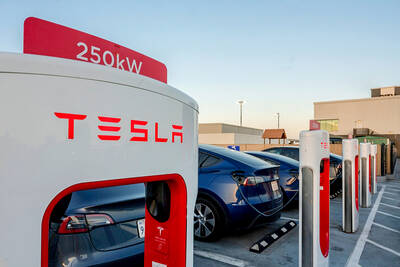
NEW IMPORTS: Car dealer PG Union Corp said it would consider introducing US-made models such as the Jeep Grand Cherokee and Stellantis’ RAM 1500 to Taiwan Tesla Taiwan yesterday said that it does not plan to cut its car prices in the wake of Washington and Taipei signing the Agreement on Reciprocal Trade on Thursday to eliminate tariffs on US-made cars. On the other hand, Mercedes-Benz Taiwan said it is planning to lower the price of its five models imported from the US after the zero tariff comes into effect. Tesla in a statement said it has no plan to adjust the prices of the US-made Model 3, Model S and Model X as tariffs are not the only factor the automaker uses to determine pricing policies. Tesla said

China’s top chipmaker has warned that breakaway spending on artificial intelligence (AI) chips is bringing forward years of future demand, raising the risk that some data centers could sit idle. “Companies would love to build 10 years’ worth of data center capacity within one or two years,” Semiconductor Manufacturing International Corp (SMIC, 中芯) cochief executive officer Zhao Haijun (趙海軍) said yesterday on a call with analysts. “As for what exactly these data centers will do, that hasn’t been fully thought through.” Moody’s Ratings projects that AI-related infrastructure investment would exceed US$3 trillion over the next five years, as developers pour eye-watering sums

Bank of America Corp nearly doubled its forecast for the nation’s economic growth this year, adding to a slew of upgrades even after a rip-roaring last year propelled by demand for artificial intelligence (AI). The firm lifted its projection to 8 percent from 4.5 percent on “relentless global demand” for the hardware that Taiwanese companies make, according to a note dated yesterday by analysts including Xiaoqing Pi (皮曉青). Taiwan’s GDP expanded 8.63 percent last year, the fastest pace since 2010. The increase “reflects our sustained optimism over Taiwan’s technology driven expansion and is reinforced by several recent developments,” including a more stable currency,


 RSS
RSS