


Taiwan has identified 12 smartphone brands that do not conform to privacy standards, and the handset makers could face fines or a ban unless they address the breaches, an official at the telecoms regulator said yesterday.
The government began to review privacy standards two months ago, after media reports said smartphones made by Chinese firm Xiaomi Technology Co Ltd (小米) could be sending user data to its Chinese servers without users’ permission.
National Communications Commission Vice Chairman Yu Hsiao-cheng (虞孝成) did not name any of the 12 brands, but said the investigation found that some of the smartphones could allow manufacturers to collect users’ data without permission.
Others contained “imperfections” which do not conform with the law, Yu said, without elaborating.
The commission’s findings would be released within weeks, he added.
Smartphones from Apple Inc, Samsung Electronics Co and HTC Corp (宏達電) were among the top five bestselling handsets in the nation during the third quarter, according to industry data firm International Data Corp. Xiaomi also said its phones were among the 12 most popular in Taiwan.
Yu said the government would ask the offending brands to modify their handsets. If they refused, the commission could fine the companies up to NT$200 million (US$6.43 million) or ban their handsets from being sold in the nation.
The probe underscores global concerns about data security and the scrutiny Chinese tech firms are subject to as governments become increasingly wary of potential cybersecurity threats from the world’s second-largest economy.
Asked about the probe, Xiaomi said its devices “never actively send any private user information without the users’ approval.”
Taiwan-based HTC said it was working with the local regulator to improve compliance with the required security standards.
Samsung said in an e-mailed statement that it “considers the privacy and security of consumers’ data a top priority.”
Apple did not immediately respond to requests for comment.
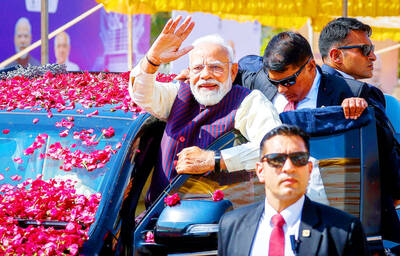
NEW IDENTITY: Known for its software, India has expanded into hardware, with its semiconductor industry growing from US$38bn in 2023 to US$45bn to US$50bn India on Saturday inaugurated its first semiconductor assembly and test facility, a milestone in the government’s push to reduce dependence on foreign chipmakers and stake a claim in a sector dominated by China. Indian Prime Minister Narendra Modi opened US firm Micron Technology Inc’s semiconductor assembly, test and packaging unit in his home state of Gujarat, hailing the “dawn of a new era” for India’s technology ambitions. “When young Indians look back in the future, they will see this decade as the turning point in our tech future,” Modi told the event, which was broadcast on his YouTube channel. The plant would convert

Nanya Technology Corp (南亞科技) yesterday said the DRAM supply crunch could extend through 2028, as the artificial intelligence (AI) boom has led the world’s major memory makers to dramatically reduce production of standard DRAM and allocate a significant portion of their capacity for high-bandwidth memory (HBM) chips. The most severe supply constraints would stretch to the first half of next year due to “very limited” increases in new DRAM capacity worldwide, Nanya Technology president Lee Pei-ing (李培瑛) told a news briefing. The company plans to increase monthly 12-inch wafer capacity to 20,000 in the first half of 2028 after a
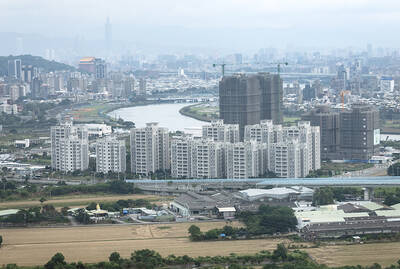
Property transactions in the nation’s six special municipalities plunged last month, as a lengthy Lunar New Year holiday combined with ongoing credit tightening dampened housing market activity, data compiled by local land administration offices released on Monday showed. The six cities recorded a total of 10,480 property transfers last month, down 42.5 percent from January and marking the second-lowest monthly level on record, the data showed. “The sharp drop largely reflected seasonal factors and tighter credit conditions,” Evertrust Rehouse Co (永慶房屋) deputy research manager Chen Chin-ping (陳金萍) said. The nine-day Lunar New Year holiday fell in February this year, reducing
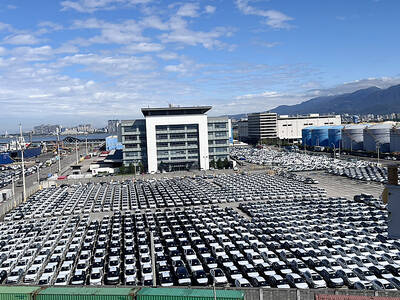
New vehicle sales in Taiwan plunged about 37 percent sequentially last month as the long Lunar New Year holiday and 228 Peace Memorial Day holiday cut short the number of working days, along with the lingering uncertainty over import tax cuts on US vehicles, market researcher U-Car said in a report yesterday. New car sales last month totaled 22,043, slumping from 35,073 units in January and down 19.89 percent from 37,515 in February last year, U-Car data showed. Sales of imported luxury cars, led by Mercedes-Benz, plummeted about 45 percent to 3,109 units last month from 5,663 units in the previous month,


 RSS
RSS