


Alongside its global reputation as a peacemaker and generous foreign aid donor, Sweden has become a major supplier of weapons and counts a number of regimes criticized for human rights abuses among its customers.
Ranked as the world’s third-largest arms exporter per capita after Israel and Russia, Sweden’s booming defense industry has stirred up ethical concerns among Swedes about some of the countries it is doing business with.
At a hangar in Sweden’s military-industrial complex, Saab AB technicians are building an assembly line for the next generation of Gripen fighters, which are equipped with state-of-the-art warfare systems and larger weapons bays, and at least 60 of which are for the Swedish Air Force.
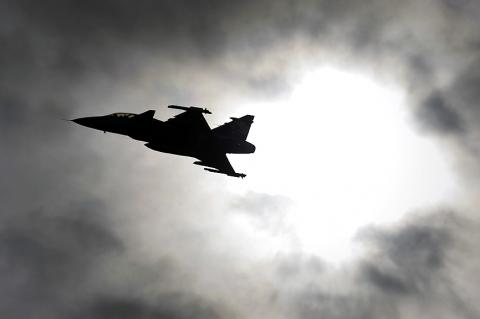
Photo: AFP
The Gripen E is designed to stand up to Russia’s best warplanes and boasts a unique networking system that allows the planes to communicate and divide up tasks such as detecting, electronic jamming and firing, Saab operations chief Lars Ydreskog said at the company’s plant in Linkoeping, southern Sweden.
“It was this tactical way of working that was noticed by Brazil and Switzerland,” he said, referring Saab’s fighter jet beating out stiff French and US competition, even though Swiss voters ultimately rejected a deal for 22 Gripens in a referendum last weekend.
Saab and other Sweden-based firms, including BAE Systems AB and Bofors, have been hugely successful in the 2000s, selling weapons and defense material to 55 countries to the tune of US$1.8 billion over the previous year.
Amid the boom, critics charge that Sweden has become more inclined to arm regimes accused of human rights abuses, including Saudi Arabia, the United Arab Emirates and Pakistan, as demand from Western nations has ebbed.
“Swedes see themselves as very ethical and restrictive when it comes to giving human rights violators or dictators things that help them stay in power, but the reality is that [that] has happened,” said Siemon Wezeman, an arms expert at the Stockholm International Peace Research Institute.
“In the last decade or so, they’ve been more open to it, because those are the markets,” he added. “In the past they wouldn’t have done business with Saudi Arabia due to human rights concerns — it’s obviously a place that rings all kinds of alarm bells — but that has changed... They’ve sold them Eriye [radar tracking systems] and anti-tank missiles, and marketed other weapons there.”
Other sales have been clandestine. In 2012, the country’s public radio revealed that the Swedish Defence Research Agency has provided Riyadh with covert technical support for a missile factory, leading to the resignation of a minister of defense and a probe into new ethical criteria for weapons sales.
One of Sweden’s most polemic exports, the Saab-made Carl Gustav rocket launcher used by the US and other armies has reportedly fallen into the hands of groups that Stockholm would not normally trade with, including the Burmese military and Islamist extremists al-Shabaab in Somalia.
Peace activist Martin Smedjeback said that Sweden’s original reason for developing a large weapons industry — the desire to be self sufficient and independent — has vanished, along with the country’s policy of neutrality as it develops closer ties to NATO.
“Politicians raise the issue of jobs and technology because there are all these other arguments that they cannot use, like: ‘It’s macho and I like macho things,’” he said. “And they also can’t say that the weapons industry is powerful and they have influence over the decisions of politicians.”
Several leading defense analysts argue that Sweden could buy defense material more cheaply and efficiently abroad, but that commercial interests stand in the way.
“The Swedish government, like many others, knows that advanced defense industry technology will spill over to other areas,” said Gunnar Hult, deputy head of military studies at the National Defense College. “And the jobs issue is quite big. People care more about local jobs than about what we do in Saudi [Arabia].”
About 30,000 people are employed in the country’s defense industry, many of them in towns where arms factories are the largest private-sector employer.
Hult believes that, at times, Sweden’s foreign policy becomes entwined with commercial arms export interests, citing the nation’s participation in enforcing a NATO no-fly zone over Libya in 2011.
“Our participation in the Libya campaign was quite beneficial to the Gripen. This is something no politician would ever admit, but it’s true. People saw it participating in air campaigns. It’s good for business,” he said.
Allan Widman, a member of governing center-right coalition the Alliance, said governments have had good reason to focus state support on two particular sectors: jet fighters and submarines.
“I think we’ve had this strategic idea in Sweden that these two weapons represent our national security interests,” he said. “I think there’s a view among politicians in Sweden that defense technology and industry represents [one] ... of the most essential parts of the Swedish economy.”
Yet many defense analysts and peace activists reject that view, arguing that weapons represent just 1 percent of the Nordic country’s total exports and that government support is more a question of national pride, particularly when it comes to selling Saab fighter jets.
“Saab is seen as one of the crown jewels of Sweden,” Wezeman said. “There is a strong feeling of pride and nationalism — that this is a good Swedish product — they’re proud of it and that plays a major role.”

Cairo’s new monorail slices across the city skyline, running above the familiar chaos of blaring horns and aging buses’ exhaust fumes that mark rush hour below. The US$4.5 billion monorail, opened this month, is among Egypt’s most prominent new transport projects, part of a debt-funded infrastructure drive criticized for sapping state finances while bringing limited benefits to most of the country’s 109 million people. “It feels like you’re in a different country,” said Ramy Sayed, a restaurant manager, aboard a driverless Innovia 300 train. “No noise, no traffic, we’re not used to this.” The eastern line runs 56km from the bustling middle-class
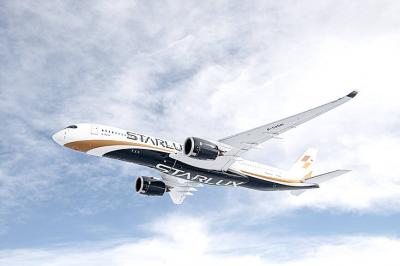
Starlux Airlines Co (星宇航空) today unveiled a long-haul network expansion plan at a shareholders’ meeting in Taipei, including direct flights to Barcelona, Spain, and Zurich, Switzerland, as well as a service connecting Taipei, Sydney and New Zealand. Starlux is to become the first Taiwanese carrier to offer non-stop services to the two European cities, while the inaugural oceanic route is expected to expand transit opportunities within the Australia-New Zealand market, Starlux said. Flight services to Chicago, Dallas, Washington and New York are under evaluation, the airline added. Prior to the shareholders’ meeting, the airline earlier this year announced that it would be
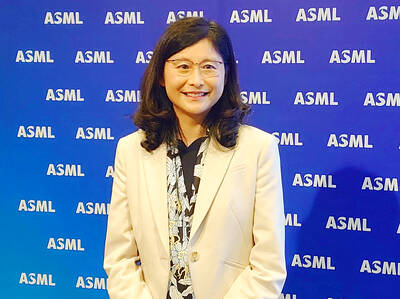
Netherlands-based semiconductor equipment supplier ASML Holding NV yesterday said that it is planning to hire an additional 1,000 people in Taiwan this year in response to growing demand from clients. ASML had previously planned to recruit 600 people this year, but that the plan has been adjusted upward, ASML vice president and ASML Taiwan general manager Grace Wang (汪佳慧) told reporters. ASML has a workforce of more than 4,500 in Taiwan, accounting for about 10 percent of its global total, Wang said. This year’s recruitment campaign would focus on adding people in the customer support, manufacturing and supply chain domains to assist ASML
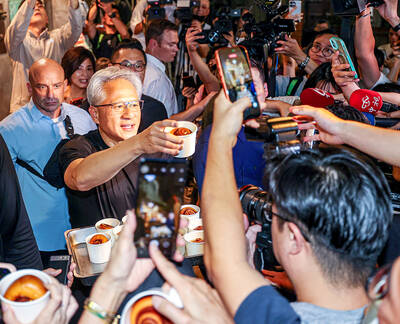
Nvidia Corp yesterday announced that CEO Jensen Huang (黃仁勳) would attend an employee meeting in Taipei tomorrow to celebrate the launch of the company’s Taiwan headquarters project. Huang would attend a gathering at the site of Nvidia’s planned headquarters in Beitou Shilin Technology Park (北投士林科技園區), the company said in a statement. After arriving in Taiwan on Saturday last week, Huang told reporters that he plans to meet with Quanta Computer Inc (廣達) chairman Barry Lam (林百里) and Taiwan Semiconductor Manufacturing Co (TSMC, 台積電) chairman C.C. Wei (魏哲家), and would attend the groundbreaking ceremony for Nvidia’s Taiwan headquarters tomorrow. Nvidia has not yet applied


 RSS
RSS