


Belgian chocolate makers believe their renowned pralines should have similar protection to that enjoyed by French champagne or Italy’s Parma ham.
They want the term “Belgian chocolate” to be their exclusive preserve and also want to crack down on foreign rivals dressing up their products as “Belgian style.”
They say copycats eat into sales and undermine a stamp of quality built up since 1912, when Jean Neuhaus invented the hard-shelled, cream-filled chocolate praline.
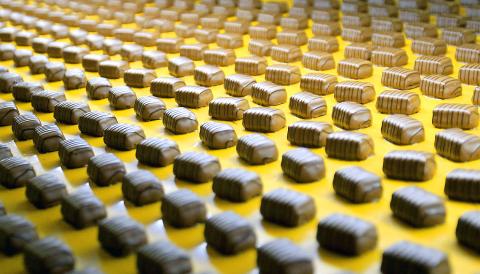
Photo: Reuters
The indsutrty federation will meet regional governments next month to decide how Belgium might apply to the EU to protect Belgian chocolates or perhaps seek a trademark to safeguard them.
“What makes us sad is that very often the copies are not up to the standard of the originals,” Neuhaus chief executive Jos Linkens told reporters in an interview.
“If top chocolatiers around the world copied us, perhaps we would be happy. We don’t want the image of quality to suffer,” said Linkens, who also heads Choprabisco, the Belgian biscuit, chocolate and confectionery federation.
Belgium is proud of its chocolate. It boasts more than 200 chocolate firms, as well as more than 2,000 chocolate stores and museums, tours and workshops.Despite their quality, like other luxury items, sales of Belgian chocolates have stagnated or slipped in mature Europe and North American markets, but seen roaring growth in emerging markets.
Overall exports of Belgian pralines rose just 1 percent between 2007 and 2011, but grew 60 percent in Asia and 82 percent in Africa.
Sales to Asia in 2011 were three times higher than a decade earlier. Individual chocolate makers talk of expansion in China and India last year of up to 50 percent.
There is yet more scope for growth, with the average Chinese person eating less than 100g of chocolate per year compared with the between 6kg and 10kg consumed by Europeans, Linkens said.
The surging demand in new markets has left foreign producers eager for a share, tempting some to claim they too make Belgian chocolates.
Choprabisco secretary-general Guy Gallet has a crate of “Belgian chocolate” boxes he and traveling Belgian executives found on their travels, which include examples from Canada, China and Hungary.
Switzerland, famous for its milk chocolate, has been more active in its protection of domestic brands.
Swiss chocolate has also seen sharp growth in Asia, with sales in China last year rising by 49 percent and by 52 percent in India.
However, Chocosuisse, the federation of Swiss chocolate makers, has trademarked the terms “Swiss” and “Switzerland” in the EU, the US and Canada, and it works to enforce those rights.
The federation has staff dedicated to the problem and can spend up to 80,000 Swiss francs (US$85,100) a year on lawyers’ fees.
Steven Candries, export manager at Belgium’s Guylian chocolate company, said the firm has been battling a Chinese maker of “Belgian chocolates” with a box design remarkably similar to Guylian’s.
“If everyone starts using the term, then what is the value? Nothing,” he said.
He and others in Belgium, whose chocolate brings in almost 4 billion euros (US$5.2 billion) each year, believe that securing the EU’s protected geographical status or a trademark would curb imposters and set Belgian chocolate apart.
Gallet said that it was hard to imagine Belgian chocolate being accorded such status, until now.
Unlike earlier protected products, the chocolate itself does not come from Belgium, with the vast majority of cocoa beans originating in Ivory Coast and Ghana.
Recently, the EU included “chocolate and derived products” as a specific category worthy of protection and this year, it modified its rule to say that a geographical indication could apply to products from a specific country.
Neuhaus’ Linkens believes it will happen, although could take some time.
The WTO is supposed to uphold protection of geographical indications, such as Colombian coffee, but can choose how to do so.
The EU’s recent bilateral trade deals, such as with South Korea and Colombia, have proven a stronger way to ensure mutual respect of protected products.
However, what counts as “Belgian chocolate” is open to debate.
Gallet says a problem is that in some cases the chocolate itself is from a Belgian facility of one of the bulk producers.
“That shouldn’t count as Belgian chocolate. What you should be saying is: ‘Made with Belgian chocolate,’” he said.
Since 2008, some Belgian producers have signed up to a non-binding chocolate code, specifying that to be labeled as “Belgian chocolate” the products must be refined and molded in Belgium, but even that has its critics, like Belgium-based Godiva Chocolatier.
Godiva has a very strong presence in North America, a market it supplies from a factory in Pennsylvania.
Guillaume de Foucault, Godiva’s general manager for Europe, the Middle East and Africa, said that these Godiva chocolates are still essentially Belgian, in the same way that one might think that a BMW made in South Carolina as still essentially a German car.
“Godiva started in 1926 in Belgium, we have a Belgian chef and Belgian facilities,” he said. “It’s important to include a lot of players. Some have difference areas of expertise. It would be very limiting if only chocolate produced in Belgium could be considered.”

OpenAI has warned US lawmakers that its Chinese rival DeepSeek (深度求索) is using unfair and increasingly sophisticated methods to extract results from leading US artificial intelligence (AI) models to train the next generation of its breakthrough R1 chatbot, a memo reviewed by Bloomberg News showed. In the memo, sent on Thursday to the US House of Representatives Select Committee on China, OpenAI said that DeepSeek had used so-called distillation techniques as part of “ongoing efforts to free-ride on the capabilities developed by OpenAI and other US frontier labs.” The company said it had detected “new, obfuscated methods” designed to evade OpenAI’s defenses
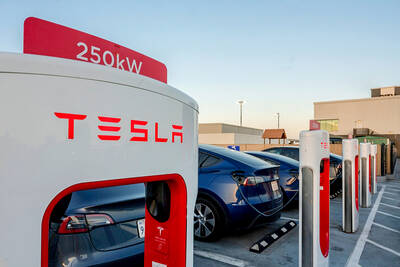
NEW IMPORTS: Car dealer PG Union Corp said it would consider introducing US-made models such as the Jeep Grand Cherokee and Stellantis’ RAM 1500 to Taiwan Tesla Taiwan yesterday said that it does not plan to cut its car prices in the wake of Washington and Taipei signing the Agreement on Reciprocal Trade on Thursday to eliminate tariffs on US-made cars. On the other hand, Mercedes-Benz Taiwan said it is planning to lower the price of its five models imported from the US after the zero tariff comes into effect. Tesla in a statement said it has no plan to adjust the prices of the US-made Model 3, Model S and Model X as tariffs are not the only factor the automaker uses to determine pricing policies. Tesla said
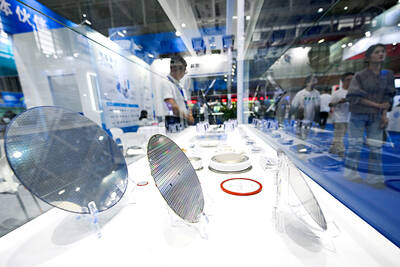
China’s top chipmaker has warned that breakaway spending on artificial intelligence (AI) chips is bringing forward years of future demand, raising the risk that some data centers could sit idle. “Companies would love to build 10 years’ worth of data center capacity within one or two years,” Semiconductor Manufacturing International Corp (SMIC, 中芯) cochief executive officer Zhao Haijun (趙海軍) said yesterday on a call with analysts. “As for what exactly these data centers will do, that hasn’t been fully thought through.” Moody’s Ratings projects that AI-related infrastructure investment would exceed US$3 trillion over the next five years, as developers pour eye-watering sums
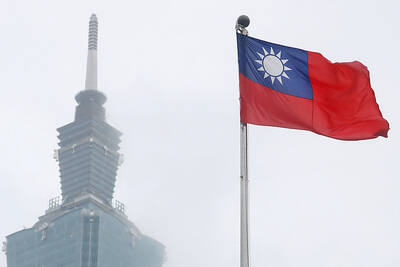
Bank of America Corp nearly doubled its forecast for the nation’s economic growth this year, adding to a slew of upgrades even after a rip-roaring last year propelled by demand for artificial intelligence (AI). The firm lifted its projection to 8 percent from 4.5 percent on “relentless global demand” for the hardware that Taiwanese companies make, according to a note dated yesterday by analysts including Xiaoqing Pi (皮曉青). Taiwan’s GDP expanded 8.63 percent last year, the fastest pace since 2010. The increase “reflects our sustained optimism over Taiwan’s technology driven expansion and is reinforced by several recent developments,” including a more stable currency,


 RSS
RSS