


Businesses across the US are increasingly worried about the nation’s looming “fiscal cliff,” the US Federal Reserve said on Wednesday in its Beige Book survey of regional economies.
While consumer spending has picked up pace in recent weeks, manufacturing has fallen off, the Fed said.
Business owners have been expressing worries about the sharp tax hikes and spending cuts that could hit them if Washington cannot agree on new legislation.
The Fed said that nine of its 12 districts reported modest or better economic growth in the weeks since its Oct. 10 report.
The New York region was weaker due to disruptions from hurricane Sandy that shut the city and surrounding areas down at the end of last month. Growth was also weaker in the Boston and Philadelphia regions, both affected to a lesser extent by the storm.
According to the survey, consumer spending grew moderately in most districts, and the real estate sector gained in a majority of regions.
Results in other industries were mixed from area to area, with the storm that raked the US east coast and hit New Jersey on Oct. 29 benefiting growth in some areas even as it shut down the economy in areas directly affected.
Employment also increased in more than half of districts reported on, with wages growing only modestly, “constrained in part by an abundant labor supply,” the Fed said.
However, manufacturing was generally weaker, with some districts reporting a contraction in the sector, citing the slower global economy.
Across most of the regions reported on, businesses surveyed expressed increasing worries about the looming deficit-slashing policies that may be enacted to deal with the fiscal cliff, which will impact the US from Jan. 1, unless Democrats and Republicans in Washington can negotiate a less harsh plan for reducing the deficit.
Manufacturers in five districts said they were worried about the economy for next year, “in part due to the uncertainty regarding the outcome of the fiscal cliff,” the report said.
Another frequent worry was the global economic slowdown and the impact of that on both business orders and the investment climate.
“A significant global manufacturer reported that growth in the US and worldwide is weak and continues to slow; this firm and another large exporter specifically reported that growth in China is slowing further,” the Fed’s Philadelphia region reported.

NEW IMPORTS: Car dealer PG Union Corp said it would consider introducing US-made models such as the Jeep Grand Cherokee and Stellantis’ RAM 1500 to Taiwan Tesla Taiwan yesterday said that it does not plan to cut its car prices in the wake of Washington and Taipei signing the Agreement on Reciprocal Trade on Thursday to eliminate tariffs on US-made cars. On the other hand, Mercedes-Benz Taiwan said it is planning to lower the price of its five models imported from the US after the zero tariff comes into effect. Tesla in a statement said it has no plan to adjust the prices of the US-made Model 3, Model S and Model X as tariffs are not the only factor the automaker uses to determine pricing policies. Tesla said

OpenAI has warned US lawmakers that its Chinese rival DeepSeek (深度求索) is using unfair and increasingly sophisticated methods to extract results from leading US artificial intelligence (AI) models to train the next generation of its breakthrough R1 chatbot, a memo reviewed by Bloomberg News showed. In the memo, sent on Thursday to the US House of Representatives Select Committee on China, OpenAI said that DeepSeek had used so-called distillation techniques as part of “ongoing efforts to free-ride on the capabilities developed by OpenAI and other US frontier labs.” The company said it had detected “new, obfuscated methods” designed to evade OpenAI’s defenses
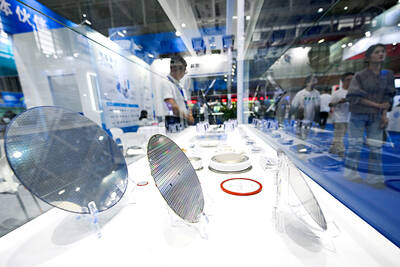
China’s top chipmaker has warned that breakaway spending on artificial intelligence (AI) chips is bringing forward years of future demand, raising the risk that some data centers could sit idle. “Companies would love to build 10 years’ worth of data center capacity within one or two years,” Semiconductor Manufacturing International Corp (SMIC, 中芯) cochief executive officer Zhao Haijun (趙海軍) said yesterday on a call with analysts. “As for what exactly these data centers will do, that hasn’t been fully thought through.” Moody’s Ratings projects that AI-related infrastructure investment would exceed US$3 trillion over the next five years, as developers pour eye-watering sums

Bank of America Corp nearly doubled its forecast for the nation’s economic growth this year, adding to a slew of upgrades even after a rip-roaring last year propelled by demand for artificial intelligence (AI). The firm lifted its projection to 8 percent from 4.5 percent on “relentless global demand” for the hardware that Taiwanese companies make, according to a note dated yesterday by analysts including Xiaoqing Pi (皮曉青). Taiwan’s GDP expanded 8.63 percent last year, the fastest pace since 2010. The increase “reflects our sustained optimism over Taiwan’s technology driven expansion and is reinforced by several recent developments,” including a more stable currency,


 RSS
RSS