


Chinese theft of valuable US trade secrets, often obtained by sophisticated cyberattacks, is becoming a more serious problem, US industry officials said on Wednesday.
“This matter requires more attention,” Jeremie Waterman, head of the US Chamber of Commerce’s China division, told a US government panel hosted by the US Trade Representative’s office.
It “has risen substantially in importance over the last year, year and a half,” Waterman said at an annual hearing on China’s compliance with WTO rules.
In one recent case, two Chinese citizens in Kansas City, Missouri, were charged with attempting to pay US$100,000 for stolen trade secrets from Pittsburgh Corning Corp, an affiliate of PPG Industries Inc and Corning Inc, at its Sedalia, Missouri, facility. The Justice Department said the pair were trying to purchase the trade secrets so a rival plant could be opened in China.
US chemicals giant Dupont also is in the midst of a legal battle over allegations that China-based Pangang Group Steel Vanadium & Titanium Co (攀鋼集團鋼鐵釩鈦) conspired to steal its trade secrets.
Earlier this year, the New York Times reported that an Austrian-based employee of the Massachusetts wind-energy company American Superconductor stole intellectual property from the firm and sold it to Chinese wind-turbine manufacturer Sinovel (華銳風電) for US$1.5 million.
Peter Dent, a vice president at Electron Energy Corp, told the government panel that both large and small US companies face “persistent and increasingly complex cyberattacks [from China] in an effort to steal intellectual property from company computer networks.”
Defending trade secrets against the attacks was “very difficult” and a costly drain on resources, he said.
Companies need the US government to take action, which could include suspending “trade benefits to countries sponsoring these actions,” Dent said.
The DuPont, Pittsburgh Corning and American Superconductor cases are “just the tip of the iceberg,” a US industry official said.
US companies are dealing with rampant “state-supported theft of trade secrets,” he said.
The hearing on Wednesday was part of USTR’s annual evaluation of how well China is meeting the commitments it made to join the WTO in 2001. A report is usually released on Dec. 11, the anniversary of Beijing’s accession to the WTO.
US exports to China have soared since China joined the WTO in 2001 and the country is now the third-largest foreign market for US goods. However, business groups told the USTR-led panel that China maintains an extensive web of discriminatory policies that prevent US companies from making additional sales and investments in the world’s second-largest economy.
Both the US Chamber of Commerce and the US-China Business Council called on Wednesday for a “bilateral investment treaty” that would open up areas of the Chinese economy to investments by US companies.
China maintains foreign ownership restrictions in nearly 100 business sectors, the business groups said.
Industry officials also complained about continuing Chinese piracy and counterfeiting of US goods, and urged the US government to aggressively challenge Chinese government subsidies that undermine US competitiveness.

Cairo’s new monorail slices across the city skyline, running above the familiar chaos of blaring horns and aging buses’ exhaust fumes that mark rush hour below. The US$4.5 billion monorail, opened this month, is among Egypt’s most prominent new transport projects, part of a debt-funded infrastructure drive criticized for sapping state finances while bringing limited benefits to most of the country’s 109 million people. “It feels like you’re in a different country,” said Ramy Sayed, a restaurant manager, aboard a driverless Innovia 300 train. “No noise, no traffic, we’re not used to this.” The eastern line runs 56km from the bustling middle-class
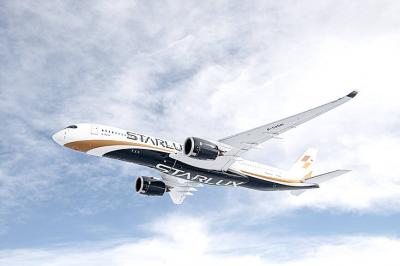
Starlux Airlines Co (星宇航空) today unveiled a long-haul network expansion plan at a shareholders’ meeting in Taipei, including direct flights to Barcelona, Spain, and Zurich, Switzerland, as well as a service connecting Taipei, Sydney and New Zealand. Starlux is to become the first Taiwanese carrier to offer non-stop services to the two European cities, while the inaugural oceanic route is expected to expand transit opportunities within the Australia-New Zealand market, Starlux said. Flight services to Chicago, Dallas, Washington and New York are under evaluation, the airline added. Prior to the shareholders’ meeting, the airline earlier this year announced that it would be

Taiwanese prosecutors suspect that three people successfully smuggled at least one shipment of Nvidia Corp artificial intelligence (AI) chips to China after first exporting them to Japan, people familiar with the matter said. The trio was detained last week by the Keelung District Prosecutors’ Office for allegedly falsifying documents related to exports of Super Micro Computer Inc servers containing advanced Nvidia chips, which the US has barred from sale to China without a license from Washington. The move marked Taiwan’s first public crackdown on AI chip diversion after years of pressure from the US to take a more active role in curtailing
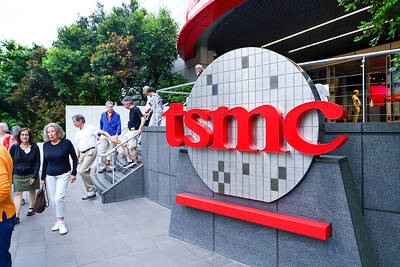
Taiwan Semiconductor Manufacturing Co (TSMC, 台積電) employee bonuses are likely to grow more than 30 percent this year, in line with the past few years as the company’s profits continue to set new records, an anonymous source cited TSMC chairman C.C. Wei (魏哲家) as saying yesterday. TSMC, the world’s largest contract chipmaker, is committed to taking care of its workers, the source said, citing Wei’s meeting with employees yesterday morning. Wei also expressed gratitude to employees for their contribution to the company’s improving bottom line, the source added. Since 2023, TSMC’s employee bonuses have grown at an annual rate of


 RSS
RSS