


Taiwan Semiconductor Manufacturing Co (TSMC, 台積電), the world’s largest contract chipmaker, yesterday said it plans to raise capital expenditure to more than US$7 billion in an effort to satisfy customers’ strong demand for its advanced 28-nanometer chips.
That is an increase of about 17 percent on an estimate of US$6 billion that TSMC made three months ago.
TSMC’s move followed speculation that constraint in its supply of 28-nanometer chips had prompted clients Nvidia Inc and Qualcomm Inc to look for a second source, such as south Korea’s Samsung Electronics Co, United Microelectronics Co (UMC, 聯電) and Abu Dhabi-funded GlobalFoundries Inc, the contract chip manufacturer that was spun off from Advanced Micro Devices Inc in 2009.
“Yes, we have had some difficulties with 28-nanometer chips, but those difficulties had to do with not having enough capacity, not the yields,” a public relations official cited TSMC chairman and chief executive Morris Chang (張忠謀) as saying at a technology forum in San Jose, California.
The Hsinchu-based company expects to complete 132 tape-outs of 28-nanometer chips for customers this year after finishing 36 at the end of last year, Chang said in January.
In the semiconductor industry, tape-out refers to the final stage of the chip design cycle, before it is sent for manufacturing.
This year, 28-nanometer chips are expected to account for about 10 percent of the company’s total revenues, Chang said in January.
“In 2011, we spent US$7 billion [on new equipment]. This year, we will spend more than the US$7 billion we spent last year,” Chang told customers at yesterday’s forum in the US.
Chang said he would give a precise figure in a few weeks.
The increase in capital spending matched the expectations of Credit Suisse, which upgraded its forecast on TSMC’s capital spending to US$7 billion for this year, allowing the chipmaker to increase its 28-nanometer capacity to 50,000 wafers a month.
That would see 28-nanometer chips make up between 15 percent and 20 percent of TSMC’s revenues by the fourth quarter of this year, Credit Suisse said in a report dated April 10.
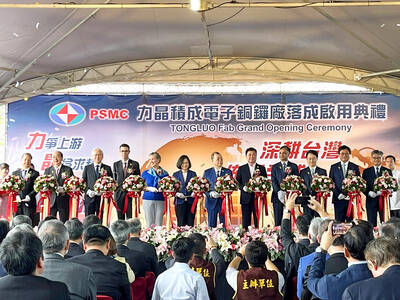
ARTIFICIAL INTELLIGENCE: The chipmaker last month raised its capital spending by 28 percent for this year to NT$32 billion from a previous estimate of NT$25 billion Contract chipmaker Powerchip Semiconductor Manufacturing Corp (力積電子) yesterday launched a new 12-inch fab, tapping into advanced chip-on-wafer-on-substrate (CoWoS) packaging technology to support rising demand for artificial intelligence (AI) devices. Powerchip is to offer interposers, one of three parts in CoWoS packaging technology, with shipments scheduled for the second half of this year, Powerchip chairman Frank Huang (黃崇仁) told reporters on the sidelines of a fab inauguration ceremony in the Tongluo Science Park (銅鑼科學園區) in Miaoli County yesterday. “We are working with customers to supply CoWoS-related business, utilizing part of this new fab’s capacity,” Huang said, adding that Powerchip intended to bridge

Microsoft Corp yesterday said that it would create Thailand’s first data center region to boost cloud and artificial intelligence (AI) infrastructure, promising AI training to more than 100,000 people to develop tech. Bangkok is a key economic player in Southeast Asia, but it has lagged behind Indonesia and Singapore when it comes to the tech industry. Thailand has an “incredible opportunity to build a digital-first, AI-powered future,” Microsoft chairman and chief executive officer Satya Nadella said at an event in Bangkok. Data center regions are physical locations that store computing infrastructure, allowing secure and reliable access to cloud platforms. The global embrace of AI

RIDING AI WAVE: : Most of its NT$15bn capital budget would be spent on packaging technologies used in AI and HPC chips and advanced testing technology, it said Chip testing and packaging service provider Powertech Technology Inc (PTI, 力成科技) plans to increase this year’s capital expenditure by 50 percent to expand capacity to meet growing demand for advanced memorychips used in artificial intelligence (AI) products. The company proposed to spend NT$15 billion (US$460.94 million) to expand advanced capacity and equipment, compared with a budget of NT$10 billion it planned three months ago. “We are seeing a recovery in market demand as well as new business opportunities. We will spend heavily on advanced packaging” equipment, Powertech chief executive officer Boris Hsieh (謝永達) told investors on Tuesday. “We will focus on ramping

INFLATION WATCH: A rate hike in March would help keep inflation at 2.16 percent this year, although a weak currency and higher electricity rates are an issue, S&P said Moody’s Ratings and S&P Global Ratings have reaffirmed Taiwan’s sovereign credit ratings at “As3” and “AA+” respectively with a stable outlook on the back of high income and wealth levels, a strong institutional framework and robust external positions. The affirmations came as Taiwan’s economy is gaining momentum after quarters of slowdown induced by stubborn global inflation and monetary tightening. Taiwan’s strong fiscal and external buffers have improved relative to peers as evidenced by recent shocks linked to the COVID-19 pandemic and the ongoing US-China technology dispute, the two ratings firms said. “Taiwan stands as the epicenter of the global semiconductor supply chain, accounting


 RSS
RSS