


US stocks opened the first week of 2012 in the plus zone, helped by optimism about the economic outlook, which fueled a strong rally on the first trading day of the year.
However, worries over more stresses in the eurozone kept a cap on gains and analysts said that would likely overshadow trading for the foreseeable future.
The tech-centric NASDAQ held the markets up for much of the week after Tuesday’s opening burst, ending on Friday at 2,674.22 with a 2.7 percent gain for the period.
The Dow Jones Industrial Average added 1.2 percent for the week to 12,359.92, while the broad-based S&P 500 gained 1.6 percent to finish at 1,277.81.
“Although the stock market was unable to close the week on a positive note, it displayed resilience in the face of a weaker euro,” Briefing.com said. “For some prognosticators, that makes for a promising start to 2012, which many believe will still be driven by global financial and economic conditions, especially those in Europe.”
Financial shares were relatively strong during the week, rising 1.5 percent helped by the better job data and hopes the government was going to take more steps to help the housing sector.
Bank of America was among the biggest beneficiaries of that speculation, surging more than 10 percent for the week.
However, tech shares were the best performers: Dell was up 4.9 percent for the week, Apple 4.3 percent, Microsoft 8.3 percent and Oracle 5.0 percent.
Disk-drive maker Seagate picked up 11.6 percent after saying it was relatively unscathed by the floods in Thailand, where it centers its production capacity.
Kodak ended the week down nearly 43 percent amid reports of a pending bankruptcy filing and the New York exchange’s threat to delist it for its ultra-low share price, at closing at US$0.37 on Friday.
Despite some bullishness, analysts said the difficulties in the eurozone continued to cloud sentiment.
On Friday, “dismal factory data out of Germany and notably lofty Italian bond yields spooked more than a few buyers,” Andrea Kramer of Schaeffer’s Investment Research said.
Next week will focus on a meeting slated for the European Central Bank on Thursday and the progress of negotiations between Greece and private creditors over a debt writedown. In the US, key data releases include consumer credit (tomorrow); the US Federal Reserve’s “Beige Book” report on regional economies (Wednesday); retail sales and business inventories (Thursday); and the US trade balance and consumer sentiment (Friday).
“Markets are likely to focus on the Fed Beige Book, prepared for the January FOMC [policy-setting] meeting and December retail sales,” Nomura Securities said.

NEW IMPORTS: Car dealer PG Union Corp said it would consider introducing US-made models such as the Jeep Grand Cherokee and Stellantis’ RAM 1500 to Taiwan Tesla Taiwan yesterday said that it does not plan to cut its car prices in the wake of Washington and Taipei signing the Agreement on Reciprocal Trade on Thursday to eliminate tariffs on US-made cars. On the other hand, Mercedes-Benz Taiwan said it is planning to lower the price of its five models imported from the US after the zero tariff comes into effect. Tesla in a statement said it has no plan to adjust the prices of the US-made Model 3, Model S and Model X as tariffs are not the only factor the automaker uses to determine pricing policies. Tesla said

OpenAI has warned US lawmakers that its Chinese rival DeepSeek (深度求索) is using unfair and increasingly sophisticated methods to extract results from leading US artificial intelligence (AI) models to train the next generation of its breakthrough R1 chatbot, a memo reviewed by Bloomberg News showed. In the memo, sent on Thursday to the US House of Representatives Select Committee on China, OpenAI said that DeepSeek had used so-called distillation techniques as part of “ongoing efforts to free-ride on the capabilities developed by OpenAI and other US frontier labs.” The company said it had detected “new, obfuscated methods” designed to evade OpenAI’s defenses
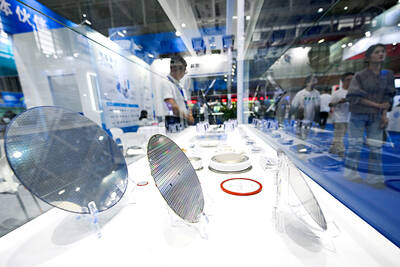
China’s top chipmaker has warned that breakaway spending on artificial intelligence (AI) chips is bringing forward years of future demand, raising the risk that some data centers could sit idle. “Companies would love to build 10 years’ worth of data center capacity within one or two years,” Semiconductor Manufacturing International Corp (SMIC, 中芯) cochief executive officer Zhao Haijun (趙海軍) said yesterday on a call with analysts. “As for what exactly these data centers will do, that hasn’t been fully thought through.” Moody’s Ratings projects that AI-related infrastructure investment would exceed US$3 trillion over the next five years, as developers pour eye-watering sums

Bank of America Corp nearly doubled its forecast for the nation’s economic growth this year, adding to a slew of upgrades even after a rip-roaring last year propelled by demand for artificial intelligence (AI). The firm lifted its projection to 8 percent from 4.5 percent on “relentless global demand” for the hardware that Taiwanese companies make, according to a note dated yesterday by analysts including Xiaoqing Pi (皮曉青). Taiwan’s GDP expanded 8.63 percent last year, the fastest pace since 2010. The increase “reflects our sustained optimism over Taiwan’s technology driven expansion and is reinforced by several recent developments,” including a more stable currency,


 RSS
RSS