


The EU executive is proposing “coordinated action” to the 27 EU nations to recapitalize banks, European Commission President Jose Manuel Barroso said yesterday.
“We are now proposing to the member states to have a coordinated action to recapitalize banks and get rid of toxic assets they may have,” Barroso said in a television interview.
The statement came after France and Belgium this week agreed to bail out Dexia, the first European bank to be dragged down by the eurozone debt crisis — and which also had to be -rescued in 2008.
The debt crisis, beginning in Greece, has snared Ireland and Portugal and put Italy and Spain in the firing line too, threatening to sink the whole euro project as banks exposed to their debt find it impossible to raise funding.
The resulting “credit crunch” has sparked warnings that there could be a replay of 2008 when US investment bank Lehman Brothers collapsed, nearly taking the global financial system with it, but for massive government support.
On Wednesday, German Chancellor Angela Merkel called on her EU partners to recapitalize the banking sector to help prevent the eurozone debt crisis spreading.
Merkel said helping the banks was “justified, if we have a joint approach,” giving nervous financial markets an immediate boost after days of heavy losses on fears the banking sector needs help urgently.
It “is important for the markets that we achieve results ... time is pressing and we have to act quickly,” she said.
Meanwhile, eurozone banks continued to deposit large amounts of overnight funds at the European Central Bank (ECB) official data showed yesterday, in a signal that banks are wary of lending to each other.
Banks put 221.35 billion euros (US$294 billion) on deposit for 24 hours at the ECB on -Wednesday, the largest amount this year, against a background of renewed concerns about the eurozone debt crisis.
The level of these deposits at the central bank is an indicator of the reluctance of banks to lend to each other on the pivotal interbank market and levels have been topping new highs this week as European governments draw up possible plans of action to avert a potential collapse of the banking sector.
“Banks’ confidence is waning and they’re unwilling to lend each other money,” German banking federation chief Andreas Schmitz told Deutschlandfunk public radio yesterday.
“Market players are telling themselves it’s safer to place money with the ECB,” Schmitz said.

MAJOR BENEFICIARY: The company benefits from TSMC’s advanced packaging scarcity, given robust demand for Nvidia AI chips, analysts said ASE Technology Holding Co (ASE, 日月光投控), the world’s biggest chip packaging and testing service provider, yesterday said it is raising its equipment capital expenditure budget by 10 percent this year to expand leading-edge and advanced packing and testing capacity amid strong artificial intelligence (AI) and high-performance computing chip demand. This is on top of the 40 to 50 percent annual increase in its capital spending budget to more than the US$1.7 billion to announced in February. About half of the equipment capital expenditure would be spent on leading-edge and advanced packaging and testing technology, the company said. ASE is considered by analysts

TRANSFORMATION: Taiwan is now home to the largest Google hardware research and development center outside of the US, thanks to the nation’s economic policies President Tsai Ing-wen (蔡英文) yesterday attended an event marking the opening of Google’s second hardware research and development (R&D) office in Taiwan, which was held at New Taipei City’s Banciao District (板橋). This signals Taiwan’s transformation into the world’s largest Google hardware research and development center outside of the US, validating the nation’s economic policy in the past eight years, she said. The “five plus two” innovative industries policy, “six core strategic industries” initiative and infrastructure projects have grown the national industry and established resilient supply chains that withstood the COVID-19 pandemic, Tsai said. Taiwan has improved investment conditions of the domestic economy
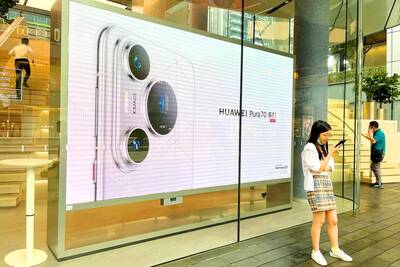
Huawei Technologies Co’s (華為) latest smartphones carry a version of the advanced made-in-China processor it revealed last year, results from an independent analysis showed. This underscored the Chinese company’s ability to sustain production of the controversial chip. The Pura 70 series unveiled last week sports the Kirin 9010 processor, research firm TechInsights found during a teardown of the device. This is a newer version of the Kirin 9000s, made by Semiconductor Manufacturing International Corp (SMIC, 中芯) for the Mate 60 Pro, which had alarmed officials in Washington who thought a 7-nanometer chip was beyond China’s capabilities. Huawei has enjoyed a resurgence since
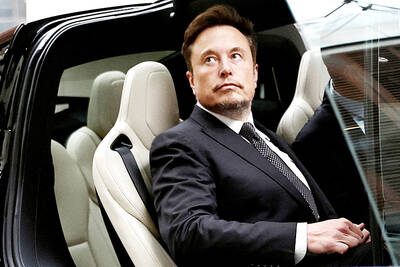
purpose: Tesla’s CEO sought to meet senior Chinese officials to discuss the rollout of its ‘full self-driving’ software in China and approval to transfer data they had collected Tesla Inc CEO Elon Musk arrived in Beijing yesterday on an unannounced visit, where he is expected to meet senior officials to discuss the rollout of "full self-driving" (FSD) software and permission to transfer data overseas, according to a person with knowledge of the matter. Chinese state media reported that he met Premier Li Qiang (李強) in Beijing, during which Li told Musk that Tesla's development in China could be regarded as a successful example of US-China economic and trade cooperation. Musk confirmed his meeting with the premier yesterday with a post on social media platform X. "Honored to meet with Premier Li


 RSS
RSS