


Manufacturing activity in China contracted for the third straight month this month, early data released yesterday showed, as turbulence in the US and Europe hurt demand for exports.
The HSBC preliminary purchasing managers’ index (PMI) fell to a two-month low of 49.4 this month from a final reading of 49.9 last month, the British banking giant said in a statement.
A reading above 50 indicates the sector is expanding, while a reading below 50 suggests contraction. The gauge stood at 49.3 in July, which was the lowest level in 28 months and the first contraction in a year.
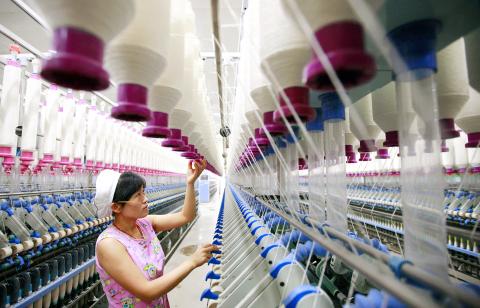
Photo: Reuters
New export orders contracted at a faster pace this month than last month, the statement said, amid deepening economic woes in the US and Europe.
However, despite the deterioration in the manufacturing sector, which employs millions of people and is a major driver of growth, HSBC chief economist Qu Hongbin (屈宏斌) said concerns of a hard landing in China were “unwarranted.”
“Resilient domestic demand is sufficient to support around 8.5-9 percent growth in the coming quarters,” Qu said in the statement.
China’s economy expanded 9.5 percent year-on-year in the second quarter of this year, slower than the 9.7 percent posted in the first quarter and 9.8 percent in the fourth quarter of last year.
The PMI figures also showed input prices, a measure of the cost of raw materials, rose at a faster pace this month, complicating Beijing’s efforts to rein in inflation.
Thus month’s reading is subject to revision when the bank publishes its final figures on Sept. 30.
BANKS LOSING DEPOSITS
Deposits are flowing out of China’s major state-owned banks as high inflation and low interest rates prompt savers to seek better returns in the private lending market, state media yesterday.
Outstanding deposits at the four biggest banks — Industrial & Commercial Bank of China, China Construction Bank, Bank of China and Agricultural Bank of China — fell 420 billion yuan (US$65.7 billion) in the first 15 days of this month, the China Securities Journal said, citing unnamed sources.
Much of the funds likely flowed into the private lending market, which offers borrowing rates about 10 times higher than the official deposit rates and has become increasingly popular as officials tighten restrictions on bank lending, the report said.

China has claimed a breakthrough in developing homegrown chipmaking equipment, an important step in overcoming US sanctions designed to thwart Beijing’s semiconductor goals. State-linked organizations are advised to use a new laser-based immersion lithography machine with a resolution of 65 nanometers or better, the Chinese Ministry of Industry and Information Technology (MIIT) said in an announcement this month. Although the note does not specify the supplier, the spec marks a significant step up from the previous most advanced indigenous equipment — developed by Shanghai Micro Electronics Equipment Group Co (SMEE, 上海微電子) — which stood at about 90 nanometers. MIIT’s claimed advances last

ISSUES: Gogoro has been struggling with ballooning losses and was recently embroiled in alleged subsidy fraud, using Chinese-made components instead of locally made parts Gogoro Inc (睿能創意), the nation’s biggest electric scooter maker, yesterday said that its chairman and CEO Horace Luke (陸學森) has resigned amid chronic losses and probes into the company’s alleged involvement in subsidy fraud. The board of directors nominated Reuntex Group (潤泰集團) general counsel Tamon Tseng (曾夢達) as the company’s new chairman, Gogoro said in a statement. Ruentex is Gogoro’s biggest stakeholder. Gogoro Taiwan general manager Henry Chiang (姜家煒) is to serve as acting CEO during the interim period, the statement said. Luke’s departure came as a bombshell yesterday. As a company founder, he has played a key role in pushing for the

EUROPE ON HOLD: Among a flurry of announcements, Intel said it would postpone new factories in Germany and Poland, but remains committed to its US expansion Intel Corp chief executive officer Pat Gelsinger has landed Amazon.com Inc’s Amazon Web Services (AWS) as a customer for the company’s manufacturing business, potentially bringing work to new plants under construction in the US and boosting his efforts to turn around the embattled chipmaker. Intel and AWS are to coinvest in a custom semiconductor for artificial intelligence computing — what is known as a fabric chip — in a “multiyear, multibillion-dollar framework,” Intel said in a statement on Monday. The work would rely on Intel’s 18A process, an advanced chipmaking technology. Intel shares rose more than 8 percent in late trading after the

GLOBAL ECONOMY: Policymakers have a choice of a small 25 basis-point cut or a bold cut of 50 basis points, which would help the labor market, but might reignite inflation The US Federal Reserve is gearing up to announce its first interest rate cut in more than four years on Wednesday, with policymakers expected to debate how big a move to make less than two months before the US presidential election. Senior officials at the US central bank including Fed Chairman Jerome Powell have in recent weeks indicated that a rate cut is coming this month, as inflation eases toward the bank’s long-term target of two percent, and the labor market continues to cool. The Fed, which has a dual mandate from the US Congress to act independently to ensure


 RSS
RSS