


A delegation of Taiwanese car parts manufacturers is traveling through France to meet with industry counterparts and discuss working together to produce electric vehicles, a delegation organizer said on Friday.
Taiwan-based Automotive Research & Testing Center (車輛研發連盟, ARTC) president Joe Huang (黃隆洲) said the delegation visited Renault S.A, PSA Peugeot Citroen and Schneider Electric, as well as the French version of ARTC.
The delegation held a seminar in Paris on Friday to brief potential French partners on the industrial development in Taiwan and efforts to develop electric cars.
Huang promoted Taiwan as having a solid foundation in information technology, a leading position in the global high-tech industry and as a very competitive manufacturer in the global electric car market.
Wang Cheng-chien (王正健), director of the Ministry of Economic Affairs’ electric car development office, who is one of the members of the Taiwanese delegation, extolled Taiwan’s strengths and spoke at length about the country’s capabilities in the fields of battery, motor and control device production. He predicted the cooperation in electric car development would greatly benefit both countries.
In addition, Huang said Taiwan and France should work together to make a mark in the tentative market for electric cars in China. Beijing is currently stepping up its own efforts to develop electric vehicles.
Huang said now is a good time for investors to enter China, because they maintain a technological lead over Chinese motor firms.
With China and Taiwan now establishing closer ties through the Economic Cooperation Framework Agreement (ECFA), Huang said that Taiwan offered France the perfect gateway into the China market.
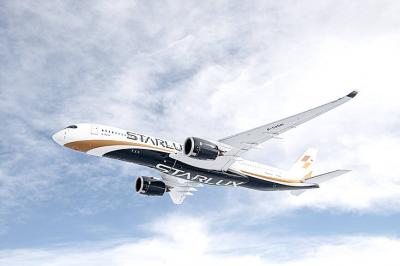
Starlux Airlines Co (星宇航空) today unveiled a long-haul network expansion plan at a shareholders’ meeting in Taipei, including direct flights to Barcelona, Spain, and Zurich, Switzerland, as well as a service connecting Taipei, Sydney and New Zealand. Starlux is to become the first Taiwanese carrier to offer non-stop services to the two European cities, while the inaugural oceanic route is expected to expand transit opportunities within the Australia-New Zealand market, Starlux said. Flight services to Chicago, Dallas, Washington and New York are under evaluation, the airline added. Prior to the shareholders’ meeting, the airline earlier this year announced that it would be

Netherlands-based semiconductor equipment supplier ASML Holding NV yesterday said that it is planning to hire an additional 1,000 people in Taiwan this year in response to growing demand from clients. ASML had previously planned to recruit 600 people this year, but that the plan has been adjusted upward, ASML vice president and ASML Taiwan general manager Grace Wang (汪佳慧) told reporters. ASML has a workforce of more than 4,500 in Taiwan, accounting for about 10 percent of its global total, Wang said. This year’s recruitment campaign would focus on adding people in the customer support, manufacturing and supply chain domains to assist ASML
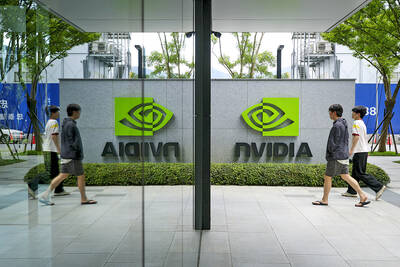
UNDER MICROSCOPE: Taiwan detained three people who allegedly conspired to buy servers in Taiwan and export them using fraudulent documentation, prosecutors said Nvidia Corp chief executive officer Jensen Huang (黃仁勳) on Saturday urged Super Micro Computer Inc to tighten up on compliance after Taiwan detained three people this week for allegedly making fraudulent declarations about artificial intelligence (AI) servers made by its US partner. The development marked the nation’s first crackdown on semiconductor smuggling, which grew after the US slapped restrictions on exports of high-end chips such as Nvidia AI accelerators to China. Nvidia is “rigorous” in explaining regulations to all of its partners, Huang told reporters after arriving in Taipei. “Ultimately Super Micro has to run their own company,” he said in response to
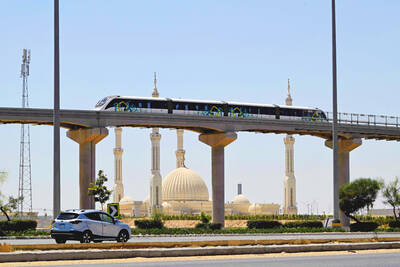
Cairo’s new monorail slices across the city skyline, running above the familiar chaos of blaring horns and aging buses’ exhaust fumes that mark rush hour below. The US$4.5 billion monorail, opened this month, is among Egypt’s most prominent new transport projects, part of a debt-funded infrastructure drive criticized for sapping state finances while bringing limited benefits to most of the country’s 109 million people. “It feels like you’re in a different country,” said Ramy Sayed, a restaurant manager, aboard a driverless Innovia 300 train. “No noise, no traffic, we’re not used to this.” The eastern line runs 56km from the bustling middle-class


 RSS
RSS