


The nation’s Apple tablet supply chain is likely to benefit from the launch of the new iPad model last week amid expectations of higher iPad 2 shipments, while notebook PC makers could face continued challenges this year, analysts said.
Apple Inc on Wednesday unveiled its new iPad at an event in San Francisco.
The iPad 2 is scheduled to hit the US market on Friday and several other countries on March 25.
With advantages in pricing, performance and immediate availability compared with other tablet products launched by smartphone and PC makers, Apple’s shipments of original iPad and iPad 2 are expected to total between 35 million and 45 million units this year, Ian Peng (彭建航), an analyst with DigiTimes Research, said in an e-mailed statement on Friday.
The overall market for tablet computers is expected to grow to between 55 million and 65 million units this year, the Taipei-based researcher predicted. Apple would dominate the market with a 70 percent share, he said.
“Taiwan supply chains are very positive and still expect more than 40 million to 50 million iPad -shipments in 2011, [up] from 14.8 million units in 2010,” Credit Suisse analysts Robert Cheng (鄭勝榮) and Pauline Chen (陳柏齡) said in a report on Friday.
Taiwanese companies involved in the iPad supply chain include main assembler Hon Hai Precision Industry Co (鴻海精密), casing producers Catcher Technology Co (可成科技) and Foxconn Technology Co (鴻準精密), printed circuit board and substrate makers Tripod Technology Corp (健鼎科技) and Kinsus Interconnect Technology Corp (景碩科技), as well as handset lens suppliers Largan Precision Co (大立光) and Genius Electronic Optical Co (玉晶光電).
Other Apple suppliers are battery makers Simplo Technology Co (新普科技) and Dynapack International Technology Corp (順達科技), passive components service providers Yageo Corp (國巨) and Delta Electronics Inc (台達電), as well as touch-panel producers Wintek Corp (勝華) and TPK Holding Co (宸鴻) and Chimei Innolux Corp (奇美電子).
Suppliers of iPad 2 are likely to continue benefiting from the tablet’s growing momentum after the new model hits the market later this month, but it is Hon Hai, the world’s biggest electronics manufacturing service provider and sole supplier of the new tablet, that is set to be the biggest beneficiary, Citigroup analyst Kevin Chang (張凱偉) said in a note on Wednesday.
“We estimate that total iPad sales will account for 11 percent to 12 percent of Hon Hai’s 2011 revenue, up from 5 percent to 6 percent in 2010,” Chang said. “More important, we believe that Hon Hai has managed to re-negotiate a better price with Apple on iPad 2 and also got higher allocation of the casing [along with Foxconn Tech].”
Credit Suisse said touch-panel makers TPK and Wintek should also gain substantially from iPad 2 because Apple orders account for over 70 percent of their revenues.
However, JPMorgan analysts led by Gokul Hariharan and J.J. Park, believe new entrants into the Apple supply chain — such as Catcher for casing, Chimei for panels and Delta for power adaptors — could see most upside in share prices, according to a client note issued on Wednesday.
Both Acer Inc (宏碁) and Asustek Computer Inc (華碩電腦) are likely to face a growing challenge from iPad’s aggressive pricing, as higher iPad shipments could lead to lower shipments in their notebook computers and Android tablets, Citigroup said.
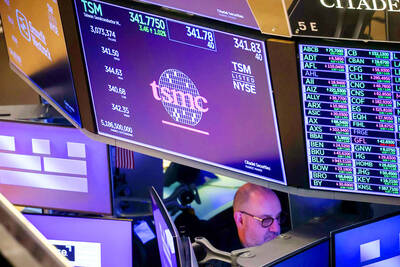
STRONG INTEREST: Analysts have pointed to optimism in TSMC’s growth prospects in the artificial intelligence era as the cause of the rising number of shareholders The number of people holding shares of chipmaker Taiwan Semiconductor Manufacturing Co (TSMC, 台積電) hit a new high last week despite a decline in its stock price, the Taiwan Depository and Clearing Corp (TDCC, 台灣集保) said. The number of TSMC shareholders rose to 2.46 million as of Friday, up 75,536 from a week earlier, TDCC data showed. The stock price fell 1.34 percent during the same week to close at NT$1,840 (US$57.55). The decline in TSMC’s share price resulted from volatility in global tech stocks, driven by rising international crude oil prices as the war against Iran continues. Dealers said
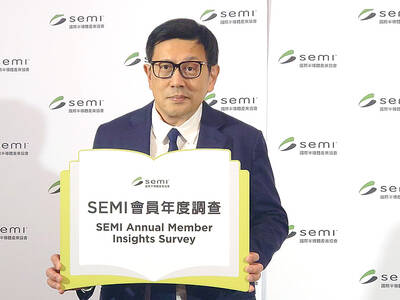
PRICE HIKES: The war in the Middle East would not significantly disrupt supply in the short term, but semiconductor companies are facing price surges for materials Taiwan’s semiconductor companies are not facing imminent supply disruptions of essential chemicals or raw materials due to the war in the Middle East, but surges in material costs loom large, industry association SEMI Taiwan said yesterday. The association’s comments came amid growing concerns that supplies of helium and other key raw materials used in semiconductor production could become a choke point after Qatar shut down its liquefied natural gas (LNG) production and helium output earlier this month due to the conflict. Qatar is the second-largest LNG supplier in the world and accounts for about 33 percent of global helium output. Helium is
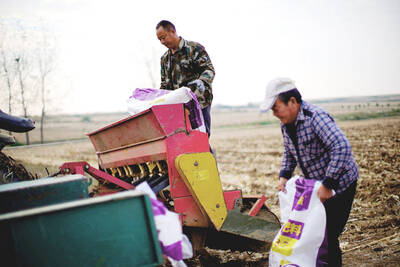
China is clamping down on fertilizer exports to protect its domestic market, industry sources said, putting an additional strain on global markets that were already grappling with shortages caused by the US-Israeli war on Iran. China is among the largest fertilizer exporters — shipping more than US$13 billion of it last year — and it has a history of controlling exports to keep prices low for farmers. Shipments through the war-blocked Strait of Hormuz account for about one-third of the sea-borne supply. This month, Beijing banned exports of nitrogen-potassium fertilizer blends and certain phosphate varieties, sources said. The ban, which has not

AMAZING ABUNDANCE: Elon Musk has announced plans for a new facility in Texas which would manufacture chips for Tesla and SpaceX to use in robotics and AI Elon Musk said his Terafab project — a grand plan to eventually manufacture his own chips for robotics, artificial intelligence (AI) and space data centers — would be built in Austin and jointly run by Tesla Inc and Space Exploration Technologies Corp (SpaceX). Musk, the chief executive officer of the two companies, said he would start off with an “advanced technology fab” in Austin that would have all of the equipment necessary to make chips of any kind. The project would call for one day supporting 1 terawatt (TW) of computing power per year, the amount Musk expects the companies to


 RSS
RSS