


Deutsche Boerse AG’s planned takeover of NYSE Euronext faces intense scrutiny from German regulators and European antitrust authorities, potentially putting the blockbuster exchange tie-up in peril.
It could also face hurdles in Washington as US lawmakers and regulators consider whether they are prepared to allow the citadel of US capitalism to fall into foreign hands, although there has been virtually no public criticism in the US as yet.
The companies said on Wednesday they were in “advanced talks” to join forces and create an exchange operator with unprecedented global reach and — most worrisome for regulators — a dominant grip on Europe’s lucrative derivatives markets.
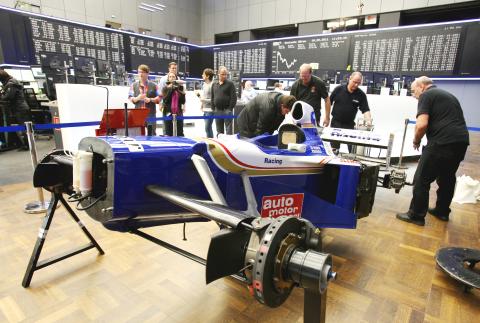
Photo: Bloomberg
While executives from Frankfurt and New York have hatched a tentative agreement, there are still obstacles that must be overcome — hurdles that scuppered past attempts to combine Deutsche Boerse with Paris-based Euronext.
“These key questions are not yet resolved,” a senior German financial source said on Thursday.
A financial regulator from the German regional state of Hesse — which must approve the deal — said it would seek to preserve the interests of Frankfurt as a financial center. Likewise, French regulator AMF said it would be vigilant about preserving Paris’ status.
Once notified, European Commission competition authorities have 25 days to decide on the case.
“The biggest danger of a failure for the deal at this point is antitrust concerns in the derivatives market, because Eurex and Liffe would have a market share of more than 90 percent in Europe,” said Stefan Brugger, a fund manager at Union Investment in Frankfurt.
“We consider these concerns as overdone,” he said.
US politicians were unusually quiet about the deal that would see the Big Board bought out and would put more than 40 percent of US options trading under one roof.
US Commodity Futures Trading Commission Chairman Gary Gensler said the companies informed his agency of their plans on Wednesday, although he declined further comment.
French Economy Minister Christine Lagarde said she was watching negotiations closely with an eye on market stability and security and the development of value on French soil.
The companies have released few details on the merger, which would create an exchange behemoth with more than US$20 trillion in annual trading volume and would give 60 percent of it to Deutsche Boerse’s shareholders.
The combination of Deutsche Boerse’s Eurex and NYSE Euronext’s London-based Liffe platforms would dominate trading in interest rate, fixed-income, as well as equity and index-based products in Europe.
Given NYSE Euronext’s plans to launch a US futures exchange and clearinghouse next month, it puts pressure squarely on Chicago-based CME Group Inc, currently the world’s top derivatives exchange operator.
“There’s a competitive element to this,” Joe Mecane, the chief administrative officer of NYSE Euronext’s US markets, said in New York. “Being able to compete with CME ... is an issue in this merger.”
CME Group executive chairman Terrence Duffy told reporters in Washington his company was ready for the competition.
“We positioned ourselves exactly because we could anticipate this coming down the pipe,” he said.
There were also questions on the benefits that will fall to shareholders, and how the combined company would distribute its headquarters and executives on the two continents.
Two people close to the deal said that the combined group’s derivatives unit — the key money maker — would be headquartered in Frankfurt, while New York would get stock trading.
Another source said Paris would handle European equity trading, including what is now done in Germany.
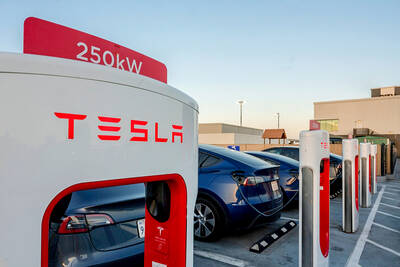
NEW IMPORTS: Car dealer PG Union Corp said it would consider introducing US-made models such as the Jeep Grand Cherokee and Stellantis’ RAM 1500 to Taiwan Tesla Taiwan yesterday said that it does not plan to cut its car prices in the wake of Washington and Taipei signing the Agreement on Reciprocal Trade on Thursday to eliminate tariffs on US-made cars. On the other hand, Mercedes-Benz Taiwan said it is planning to lower the price of its five models imported from the US after the zero tariff comes into effect. Tesla in a statement said it has no plan to adjust the prices of the US-made Model 3, Model S and Model X as tariffs are not the only factor the automaker uses to determine pricing policies. Tesla said

OpenAI has warned US lawmakers that its Chinese rival DeepSeek (深度求索) is using unfair and increasingly sophisticated methods to extract results from leading US artificial intelligence (AI) models to train the next generation of its breakthrough R1 chatbot, a memo reviewed by Bloomberg News showed. In the memo, sent on Thursday to the US House of Representatives Select Committee on China, OpenAI said that DeepSeek had used so-called distillation techniques as part of “ongoing efforts to free-ride on the capabilities developed by OpenAI and other US frontier labs.” The company said it had detected “new, obfuscated methods” designed to evade OpenAI’s defenses
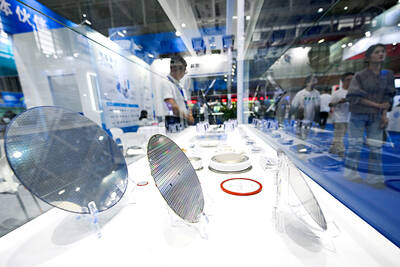
China’s top chipmaker has warned that breakaway spending on artificial intelligence (AI) chips is bringing forward years of future demand, raising the risk that some data centers could sit idle. “Companies would love to build 10 years’ worth of data center capacity within one or two years,” Semiconductor Manufacturing International Corp (SMIC, 中芯) cochief executive officer Zhao Haijun (趙海軍) said yesterday on a call with analysts. “As for what exactly these data centers will do, that hasn’t been fully thought through.” Moody’s Ratings projects that AI-related infrastructure investment would exceed US$3 trillion over the next five years, as developers pour eye-watering sums
Bank of America Corp nearly doubled its forecast for the nation’s economic growth this year, adding to a slew of upgrades even after a rip-roaring last year propelled by demand for artificial intelligence (AI). The firm lifted its projection to 8 percent from 4.5 percent on “relentless global demand” for the hardware that Taiwanese companies make, according to a note dated yesterday by analysts including Xiaoqing Pi (皮曉青). Taiwan’s GDP expanded 8.63 percent last year, the fastest pace since 2010. The increase “reflects our sustained optimism over Taiwan’s technology driven expansion and is reinforced by several recent developments,” including a more stable currency,


 RSS
RSS