


Sugar futures in India, the world’s biggest consumer of the sweetener, began trading for the first time in 19 months after a ban ended.
M-grade sugar for January delivery started trading at 3,049 rupees (US$67) per 100kg on the National Commodity & Derivatives Exchange Ltd and was at 3,035 rupees at 11:01am in Mumbai, India.
India banned sugar futures in May last year after global and domestic prices surged as supplies failed to keep pace with demand. Sugar production in India, the world’s second-largest producer, is forecast to exceed usage this season for the first time in three years, spurring exports.
“The price will be decided by market forces not by speculation, but it will solely depend upon how much liquidity gets into the market,” said Sanjay Tapriya, chief financial officer at Simbhaoli Sugars Ltd, a 75-year old mill. “At least there will be some price discovery, which will help us.”
Sugar production in India may rebound to 24.5 million tonnes in the year started Oct. 1, from 18.9 million tonnes a year ago, according to government forecasts.
Multi Commodity Exchange of India Ltd was to also start sugar futures yesterday, according to spokesman Suman Das Sarma. ACE Derivatives & Commodity Exchange Ltd, backed by Indian billionaire Uday Kotak, said in a statement on Friday it was to offer a sugar futures contracts beginning yesterday.
“This contract will provide an effective hedging platform, and will be useful for sugar traders, brokers, millers and bulk consumers,” ACE chief executive officer Dilip Bhatia said in the statement.
Sugar futures in New York, a global benchmark, more than doubled last year and have advanced 26 percent this year. The commodity reached a 30-year high on Friday.

OpenAI has warned US lawmakers that its Chinese rival DeepSeek (深度求索) is using unfair and increasingly sophisticated methods to extract results from leading US artificial intelligence (AI) models to train the next generation of its breakthrough R1 chatbot, a memo reviewed by Bloomberg News showed. In the memo, sent on Thursday to the US House of Representatives Select Committee on China, OpenAI said that DeepSeek had used so-called distillation techniques as part of “ongoing efforts to free-ride on the capabilities developed by OpenAI and other US frontier labs.” The company said it had detected “new, obfuscated methods” designed to evade OpenAI’s defenses

NEW IMPORTS: Car dealer PG Union Corp said it would consider introducing US-made models such as the Jeep Grand Cherokee and Stellantis’ RAM 1500 to Taiwan Tesla Taiwan yesterday said that it does not plan to cut its car prices in the wake of Washington and Taipei signing the Agreement on Reciprocal Trade on Thursday to eliminate tariffs on US-made cars. On the other hand, Mercedes-Benz Taiwan said it is planning to lower the price of its five models imported from the US after the zero tariff comes into effect. Tesla in a statement said it has no plan to adjust the prices of the US-made Model 3, Model S and Model X as tariffs are not the only factor the automaker uses to determine pricing policies. Tesla said
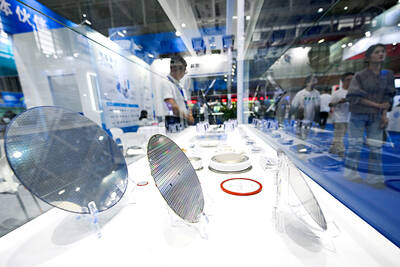
China’s top chipmaker has warned that breakaway spending on artificial intelligence (AI) chips is bringing forward years of future demand, raising the risk that some data centers could sit idle. “Companies would love to build 10 years’ worth of data center capacity within one or two years,” Semiconductor Manufacturing International Corp (SMIC, 中芯) cochief executive officer Zhao Haijun (趙海軍) said yesterday on a call with analysts. “As for what exactly these data centers will do, that hasn’t been fully thought through.” Moody’s Ratings projects that AI-related infrastructure investment would exceed US$3 trillion over the next five years, as developers pour eye-watering sums

Australian singer Kylie Minogue says “nothing compares” to performing live, but becoming an international wine magnate in under six years has been quite a thrill for the Spinning Around star. Minogue launched her first own-label wine in 2020 in partnership with celebrity drinks expert Paul Schaafsma, starting with a basic rose but quickly expanding to include sparkling, no-alcohol and premium rose offerings. The actress and singer has since wracked up sales of around 25 million bottles, with her carefully branded products pitched at low-to mid-range prices in dozens of countries. Britain, Australia and the United States are the biggest markets. “Nothing compares to performing


 RSS
RSS