


McDonald’s Corp, the world’s largest restaurant chain, increased prices for its burgers, drinks and snacks in China yesterday to offset costs after the country’s inflation surged to a two-year high.
Product prices were raised between 0.5 yuan and 1 yuan (US$0.08 and US$0.15) because of higher raw material costs, Sophia Luan (欒江紅), China spokeswoman for the Oak Brook, Illinois-based company, said in a telephone interview. She declined to provide an average percentage increase.
China has the world’s cheapest Big Macs partly because of a weak yuan, according to The Economist Big Mac Index as of Oct. 14. The sandwiches cost US$2.18 each on average in Beijing and Shenzhen, compared with US$3.71 in the US.
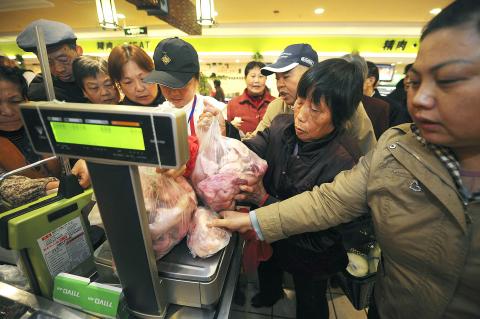
Photo: Reuters
Big Macs are most expensive in Switzerland at US$6.78, according to the magazine’s index, which uses the concept of purchasing power parity that states the dollar should buy the same amount in all countries.
Meanwhile, China’s Cabinet is drafting measures to counter excessive price increases, Chinese Premier Wen Jiabao (溫家寶) told state television on Tuesday. In comments posted late Tuesday on the government’s Web site, Wen said: “Great attention should be paid to market supply and demand and prices because they are related to the public’s basic interests.”
“The State Council is formulating measures to curb the overly fast rises of prices,” he said, giving no details.
Wen made the comments during a visit to a supermarket last Thursday in Guangzhou.
He spoke after data last week showed the nation’s consumer price index rose 4.4 percent year-on-year last month, much higher than the government’s full-year target of 3 percent. It was the fastest since September 2008, after which the global financial crisis slowed down price rises.
A Chinese consumer confidence index fell in the three months ended September, the first decline in six quarters, on expectations the costs of goods and services will keep rising.
A total of 76 percent of consumers expect prices will increase further over the next year, up from 70 percent the previous quarter, according to a statement from Nielsen Co and the Chinese statistics bureau’s Economic Monitoring and Analysis Center yesterday. Concerns about inflation are strongest among rural and first-tier city consumers, the survey said.
“If consumers see justifications for price increases, such as value and product safety, they will be willing to pay for it,” Vinay Dixit, senior director of Asia consumer centers at McKinsey & Co, said in an interview in Shanghai.
China may impose price limits on food and toughen punishment of those found speculating on agriculture futures including corn and cotton, the China Securities Journal reported, citing an unidentified person.
The Shanghai Composite Index, which tracks the bigger of China’s stock exchanges, dropped 55.68, or 1.9 percent, to 2,838.86 at the 3pm close, the lowest level in a month. The gauge has lost 10 percent since reaching an almost seven-month high on Nov. 8 as investors speculated the government will raise rates for the second time in a month and institute price controls to combat the fastest inflation in two years. The CSI 300 Index retreated 2.1 percent to 3,103.91 yesterday.

NEW MARKET: The partnership opens up India to the Dutch company, which already has a strong hold in the semiconductor market of South Korea, Taiwan and China ASML Holding NV entered into a partnership agreement with Tata Electronics Pvt Ltd aimed at ramping up India’s goal to develop domestic chip-manufacturing capabilities. The Dutch company’s technology would help power Tata Electronics’ planned 300 millimeter (mm) semiconductor foundry in Gujarat, according to a joint statement from the two companies on Saturday. The signing of a memorandum of understanding coincides with a visit by Indian Prime Minister Narendra Modi to the Netherlands, which is looking to deepen bilateral relations with New Delhi. ASML, whose top customers include Taiwan Semiconductor Manufacturing Co (台積電) and Samsung Electronics Co, makes lithography machines that can print
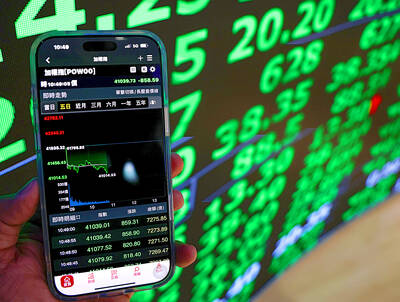
PORTFOLIO REBALANCING: The adjustments in three global equity indices reflect rising investor appetite for semiconductor and artificial intelligence-related stocks Taiwan’s weighting in major global equity indices compiled by MSCI Inc is to rise modestly following the latest quarterly review, underscoring the market’s expanding role in emerging-market portfolios, as global investors continue to favor the nation’s technology sector. Taiwan’s weighting in the MSCI Emerging Markets Index is to increase by 0.30 percentage points to 23.76 percent, after the changes take effect at the close of the May 29 session. Its weighting in the MSCI All-Country Asia ex-Japan Index is to rise 0.37 percentage points to 27.16 percent, while that in the MSCI All Country World Index is to edge up slightly to
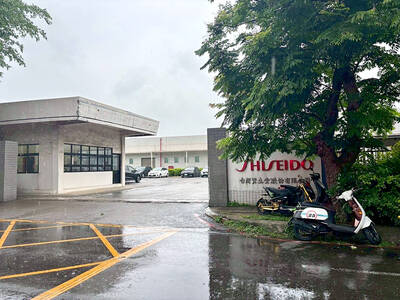
The Hsinchu County Government’s Labor Affairs Department yesterday said that it has received a plan from cosmetics brand Taiwan Shiseido Co (台灣資生堂) detailing mass layoffs at its plant in Hukou Township (湖口). While the labor authorities did not disclose the number of employees to be laid off, Japanese news media earlier in the day reported that the closure of the company’s factory in Hukou would result in 170 employees losing their jobs. Shiseido followed the law by reporting its layoff plan, the department said, adding that authorities would closely monitor negotiations between the management and affected employees and step in if any
Hon Hai Precision Industry Co (鴻海精密) on Tuesday confirmed a cyberattack targeting some of its North American facilities, but said the affected factories were gradually returning to normal. The company, known globally as Foxconn Technology Group (富士康科技集團), said that its cybersecurity team “activated the response mechanism and implemented operational measures to ensure the continuity of production and delivery.” “The affected factories are resuming normal production,” the company said in a statement. Hon Hai had previously described it as a “technical issue,” when news of the cyberattack first surfaced. The confirmation followed media reports of a large-scale information technology system incident that broke out at


 RSS
RSS