


Taiwanese turned more conservative this month about the economic outlook as many expect jobs to remain hard to find and consider now a bad time for property transactions, a survey released by Cathay Financial Holding Co (國泰金控) showed yesterday.
The monthly survey, which had 4,219 valid samples, indicated that only 32.3 percent of respondents thought the economy would improve slightly in the next six months, while 31.6 percent said it would remain unchanged.
BEARISH
A total of 19.1 percent said they expected the economy to deteriorate, with another 6 percent expecting an obvious retreat, the survey said.
The findings are in line with the Directorate General of Budget, Accounting and Statistics’ forecast last month that annual GDP growth would slow to 6.9 percent this quarter and 1.37 percent next quarter. That would pale in comparison with the 13.71 percent and 12.53 percent growth recorded in the first and second quarters respectively.
Nearly 39 percent of respondents believed the job market was unlikely to improve in the coming six months, while 32.3 percent said it would be more difficult to find a job, the survey said, adding that only 18.3 percent expected job-hunting to be easier.
HOUSE BUYING
As many as 72.7 percent said they considered now a bad time to buy homes, while 48.5 percent said it was not wise to sell houses either, the survey said.
The findings are likely to dampen housing transactions, which last month dropped to the level at the onset of the global financial crisis in September 2008.
However, the respondents appeared more confident about stock performance as 35.3 percent thought the TAIEX would gain strength in the next six months, while 28.3 percent expected the index to fall, the survey said.
A total of 49.9 percent said they had no plans to increase their stock holdings, while 22.5 percent expressed willingness to channel more cash or time deposits to the local bourse, the survey said.

Apple Inc increased iPhone production in India by about 53 percent last year and now makes a quarter of its marquee devices there, reflecting the US company’s efforts to avoid tariffs on China. The company assembled about 55 million iPhones in India last year, up from 36 million a year earlier, people familiar with the matter said, asking not to be named because the numbers aren’t public. Apple makes about 220 million to 230 million iPhones a year globally, with India’s share of the total increasing rapidly. Apple has accelerated its expansion in the world’s most populous country in recent years, bolstered

HEADWINDS: The company said it expects its computer business, as well as consumer electronics and communications segments to see revenue declines due to seasonality Pegatron Corp (和碩) yesterday said it aims to grow its artificial intelligence (AI) server revenue more than 10-fold this year from last year, driven by orders from neocloud solutions clients and large cloud service providers. The electronics manufacturing service provider said AI server revenue growth would be driven primarily by the Nvidia Corp GB300 server platform. Server shipments are expected to increase each quarter this year, with the second half likely to outperform the first half, it said. The AI server market is expected to broaden this year as more inference applications emerge, which would drive demand for system-on-chip, application-specific integrated circuits
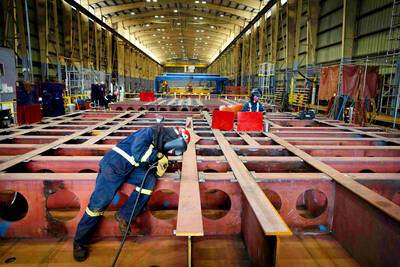
At a massive shipyard in North Vancouver, Canadian workers grind metal beams for a powerful new icebreaker crucial to cementing the country’s presence in the increasingly contested arctic. Icebreakers are specialized, expensive vessels able to navigate in the frozen far north. And “this is the crown jewel,” said Eddie Schehr, vice president of production at the Seaspan shipyard. For Canadian Prime Minister Mark Carney, who heads to Norway next Friday to observe arctic defense drills involving troops from 14 NATO states, Canada’s extreme north has emerged as a strategic priority. “Canada is and forever will be an Arctic nation,” he said ahead of

Chinese entrepreneur Frank Gao used to spend long hours running his social media accounts but now outsources the chore to artificial intelligence (AI) agent tool OpenClaw, which is taking China by storm despite official warnings over cybersecurity. OpenClaw, created in November by an Austrian coder, differs from bots such as ChatGPT because it can execute real-life tasks such as sending e-mails, organizing files or even booking flight tickets. “Since January, I’ve spent hours on the lobster every day,” Gao said in an interview, referring to OpenClaw’s red crustacean mascot. “We’re family.” After downloading OpenClaw, users connect it to artificial intelligence models of their


 RSS
RSS