

Dell Inc, the world’s third-largest personal-computer maker, is testing Google Inc’s Chrome operating system (OS) on some computers, a move that might give users an alternative to Microsoft Corp’s Windows.
Trials of Chrome OS are being conducted on prototypes of netbook and tablet computers, Stephen Felice, Dell’s consumer and small and medium business president, said in an interview on Thursday at Dell’s annual analyst meeting.
“We have to wait and see how this product is received,” Felice said at the meeting in Austin, Texas. He called Chrome a “very compelling” operating system.
Dell is trying to lessen its dependence on PCs, moving into technology services and smartphones and releasing a tablet computer called Streak that is powered by Google’s Android OS. Chief Executive Officer Michael Dell said on Thursday that Chrome “runs great on many Dell products.”
Chrome OS, a free operating system based on the open-source Linux software, is designed to let computer users quickly boot up their machines and access the Internet. Google, owner of the world’s most popular search engine, aims to have Chrome drive more users to the Web as a means to boost advertising sales. The first machines using it are due later this year.
Chrome and Android will “eventually play a role” on personal computers, Felice said. The concept of “always-on technology,” which allows users to quickly get online, could be compelling to customers, he said.
Microsoft Windows runs about 90 percent of the world’s PCs. Mark Martin, a spokesman for Redmond, Washington-based Microsoft, declined to comment.
Google, at the time of the Chrome OS announcement last year, said it was working with Acer Inc (宏碁), Asustek Computer Inc (華碩), Hewlett-Packard Co, Lenovo Group Ltd (聯想) and Toshiba Corp, among others.
Google, based in Mountain View, California, declined to comment directly on Dell’s plans.
“The Google Chrome OS team is currently working with a number of technology companies to design and build devices that deliver an extraordinary end user experience,” the company said in an e-mailed statement.


INFRINGEMENT: The investigation comes after a complaint from Vicor Corp, with the company seeking a limited exclusion order as well as cease-and-desist orders, the ITA said The US International Trade Commission (USITC) has launched a Section 337 investigation naming Taiwanese technology companies, including Hon Hai Precision Industry Co (鴻海), Delta Electronics Inc (台達電) and Quanta Computer Inc (廣達), as respondents. The Ministry of Economic Affairs (MOEA) pledged assistance if needed. The USITC said on Friday in a statement that it had voted to institute an investigation under Section 337 of the US Tariff Act of 1930 into certain vertical power delivery systems, related components and computing devices incorporating such systems. The investigation covers 20 companies from Taiwan, China, Germany and the US, the commission said, adding that it
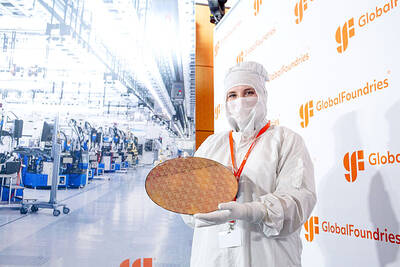
PACKAGING PUSH: The chipmaker said that it would begin ramping up silicon interposer production in New York in the first half of 2028 to support AI systems GlobalFoundries Inc shares gained as much as 7 percent after the chip manufacturer announced a five-year, US$2 billion deal to provide US production capacity to Taiwan Semiconductor Manufacturing Co (TSMC, 台積電). Under the agreement, announced on Thursday, GlobalFoundries is to help supply components known as silicon interposers. The US company is to rely on manufacturing at its facility in Malta, New York, and said it has the option to expand capacity “as customer demand grows.” An interposer is a small layer of silicon that sits between a chip and its packaging. It is home to the wires that carry electronic signals and
A man charged along with Super Micro Computer Inc co-founder Yih-Shyan “Wally” Liaw (廖益賢) of conspiring to send cutting-edge chips to China in violation of US export controls pleaded guilty, court documents said. Ting-Wei “Willy” Sun (孫廷瑋), a former outside contractor described by US authorities as a “fixer” who allegedly aided in the sales, pleaded guilty on Thursday at a hearing in federal court in New York as part of an agreement with prosecutors, court filings showed. Prosecutors claimed the men were part of a scheme to send Nvidia Corp-powered servers to an unnamed Southeast Asian company and then divert them to
SECOND-TOP MONTH: September revenue was 0.6 percent lower month-on-month, but despite the drop, it was the firm’s highest-ever sales report for the month Taiwan Semiconductor Manufacturing Co (TSMC, 台積電) yesterday reported record quarterly revenue for last quarter, after sales last month hit the second-highest monthly level in the company’s history. Revenue in the quarter ended last month was NT$1.49 trillion (US$46.75 billion), up 17 percent from NT$1.27 trillion in the second quarter and exceeding the combined prediction of 19 LSEG SmartEstimate analysts of NT$1.46 trillion. Last quarter’s figure — which was up 12 percent from the midpoint of last year — also surpassed the company’s July estimates of US$44.6 billion to US$45.8 billion amid surging demand for the ramp-up of its advanced 2-nanometer technology, artificial


 RSS
RSS