


Fitch Ratings yesterday raised its outlook on AU Optronics Corp (友達光電), the world’s third-biggest maker of liquid-crystal-display (LCD) panels, to “stable” from “negative” because improving profitability has helped strengthen the company’s ability to repay debt.
“Fitch has changed its forecast for AU Optronic’s operating results and credit measurements over the medium-term, because AU Optronics has shown significant improvement in profitability since the second quarter of 2009,” Fitch Ratings analyst Kevin Chang (張崇仁) said in a report.
AU Optronics improved its earnings margin before interest, tax, depreciation and amortization (EBITDA) to 27.9 percent last quarter, compared with 21.5 percent in the second quarter after returning to positive 1.7 percent in the first quarter of this year.
“This effectively turned its earnings before interest and tax positive for the first time since the fourth quarter of 2008, enhancing the company’s debt service capability,” Chang said.
This year as a whole, AU Optronics, however, would still see negative cash flow from its operations, Chang said.
The panel maker has posted minus NT$24.83 billion (US$771.9 million) in net cash in the first nine months of this year, the company’s financial statements on its Web site showed.
In terms of revenue, Chang said he expected AU Optronics to resume growth next year, as the recovering global economy may spur demand for TVs and laptop computers in emerging markets and developed countries.
This year, AU Optronics may see revenues decline at a slower pace of between 15 percent and 20 percent year-on-year on falling panel prices, rather than the 30 percent to 40 percent contraction estimated by the agency six months ago, the report said.
AU Optronics posted NT$423.93 billion in revenues last year.
Supporting Chang’s positive outlook for the LCD industry, Taipei-based researcher WitsView said global PC and TV panel shipments increased 4.3 percent month-on-month, or 74.2 percent year-on-year, to 49.53 million units last quarter, far better than its previous estimate of a flat November.
“Improving retail sales during the Thanksgiving and Christmas holidays in the US and Europe and growing demand in China has helped boost the LCD industry,” WitsView said in a press release. “This conventional slack season doesn’t look slow at all.”
Shares of AU Optronics jumped 2.02 percent to NT$35.4, out-performing the benchmark TAIEX, which rose 1.53 percent yesterday. Smaller rival Chi Mei Optoelectronics Corp (奇美電子) dropped 0.24 percent to NT$20.75.

HSBC Holdings PLC is deepening its commitment to Taiwan as the economy emerges as one of the bank’s fastest-growing markets globally, driven by an artificial intelligence (AI) investment boom, expanding cross-border trade, and rising wealth creation. “The advantage that Taiwan has is a growth story linked to the semiconductor and broader AI industries, strong underlying corporate performance, and wealth creation,” said Surendra Rosha, HSBC’s co-chief executive for Asia and the Middle East, in an exclusive interview with the Taipei Times on June 2, during this year’s HSBC Taiwan Conference. That combination has helped HSBC cement its position as the most profitable international
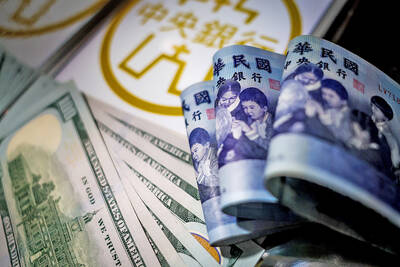
The New Taiwan dollar yesterday fell sharply against the US dollar to close at its lowest level since May 22 amid a massive outflow of funds from the country because of investors panicking over global equity markets. The NT dollar ended at NT$31.580 against the US dollar, slightly lower than its close of NT$31.568 on May 22, after moving between NT$31.5 and NT$31.648 on combined turnover of US$3.062 billion on the Taipei Foreign Exchange and the Cosmos Foreign Exchange. The NT dollar received a significant hit in the morning session, slumping as much as NT$0.173 at a time when other Asian currencies
Taiwan Semiconductor Manufacturing Co (TSMC, 台積電) is now ranked ninth among the world’s 100 most valuable companies after its market capitalization more than doubled over the past year, PricewaterhouseCoopers (PwC) Taiwan said in a report last month. TSMC’s market capitalization surged 101 percent year-on-year to US$1.427 trillion as of March 31, the accounting and consulting firm’s 2026 Global Top 100 Companies by Market Capitalization report said. The gain catapulted the world’s largest contract chipmaker from 12th place to ninth in the rankings, and it was the fastest-growing among the global top 10, it said. TSMC was the only Taiwanese company among the top
Taiwan Semiconductor Manufacturing Co (TSMC, 台積電) yesterday reported record revenue of NT$416.975 billion (US$13.17 billion) for last month, putting the world’s largest contract chipmaker on track to set a record for quarterly revenue. Last month’s figure surpassed March’s record NT$415.19 billion and represented increases of 1.5 percent from April and 30.1 percent from a year earlier. For the first five months of the year, TSMC generated NT$1.96 trillion in revenue, up 30 percent year-on-year, it said in a statement. TSMC has forecast second-quarter revenue of between US$39 billion and US$40.2 billion, representing sequential growth of about 10 percent and year-on-year growth of about


 RSS
RSS