


Japan’s unemployment rate rose to an all-time high last month, deflation intensified and families cut spending — a triple dose of bad news for Japanese Prime Minister Taro Aso as his party heads for almost certain defeat in tomorrow’s parliamentary elections.
The jobless rate hit a seasonally adjusted 5.7 percent, the highest level in Japan’s post-World War II era and worsening from 5.4 percent in June, the government said yesterday.
The previous record was 5.5 percent, last hit in April 2003.
Prices fell sharply amid the labor market worries. Japan’s key consumer price index, which excludes volatile fresh food prices, tumbled a record 2.2 percent last month from a year earlier, according to the Ministry of Internal Affairs and Communications.
The figures come just two days before the country holds lower elections, widely seen as a referendum on the ruling party’s handling of the economy.
Recent polls predict that the Liberal Democratic Party, in power for most of the last half-century, is headed toward a historic drubbing at the hands of the opposition Democratic Party of Japan (DPJ).
DPJ officials were quick to use the latest jobless figures as political ammunition.
“Although the ruling bloc claimed that ‘the economy has rebounded,’ [the nation’s] weak economic structure dependent on external demand has not changed,” Tetsuro Fukuyama, a DPJ senior official, was quoted by Kyodo news agency as saying.
“It is necessary to swiftly realize the domestic demand-led economic measures we are advocating,” Fukuyama said.
Under a mantra of “Putting People’s Lives First,” the Democrats are offering a platform heavy on social welfare initiatives, including cash handouts for job seekers in training and families with children.
The government’s chief spokesman, Takeo Kawamura, defended Aso’s policies, pointing to economic growth Japan recorded in the second quarter after a yearlong recession.
“There is no denying the fact that the economy is improving overall,” he said at a news conference, according to Kyodo.
The world’s No. 2 economy expanded at an annual pace of 3.7 percent in the April-June quarter. But economists note that exports served as the main driver of growth and that domestic demand remains fragile.
A separate government report showed that families are scaling back their spending. Average household spending, a key barometer of individual consumption, last month declined 2 percent from a year earlier.

The Eurovision Song Contest has seen a surge in punter interest at the bookmakers, becoming a major betting event, experts said ahead of last night’s giant glamfest in Basel. “Eurovision has quietly become one of the biggest betting events of the year,” said Tomi Huttunen, senior manager of the Online Computer Finland (OCS) betting and casino platform. Betting sites have long been used to gauge which way voters might be leaning ahead of the world’s biggest televised live music event. However, bookmakers highlight a huge increase in engagement in recent years — and this year in particular. “We’ve already passed 2023’s total activity and

Nvidia Corp CEO Jensen Huang (黃仁勳) today announced that his company has selected "Beitou Shilin" in Taipei for its new Taiwan office, called Nvidia Constellation, putting an end to months of speculation. Industry sources have said that the tech giant has been eyeing the Beitou Shilin Science Park as the site of its new overseas headquarters, and speculated that the new headquarters would be built on two plots of land designated as "T17" and "T18," which span 3.89 hectares in the park. "I think it's time for us to reveal one of the largest products we've ever built," Huang said near the
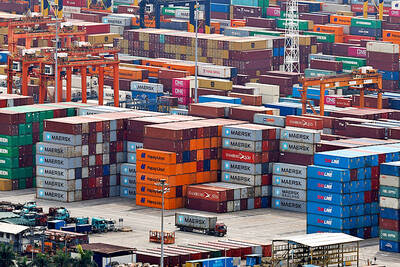
China yesterday announced anti-dumping duties as high as 74.9 percent on imports of polyoxymethylene (POM) copolymers, a type of engineering plastic, from Taiwan, the US, the EU and Japan. The Chinese Ministry of Commerce’s findings conclude a probe launched in May last year, shortly after the US sharply increased tariffs on Chinese electric vehicles, computer chips and other imports. POM copolymers can partially replace metals such as copper and zinc, and have various applications, including in auto parts, electronics and medical equipment, the Chinese ministry has said. In January, it said initial investigations had determined that dumping was taking place, and implemented preliminary

Intel Corp yesterday reinforced its determination to strengthen its partnerships with Taiwan’s ecosystem partners including original-electronic-manufacturing (OEM) companies such as Hon Hai Precision Industry Co (鴻海精密) and chipmaker United Microelectronics Corp (UMC, 聯電). “Tonight marks a new beginning. We renew our new partnership with Taiwan ecosystem,” Intel new chief executive officer Tan Lip-bu (陳立武) said at a dinner with representatives from the company’s local partners, celebrating the 40th anniversary of the US chip giant’s presence in Taiwan. Tan took the reins at Intel six weeks ago aiming to reform the chipmaker and revive its past glory. This is the first time Tan


 RSS
RSS