

Sales of personal computers in the Asia-Pacific region excluding Japan fell 5 percent in the first quarter from the previous year as the global economic slump hurt demand, a report said yesterday.
However, strong sales of portable PCs in markets like China, Hong Kong and Taiwan limited the overall decline and kept total shipments close to forecasts during the quarter, industry research firm IDC said.
“Even though the quarter was soft, it was somewhat relieving to see that the region’s market was able to hold up to forecasts ... especially compared to a dismal fourth quarter,” IDC analyst Bryan Ma said.
But he said the market was not out of the woods yet.
“The economy is still showing mixed signals and recent political instability in markets like Thailand created further uncertainty,” he said, referring to recent anti-government riots in Bangkok.
“Commercial buying is thus still likely to remain questionable this year, but hopefully consumer portables can help offset that,” Ma said.
Although overall computer shipments were down, sales for portable PCs rose 12 percent from the previous year, the report said.
Chinese computer giant Lenovo (聯想) remained the maket leader with a 16.9 percent market share, followed by US rivals Hewlett-Packard and Dell, with Taiwan’s Acer (宏碁) in fourth place, IDC said.

EQUAL SHARE: A row over Micron’s payouts coincides with a global debate about who deserves a cut of the sudden wealth generated by the artificial intelligence boom Micron Technology Inc is to provide its engineers in Taiwan a cash bonus of NT$1 million (US$31,600) plus equity rewards, as the company’s local unions are demanding an additional payout to reflect their contribution to the chipmaker’s blowout profits. The Idaho-based chipmaker said in a statement yesterday that its entry-level, Taiwan-based engineers’ average compensation would reach NT$3.4 million for the past fiscal year after the cash and equities awards. All employees in Taiwan would receive equities as part of the annual merit grants, the company added. Before the announcement, Micron’s unions asked for a one-time cash payout equal to about seven years
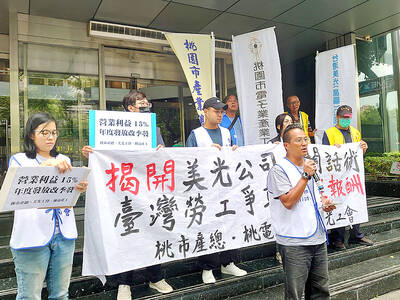
UNION DETERMINATION: Rejecting an offer for a one-time payout as an attempt to influence opinion, the union said a strike at the memory chip manufacturer is possible The Micron Taiwan workers’ union yesterday rejected a one-time payout unveiled by US-based Micron Technology Inc last week, saying it wants a long-term mechanism under which employees would share 15 percent of the company’s operating profits. While the union and the company are still in talks over the dispute, the reward package was proposed unilaterally by the employer without reaching an agreement with the union, union head Jerry Lin (林哲瑞) told reporters. Lin said he suspected the company was seeking to influence public opinion with the move. On Friday last week, Micron announced a reward package under which employees in Taiwan would receive

SOME CUSHION: Taiwan’s GDP is forecast to grow more than 11 percent this year, so the economy should be able to absorb the impact of a rate hike, an expert said With domestic inflation topping the 2 percent alert level for a fourth consecutive month last month and several major central banks around the world raising their key interest rates, Taiwan’s central bank is facing growing pressure to raise rates at its quarterly policymaking meeting on Thursday, economists said. At its June meeting, the central bank left interest rates unchanged for the ninth consecutive quarter, with the discount rate at 2 percent. Central Bank Governor Yang Chin-long (楊金龍) had said that the bank maintained a somewhat hawkish stance, with two board directors voicing support for a rate hike at the meeting. Cathay United
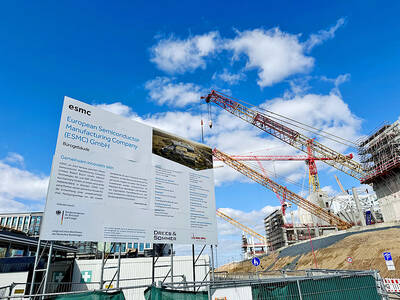
BUILDER’s RITES: The topping out ceremony is held when a project being built has its highest point laid out, a sure sign that TSMC’s European project is making solid progress A “topping out” ceremony was held on Monday at a plant under construction in Germany by Taiwan Semiconductor Manufacturing Co (TSMC, 台積電), indicating that the fab is progressing as planned and within budget, the head of a joint-venture company in charge of the project said. A topping out ceremony is the construction milestone of laying the final beam or structural piece at the highest point of a building, and it honors the construction crew, architects and engineers. European Semiconductor Manufacturing Co (ESMC) president Christian Koitzsch said that about 2,000 workers from 106 countries are working around the clock at the site in


 RSS
RSS