

Three financial holding companies have expressed their willingness to adjust the dates of their annual general meetings (AGMs) after the financial regulator raised concerns that too many listed financial holding companies had decided to hold their meetings on the same date. The meetings — scheduled for June 19 — would jeopardize shareholders’ rights, it said.
Chinatrust Financial Holding Co (中信金控), Taishin Financial Holding Co (台新金控) and Taiwan Cooperative Bank (合作金庫銀行) informed the Financial Supervisory Commission that they would reschedule their AGMs for shareholders, the financial regulator said in a statement yesterday.
Chinatrust will reschedule to June 26 from June 19, while the other two are still working on new dates.
The commission said that rescheduling was also under discussion at other financial holding companies or banks.
“To enhance corporate governance and safeguard shareholders’ rights, [some] financial holding companies and banks have agreed to reschedule their annual general meetings ... The commission very much welcomes this positive response,” the commission said in a statement.
As of yesterday, nine financial holding companies were still due to hold their AGMs on June 19, along with 16 banks, brokerages and insurance companies, Taiwan Stock Exchange tallies showed.
First Financial Holding Co (第一金控) was the only financial institution to originally set a different date for its AGM, May 22. Jih Sun Financial Holding Co (日盛金控) has yet to set a date.
Fubon Financial Holding Co (富邦金控) denied that it planned to reschedule its meeting as reported by the Chinese-language Commercial Times yesterday.
The financial regulator is under pressure by lawmakers to persuade local financial institutions to spread out the dates of their annual general meetings after 28 companies, or 73.7 percent, of 38 listed financial companies announced they would hold meetings on June 19.
At the legislature’s Finance Committee on Wednesday, lawmakers said financial institutions’ plans to hold meetings on the same day would prevent shareholders learning about company operations and leave them unable to vote in board directors elections.
Lawmakers, moreover, were outraged after learning from the latest stock exchange tallies that 284 listed companies have scheduled to hold their meetings on June 10, 241 firms on June 16 and 258 on June 19.
To resolve this problem, the financial regulator yesterday held a meeting among its commission members and decided to propose an amendment to Article 36 of the Securities and Exchange Act (證券交易法).
Under the proposed amendment, listed companies (not just confined to financial companies) will be able to disclose their audited financial reports within three months following the close of each fiscal year, instead of four months.
In doing so, listed companies will have one more month to set their annual meetings as the Corporation Act (公司法) requires them to hold meetings by the end of June.
The commission said its banking bureau is currently working on the proposed amendment before submitting it to legislative review. Nevertheless, it will not be possible to implement the amendment this year and the commission said it would continue negotiations with listed companies to reschedule the dates.

INFRINGEMENT: The investigation comes after a complaint from Vicor Corp, with the company seeking a limited exclusion order as well as cease-and-desist orders, the ITA said The US International Trade Commission (USITC) has launched a Section 337 investigation naming Taiwanese technology companies, including Hon Hai Precision Industry Co (鴻海), Delta Electronics Inc (台達電) and Quanta Computer Inc (廣達), as respondents. The Ministry of Economic Affairs (MOEA) pledged assistance if needed. The USITC said on Friday in a statement that it had voted to institute an investigation under Section 337 of the US Tariff Act of 1930 into certain vertical power delivery systems, related components and computing devices incorporating such systems. The investigation covers 20 companies from Taiwan, China, Germany and the US, the commission said, adding that it
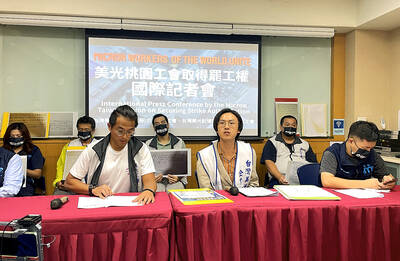
INDUSTRY STANDARD: Most global semiconductor companies have tied employee bonuses directly to corporate profits, the union said, urging Micron to do the same Micron Memory Taiwan Co’s (台灣美光) Taoyuan union secured strike authorization yesterday after a six-day vote, ramping up pressure on management to build a reasonable profit-sharing mechanism. Before the strike, the Taoyuan union “encourages” members to join a protest in Taipei on Oct. 19, union chairman Jerry Lin (林哲瑞) told a news conference in Taipei. The union did not rule out staging a snap strike, Lin said. The union has 2,258 registered members, with 88.3 percent backing the strike, he said. The vote comes as Micron’s board of directors is meeting today and tomorrow in the US. The union expects the board to respond

Elon Musk said his business empire would build and operate Terafab independently, quashing speculation about industry leader Taiwan Semiconductor Manufacturing Co (TSMC, 台積電) swooping in to run his ambitious chipmaking venture. Based in Texas, the Terafab project is Musk’s effort to break into the business of fabricating chips, in service of his companies Tesla Inc and SpaceXAI. While Musk had said that he was in discussions with TSMC, the trillionaire clarified in an X post yesterday that the only matter under consideration is for TSMC potentially leasing some part of the planned site and would not involve any operational role. “Maybe TSMC
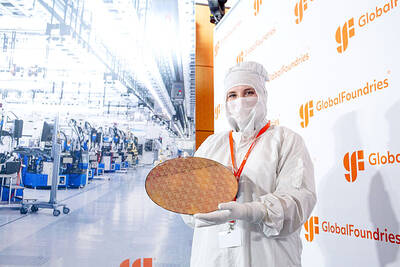
PACKAGING PUSH: The chipmaker said that it would begin ramping up silicon interposer production in New York in the first half of 2028 to support AI systems GlobalFoundries Inc shares gained as much as 7 percent after the chip manufacturer announced a five-year, US$2 billion deal to provide US production capacity to Taiwan Semiconductor Manufacturing Co (TSMC, 台積電). Under the agreement, announced on Thursday, GlobalFoundries is to help supply components known as silicon interposers. The US company is to rely on manufacturing at its facility in Malta, New York, and said it has the option to expand capacity “as customer demand grows.” An interposer is a small layer of silicon that sits between a chip and its packaging. It is home to the wires that carry electronic signals and


 RSS
RSS