


The chairman of the Taiwan External Trade Development Council (TAITRA) predicted yesterday that based on an improvement in Taiwan’s poor export figures for January and last month, an economic spring would arrive next year.
“The swallows will surely come back as early as next year, and we should see exports pick up by the end of this year,” TAITRA chairman Wang Chih-kang (王志剛) said at the opening of a conference involving overseas economic and business personnel of TAITRA and the Ministry of Economic Affairs (MOEA) to discuss the global economic crisis.
Noting that the contraction of exports has slightly improved from January’s minus 44 percent to last month’s minus 28 percent, while exports to China have also improved from January’s minus 58 percent to last month’s minus 26 percent, Wang said the difference between the two months should be taken seriously and rationally.
The TAITRA chairman said exports improved slightly last month and that there should be more improvement this month, and even more next month.
Stressing the importance of exports, Wang said that Taiwan’s economic lifeline depended on its exports because when they grow, it can activate a chain effect that includes increasing companies’ willingness to invest and hire more employees, resolving the problem of rising unemployment and stimulating consumption and the government’s public spending.
“Without exports, Taiwan’s GDP growth will definitely be negative,” he said.

HSBC Holdings PLC is deepening its commitment to Taiwan as the economy emerges as one of the bank’s fastest-growing markets globally, driven by an artificial intelligence (AI) investment boom, expanding cross-border trade, and rising wealth creation. “The advantage that Taiwan has is a growth story linked to the semiconductor and broader AI industries, strong underlying corporate performance, and wealth creation,” said Surendra Rosha, HSBC’s co-chief executive for Asia and the Middle East, in an exclusive interview with the Taipei Times on June 2, during this year’s HSBC Taiwan Conference. That combination has helped HSBC cement its position as the most profitable international
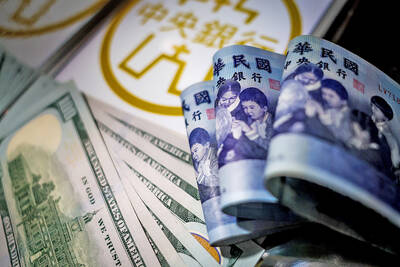
The New Taiwan dollar yesterday fell sharply against the US dollar to close at its lowest level since May 22 amid a massive outflow of funds from the country because of investors panicking over global equity markets. The NT dollar ended at NT$31.580 against the US dollar, slightly lower than its close of NT$31.568 on May 22, after moving between NT$31.5 and NT$31.648 on combined turnover of US$3.062 billion on the Taipei Foreign Exchange and the Cosmos Foreign Exchange. The NT dollar received a significant hit in the morning session, slumping as much as NT$0.173 at a time when other Asian currencies
Taiwan Semiconductor Manufacturing Co (TSMC, 台積電) is now ranked ninth among the world’s 100 most valuable companies after its market capitalization more than doubled over the past year, PricewaterhouseCoopers (PwC) Taiwan said in a report last month. TSMC’s market capitalization surged 101 percent year-on-year to US$1.427 trillion as of March 31, the accounting and consulting firm’s 2026 Global Top 100 Companies by Market Capitalization report said. The gain catapulted the world’s largest contract chipmaker from 12th place to ninth in the rankings, and it was the fastest-growing among the global top 10, it said. TSMC was the only Taiwanese company among the top
Taiwan Semiconductor Manufacturing Co (TSMC, 台積電) yesterday reported record revenue of NT$416.975 billion (US$13.17 billion) for last month, putting the world’s largest contract chipmaker on track to set a record for quarterly revenue. Last month’s figure surpassed March’s record NT$415.19 billion and represented increases of 1.5 percent from April and 30.1 percent from a year earlier. For the first five months of the year, TSMC generated NT$1.96 trillion in revenue, up 30 percent year-on-year, it said in a statement. TSMC has forecast second-quarter revenue of between US$39 billion and US$40.2 billion, representing sequential growth of about 10 percent and year-on-year growth of about


 RSS
RSS