


China Mobile (中國移動通信), the world’s largest mobile phone network operator, said yesterday its profits jumped by 30 percent last year, but warned China’s telecoms market faced a tough year ahead.
Net profit rose to 112.79 billion yuan (US$16.50 billion) last year, up from 87.06 billion yuan in 2007, the company said in a statement.
The firm, which has more subscribers than any other global carrier, said it had increased its customer base to more than 457 million, up 23.8 percent from the previous year.
Company chairman and chief executive officer Wang Jianzhou (王建宙) said he was delighted with the firm’s performance last year, but said it was unlikely to escape the fallout from the global economic slowdown.
“The influence of [the] financial crisis that swept across the globe in 2008 will likely widen and deepen, and its impact on China’s economy will continue,” Wang said in the statement to the Hong Kong Stock Exchange, where the firm is listed.
“The telecommunications industry will be affected,” Wang said.
He said the firm would be looking to boost its wireless broadband services in the coming year, and would also consider expansion into foreign markets.
“The company will actively search for quality overseas telecommunications assets as investment opportunities and as a way to explore international development,” Wang added.
Mobile phone use has exploded in China in recent years on the back of falling handset prices and user charges. The total number of mobile users in China last month reached 565 million, making it the world’s biggest cellular phone market, according to government figures.
Wang said the company had seen strong growth among rural customers last year, and had also increased the size of its corporate market.
He also welcomed China’s huge economic stimulus package, and said he believed it would have a positive impact on the telecoms sector.
China Mobile’s turnover grew 15.5 percent to 412.34 billion yuan over the 12 months.
It paid a dividend of HK$1.40 (US$0.18) per share, compared with HK$1.16 the previous year.
China Mobile was in January awarded one of the three licenses to run third-generation (3G) networks across the country.
In his statement, Wang said the firm was focused on migrating its customers onto 3G networks without their needing to change SIM cards, mobile numbers or reregistering.
Earlier this year, Wang said factory closures as a result of reduced demand for Chinese-made goods had hit the mobile market, as users had moved back to rural areas and reduced the number of calls they made.

Cairo’s new monorail slices across the city skyline, running above the familiar chaos of blaring horns and aging buses’ exhaust fumes that mark rush hour below. The US$4.5 billion monorail, opened this month, is among Egypt’s most prominent new transport projects, part of a debt-funded infrastructure drive criticized for sapping state finances while bringing limited benefits to most of the country’s 109 million people. “It feels like you’re in a different country,” said Ramy Sayed, a restaurant manager, aboard a driverless Innovia 300 train. “No noise, no traffic, we’re not used to this.” The eastern line runs 56km from the bustling middle-class
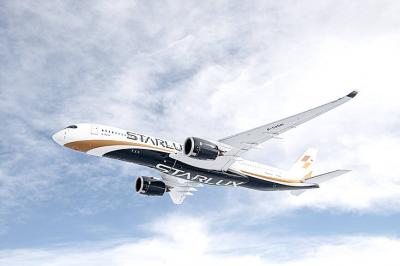
Starlux Airlines Co (星宇航空) today unveiled a long-haul network expansion plan at a shareholders’ meeting in Taipei, including direct flights to Barcelona, Spain, and Zurich, Switzerland, as well as a service connecting Taipei, Sydney and New Zealand. Starlux is to become the first Taiwanese carrier to offer non-stop services to the two European cities, while the inaugural oceanic route is expected to expand transit opportunities within the Australia-New Zealand market, Starlux said. Flight services to Chicago, Dallas, Washington and New York are under evaluation, the airline added. Prior to the shareholders’ meeting, the airline earlier this year announced that it would be

Taiwanese firms have increased investment in the Philippines in recent years as Manila’s ties with Washington deepen and global supply chains continue to shift away from China, an expert at the Chung-Hua Institution for Economic Research (CIER, 中華經濟研究院) said yesterday. The Philippines had not been among Taiwanese investors’ top choices in Southeast Asia, CIER Taiwan ASEAN Studies Center director Kristy Hsu (徐遵慈) said at a seminar in Taipei. However, Taiwan’s investment in the country has grown significantly since the COVID-19 pandemic, reaching US $257 million last year, a high in recent years, she said. Although Taiwan’s total investment in the Philippines still lags

Taiwanese prosecutors suspect that three people successfully smuggled at least one shipment of Nvidia Corp artificial intelligence (AI) chips to China after first exporting them to Japan, people familiar with the matter said. The trio was detained last week by the Keelung District Prosecutors’ Office for allegedly falsifying documents related to exports of Super Micro Computer Inc servers containing advanced Nvidia chips, which the US has barred from sale to China without a license from Washington. The move marked Taiwan’s first public crackdown on AI chip diversion after years of pressure from the US to take a more active role in curtailing


 RSS
RSS