


Trend Micro Inc (趨勢科技), the nation’s top software company by market share, anticipates double-digit sales growth in Taiwan this year as the need for information technology (IT) security becomes even more pressing amid increasing Internet activity worldwide.
As a leader in Internet content security, Trend Micro reported 15 percent year-on-year domestic revenue growth last year, capturing around 46 percent of the local anti-virus market, the company said at a press briefing on Wednesday.
The company said that wide use of universal serial bus (USB) devices and the Internet has made USB and Web threats the two main sources of security issues. The top three viruses that affected domestic computers last year were the downloader virus, the vital information resource under siege virus and the portable executive virus, accounting for 35 percent, 22 percent, and 12 percent of reported local cases.
Oscar Chang (張偉欽), executive vice president of Trend Micro’s Greater China region, warned of rising potential threats this year, including attacks on social networking Web sites, USB-embedded spyware and malicious software written specifically for smartphone platforms.
“As social networking becomes mainstream, these Web sites become festering grounds for criminal activities. For instance, by stealing information from powersellers and spamming their clients, high-tech thieves can engage in transactions with unsuspecting shoppers and sell items that they don’t have,” said Samson Tai (戴燊), marketing director of Trend Micro’s Taiwan business unit.
“Moreover, it’s not enough to simply ignore spam e-mails; often times, hackers send personal e-mails mimicking an acquaintance, but as soon as you open the encoded e-mail, your computer’s infected,” Tai added.
Furthermore, electronic devices with USB autorun programs, such as smartphones, are turning into favorable mediums to transfer malware from one computer to another, the company said.
With each computer sync, spyware is transferred onto computers, which is increasing viruses online at faster speeds than anti-virus companies can track them, Tai said.
Trend Micro also foresees Internet criminals directly writing malicious softwares for smartphone platforms such as Windows mobile and Linux.
Also, with the emerging trend of cloud computing, virtual resources are provided as a service over the Internet, putting worldwide computer users at risk.
“Applications such as Web 2.0 or the Google applications are examples of cloud computing, and their virus attacks are much more severe and direct,” Chang said.

HORMUZ ISSUE: The US president said he expected crude prices to drop at the end of the war, which he called a ‘minor excursion’ that could continue ‘for a little while’ The United Arab Emirates (UAE) and Kuwait started reducing oil production, as the near-closure of the crucial Strait of Hormuz ripples through energy markets and affects global supply. Abu Dhabi National Oil Co (ADNOC) is “managing offshore production levels to address storage requirements,” the company said in a statement, without giving details. Kuwait Petroleum Corp said it was lowering production at its oil fields and refineries after “Iranian threats against safe passage of ships through the Strait of Hormuz.” The war in the Middle East has all but closed Hormuz, the narrow waterway linking the Persian Gulf to the open seas,

Apple Inc increased iPhone production in India by about 53 percent last year and now makes a quarter of its marquee devices there, reflecting the US company’s efforts to avoid tariffs on China. The company assembled about 55 million iPhones in India last year, up from 36 million a year earlier, people familiar with the matter said, asking not to be named because the numbers aren’t public. Apple makes about 220 million to 230 million iPhones a year globally, with India’s share of the total increasing rapidly. Apple has accelerated its expansion in the world’s most populous country in recent years, bolstered

HEADWINDS: The company said it expects its computer business, as well as consumer electronics and communications segments to see revenue declines due to seasonality Pegatron Corp (和碩) yesterday said it aims to grow its artificial intelligence (AI) server revenue more than 10-fold this year from last year, driven by orders from neocloud solutions clients and large cloud service providers. The electronics manufacturing service provider said AI server revenue growth would be driven primarily by the Nvidia Corp GB300 server platform. Server shipments are expected to increase each quarter this year, with the second half likely to outperform the first half, it said. The AI server market is expected to broaden this year as more inference applications emerge, which would drive demand for system-on-chip, application-specific integrated circuits
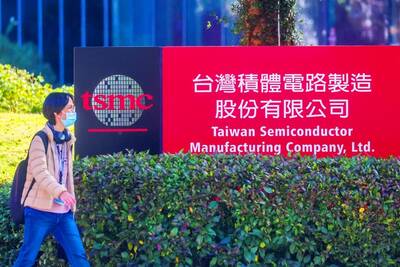
PROJECTION: TSMC said it expects strong growth this year, with revenue in US dollars projected to grow by about 30 percent, outperforming the industry Taiwan Semiconductor Manufacturing Co (TSMC, 台積電) yesterday reported consolidated sales last month reached NT$317.66 billion (US$9.98 billion), the highest ever for the month of February, driven by robust demand for chips built using the company’s advanced 3-nanometer (3nm) process. Last month’s figure was up 22.2 percent from a year earlier, but fell 20.8 percent from January, the world’s largest contract chipmaker said in a statement. For the first two months of the year, TSMC posted cumulative sales of NT$718.91 billion, up 29.9 percent from a year earlier. Analysts attributed the growth to sustained global demand for artificial intelligence (AI) products


 RSS
RSS